


Glutathione Peroxidase-Like Activity of Amino-Substituted Water-Soluble Cyclic Selenides: A Shift of the Major Catalytic Cycle in Methanol
- PMID: 28245615
- PMCID: PMC6155421
- DOI: 10.3390/molecules22030354
Glutathione Peroxidase-Like Activity of Amino-Substituted Water-Soluble Cyclic Selenides: A Shift of the Major Catalytic Cycle in Methanol
Abstract
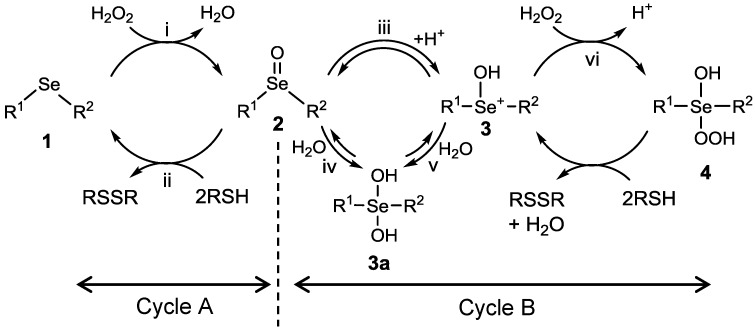
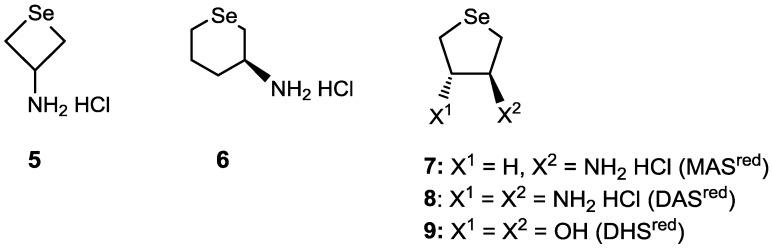
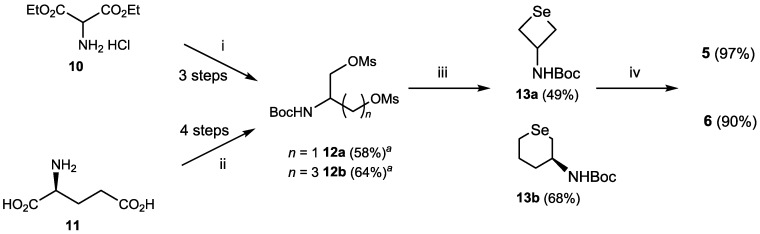
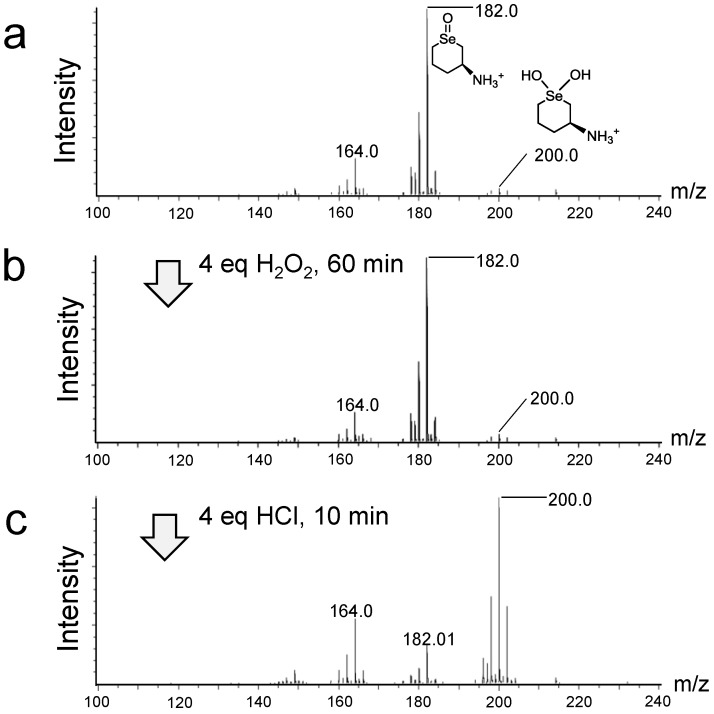
We previously reported that water-soluble cyclic selenides can mimic the antioxidative function of glutathione peroxidase (GPx) in water through a simple catalytic cycle, in which the selenide (>Se) is oxidized by H₂O₂ to the selenoxide (>Se=O) and the selenoxide is reduced by a thiol back to the selenide. In methanol, however, the GPx-like activity could not be explained by this simple scenario. To look into the reasons for the unusual behaviors in methanol, monoamino-substituted cyclic selenides with a variable ring size were synthesized, and the intermediates of the catalytic cycle were characterized by means of 77Se-NMR and LC-MS spectroscopies. In water, it was confirmed that the selenide and the selenoxide mainly contribute to the antioxidative function, though a slight contribution from the dihydroxy selenane (>Se(OH)₂) was also suggested. In methanol, on the other hand, other active species, such as hydroxyselenonium (>Se⁺-OH) and hydroxy perhydroxy selenane (>Se(OH)(OOH)), could be generated to build another catalytic cycle. This over-oxidation would be more feasible for amino-substituted cyclic selenides, probably because the ammonium (NH₃⁺) group would transfer a proton to the selenoxide moiety to produce a hydroxyselenonium species in the absence of an additional proton source. Thus, a shift of the major catalytic cycle in methanol would make the GPx-like antioxidative function of selenides perplexing.
Keywords: antioxidant; enzyme model; glutathione peroxidase; hydroxy perhydroxy selenane; selenide; selenoxide.
Conflict of interest statement
The authors declare no conflict of interest. The founding sponsors had no role in the design of the study; in the collection, analyses, or interpretation of data; in the writing of the manuscript, and in the decision to publish the results.
Figures
References
-
- Hepel M., Andreescu S. Oxidative Stress: Diagnostics, Prevention, and Therapy Volume 2. American Chemical Society; Washington, DC, USA: 2015. Oxidative stress and human health; pp. 1–33. (ACS Symposium Series).
-
- Alberto E.E., do Nascimento V., Braga A.L. Catalytic application of selenium and tellurium compounds as glutathione peroxidase enzyme mimetics. J. Braz. Chem. Soc. 2010;21:2032–2041. doi: 10.1590/S0103-50532010001100004. - DOI
-
- Santi C., Tidei C., Scalera C., Piroddi M., Galli F. Selenium Containing Compounds from Poison to Drug Candidates: A Review on the GPx-like Activity. Curr. Chem. Biol. 2013;7:25–36. doi: 10.2174/2212796811307010003. - DOI
MeSH terms
Substances
LinkOut - more resources
Full Text Sources
Other Literature Sources
