


Chlorogenic Acid: Recent Advances on Its Dual Role as a Food Additive and a Nutraceutical against Metabolic Syndrome
- PMID: 28245635
- PMCID: PMC6155416
- DOI: 10.3390/molecules22030358
Chlorogenic Acid: Recent Advances on Its Dual Role as a Food Additive and a Nutraceutical against Metabolic Syndrome
Abstract
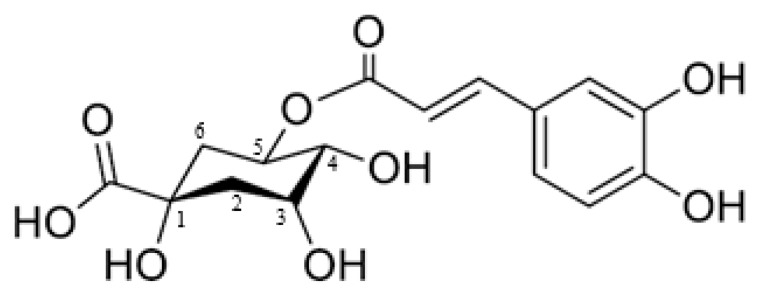
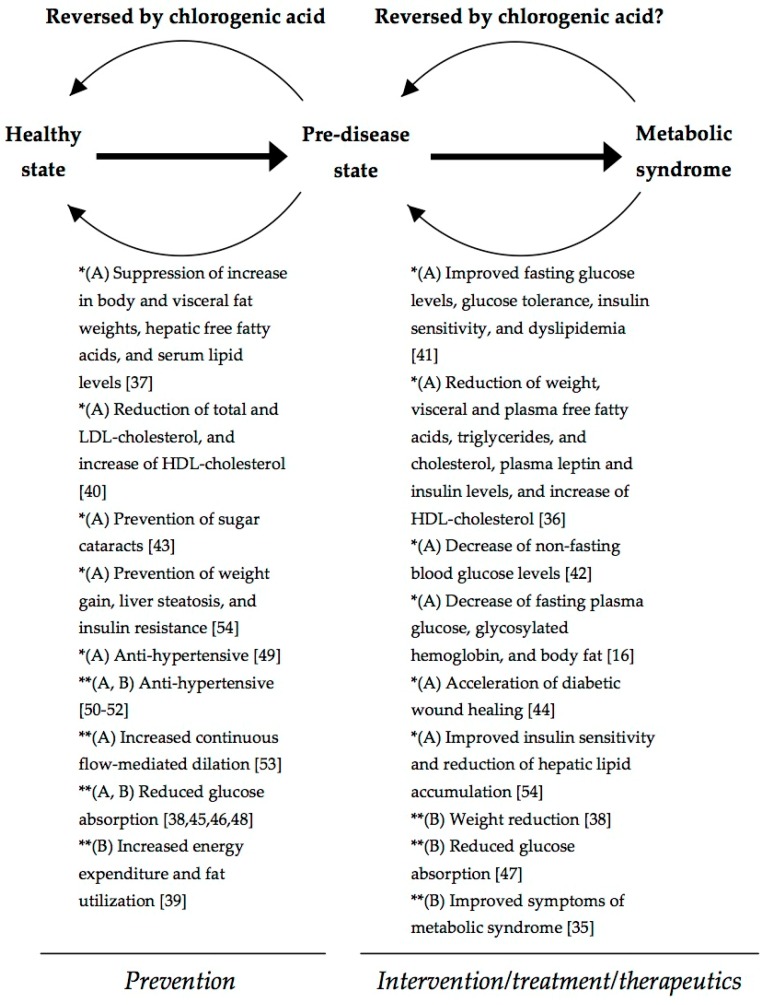
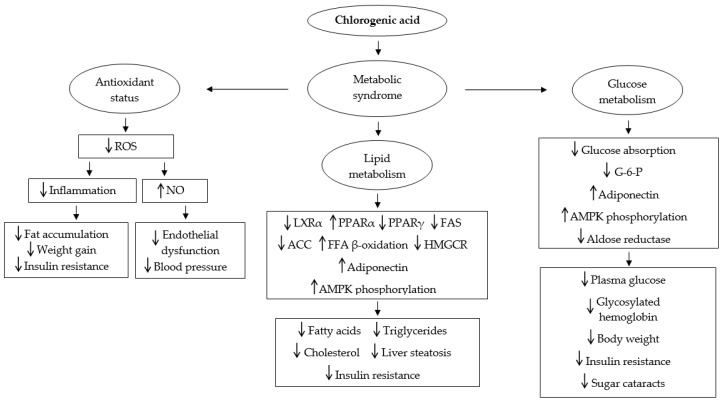
Chlorogenic acid (5-O-caffeoylquinic acid) is a phenolic compound from thehydroxycinnamic acid family. This polyphenol possesses many health-promoting properties, mostof them related to the treatment of metabolic syndrome, including anti-oxidant, anti-inflammatory,antilipidemic, antidiabetic, and antihypertensive activities. The first part of this review will discussthe role of chlorogenic acid as a nutraceutical for the prevention and treatment of metabolicsyndrome and associated disorders, including in vivo studies, clinical trials, and mechanisms ofaction. The second part of the review will be dealing with the role of chlorogenic acid as a foodadditive. Chlorogenic acid has shown antimicrobial activity against a wide range of organisms,including bacteria, yeasts, molds, viruses, and amoebas. These antimicrobial properties can beuseful for the food industry in its constant search for new and natural molecules for thepreservation of food products. In addition, chlorogenic acid has antioxidant activity, particularlyagainst lipid oxidation; protective properties against degradation of other bioactive compoundspresent in food, and prebiotic activity. The combination of these properties makes chlorogenic acidan excellent candidate for the formulation of dietary supplements and functional foods.
Keywords: 5-O-caffeoylquinic acid; antibiotic; antioxidant; chlorogenic acid; metabolic syndrome; prebiotic.
Conflict of interest statement
The authors declare no conflict of interest.
Figures
References
-
- Naso L.G., Valcarcel M., Roura-Ferrer M., Kortazar D., Salado C., Lezama L., Rojo T., González-Baró A.C., Williams P.A.M., Ferrer E.G. Promising antioxidant and anticancer (human breast cancer) oxidovanadium(IV) complex of chlorogenic acid. Synthesis, characterization and spectroscopic examination on the transport mechanism with bovine serum albumin. J. Inorg. Biochem. 2014;135:86–99. doi: 10.1016/j.jinorgbio.2014.02.013. - DOI - PubMed
-
- Wang L.-N., Wang W., Hattori M., Daneshtalab M., Ma C.-M. Synthesis, anti-HCV, antioxidant and reduction of intracellular reactive oxygen species generation of a chlorogenic acid analogue with an amide bond replacing the ester bond. Molecules. 2016;21:737. doi: 10.3390/molecules21060737. - DOI - PMC - PubMed
-
- Kremr D., Bajer T., Bajerová P., Surmová S., Ventura K. Unremitting problems with chlorogenic acid nomenclature: A review. Quím. Nova. 2016;39:530–533. doi: 10.5935/0100-4042.20160063. - DOI
Publication types
MeSH terms
Substances
LinkOut - more resources
Full Text Sources
Other Literature Sources
Medical
