. 2017 Feb 28;17(1):24.
doi: 10.1186/s12896-017-0341-x.

A streamlined method for the design and cloning of shRNAs into an optimized Dox-inducible lentiviral vector

Affiliations

A streamlined method for the design and cloning of shRNAs into an optimized Dox-inducible lentiviral vector

Sander B Frank et al. BMC Biotechnol. .

Abstract

Background: Short hairpin RNA (shRNA) is an established and effective tool for stable knock down of gene expression. Lentiviral vectors can be used to deliver shRNAs, thereby providing the ability to infect most mammalian cell types with high efficiency, regardless of proliferation state. Furthermore, the use of inducible promoters to drive shRNA expression allows for more thorough investigations into the specific timing of gene function in a variety of cellular processes. Moreover, inducible knockdown allows the investigation of genes that would be lethal or otherwise poorly tolerated if constitutively knocked down. Lentiviral inducible shRNA vectors are readily available, but unfortunately the process of cloning, screening, and testing shRNAs can be time-consuming and expensive. Therefore, we sought to refine a popular vector (Tet-pLKO-Puro) and streamline the cloning process with efficient protocols so that researchers can more efficiently utilize this powerful tool. METHODS: First, we modified the Tet-pLKO-Puro vector to make it easy ("EZ") for molecular cloning (EZ-Tet-pLKO-Puro). Our primary modification was to shrink the stuffer region, which allows vector purification via polyethylene glycol precipitation thereby avoiding the need to purify DNA through agarose. In addition, we generated EZ-Tet-pLKO vectors with hygromycin or blasticidin resistance to provide greater flexibility in cell line engineering. Furthermore, we provide a detailed guide for utilizing these vectors, including shRNA design strategy and simplified screening methods.

Results: Notably, we emphasize the importance of loop sequence design and demonstrate that the addition of a single mismatch in the loop stem can greatly improve shRNA efficiency. Lastly, we display the robustness of the system with a doxycycline titration and recovery time course and provide a cost/benefit analysis comparing our system with purchasing pre-designed shRNA vectors.

Conclusions: Our aim was twofold: first, to take a very useful shRNA vector and make it more amenable for molecular cloning and, secondly, to provide a streamlined protocol and rationale for cost-effective design, cloning, and screening of shRNAs. With this knowledge, anyone can take advantage of this powerful tool to inducibly knockdown any gene of their choosing.

Keywords: Inducible; Lentivirus; pLKO; shRNA.


Figures

Fig. 1
Fig. 1
Vector maps and PEG purification. a Basic vector maps (not to scale) for the original Tet-pLKO-Puro vector and our modified versions. b Agarose gel electrophoresis comparing DNA precipitation methods. 10 μg of EZ-Tet-pLKO vector DNA was co-digested with NheI + EcoRI. The digest was split into three 3 μg aliquots and precipitated with isopropanol (Iso) or polyethylene glycol (PEG) at 6 or 8% concentration. 1 μg of control DNA (uncut and cut) was run alongside 1/3 of the precipitated DNA samples
Fig. 2
Fig. 2
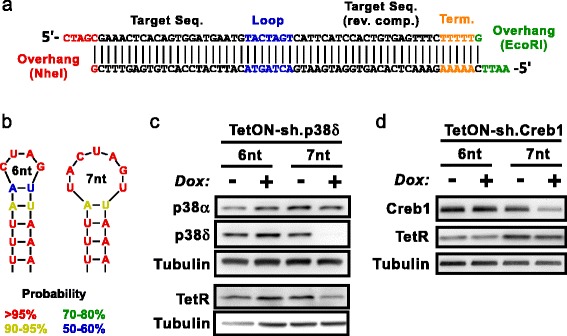
shRNA oligo design and loop comparison. a Format for shRNA oligo design. Upper strand is sense oligo, lower strand is anti-sense oligo. b Diagram of predicted shRNA loop structure with a basic SpeI sequence (6 nt: ACUAGU) or including a single stem mismatch (7 nt: UACUAGU). Colors correlate to calculated likelihood of the depicted pairing. See methods for details on prediction tool. c Immunoblot showing two different pools of iPrEC cells with shRNA against p38δ, with the only difference being a single mismatch in the loop sequence of the shRNA. Cells were treated −/+ Dox for 72 h. TetR was probed on a separate gel. p38α and Tubulin serve as loading controls. d Same experiment as c using a different pair of shRNAs targeting Creb1. Cells were treated −/+ Dox for 5 days
Fig. 3
Fig. 3
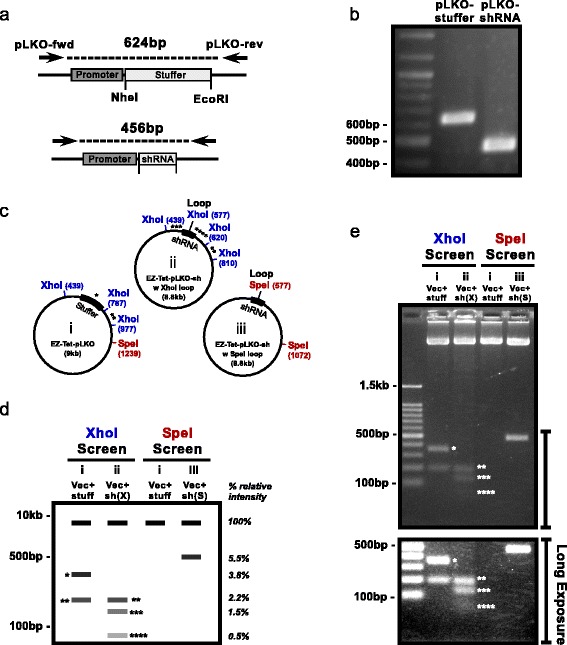
Screening techniques. a Diagram showing expected products from PCR screening pLKO ligation-transformed colonies. b Agarose gel (2%) with a positive and negative PCR product. c Vector maps (not to scale) with XhoI and SpeI restriction digest sites labeled in bp. Asterisks indicate corresponding bands in Fig. 3d and e. d Diagram showing expected DNA fragments and relative intensity on gel from an XhoI (blue) vs SpeI (red) shRNA loop restriction digest screen of the plasmids shown in 3c (i - parental EZ- Tet-pLKO vector with stuffer (Vec + stuff), ii - EZ-Tet-pLKO with shRNA XhoI loop (Vec + sh(X)), iii - EZ-Tet-pLKO with shRNA SpeI loop (Vec + sh(S)). (*) is the predicted 348 bp XhoI fragment spanning the stuffer region in the original Tet-pLKO vector (i). In the EZ-Tet-pLKO vector harboring an shRNA with an XhoI site in the loop (ii), XhoI digestion will generate three small fragments, 190 bp (**), 138 bp (***), and 43 bp (****). In the EZ-Tet-pLKO vector harboring an shRNA with an SpeI site in the loop (iii), SpeI digestion will generate a clearly visible diagnostic 500 bp fragment. e Agarose gel (2%) with XhoI or SpeI shRNA screens of constructs indicated in 3c (i, ii, iii). Each lane was loaded with 4 μg of digested DNA. Bottom image shows lower part of the same gel with a longer exposure to show the barely detectable 43 bp (****) fragment
Fig. 4
Fig. 4
Dox titration and recovery. a Immunoblot showing Dox titration with iPrECs containing EZ-Tet-pLKO-sh.p38α. Cells were treated with Dox for 72 h and lysed. Note: the lower band (arrow pointing) is p38α. b Cells were treated −/+ Dox (50 ng/mL) for 72 h. At that time, two samples were lysed (72 h pre-treated) while another plate of treated cells was split and allowed to recover without Dox for 1–8 days. Note: due to changes in confluency, the ‘pre-treated’ cells have higher basal level of p38 (α and δ) than at day 8

References

    1. Davidson BL, McCray PB., Jr Current prospects for RNA interference-based therapies. Nat Rev Genet. 2011;12(5):329–40. doi: 10.1038/nrg2968. - DOI - PMC - PubMed
    1. Hannon GJ. RNA interference. Nature. 2002;418(6894):244–51. doi: 10.1038/418244a. - DOI - PubMed
    1. Fellmann C, Lowe SW. Stable RNA interference rules for silencing. Nat Cell Biol. 2014;16(1):10–8. doi: 10.1038/ncb2895. - DOI - PMC - PubMed
    1. Singer O, Verma IM. Applications of lentiviral vectors for shRNA delivery and transgenesis. Curr Gene Ther. 2008;8(6):483–8. doi: 10.2174/156652308786848067. - DOI - PMC - PubMed
    1. Moffat J, Grueneberg DA, Yang X, Kim SY, Kloepfer AM, Hinkle G, Piqani B, Eisenhaure TM, Luo B, Grenier JK, et al. A lentiviral RNAi library for human and mouse genes applied to an arrayed viral high-content screen. Cell. 2006;124(6):1283–98. doi: 10.1016/j.cell.2006.01.040. - DOI - PubMed

Publication types

MeSH terms