Considering benefits and harms of duloxetine for treatment of stress urinary incontinence: a meta-analysis of clinical study reports
- PMID: 28246265
- PMCID: PMC5289870
- DOI: 10.1503/cmaj.151104
Considering benefits and harms of duloxetine for treatment of stress urinary incontinence: a meta-analysis of clinical study reports
Abstract
Background: The European Medicines Agency makes clinical study reports publicly available and publishes reasons for not approving applications for marketing authorization. Duloxetine has been approved in Europe for the treatment of stress urinary incontinence in women. The reported adverse effects of duloxetine include mental health problems and suicidality. We obtained clinical study reports from the European Medicines Agency concerning use of this drug for stress urinary incontinence.
Methods: We performed a meta-analysis of 4 randomized placebo-controlled trials of duloxetine (involving a total of 1913 patients) submitted to the European Medicines Agency for marketing approval for the indication of stress urinary incontinence in women. We used data from the clinical study reports (totalling 6870 pages and including individual patient data) to assess benefits (including frequency of incontinence and changes in quality-of-life scores, such as Patient Global Impression of Improvement rating) and harms (both general harms, including discontinuation because of adverse events, and harms related to suicidality, violent behaviour and their potential precursors, such as akathisia and activation [stimulating effects such as insomnia, anxiety and agitation]).
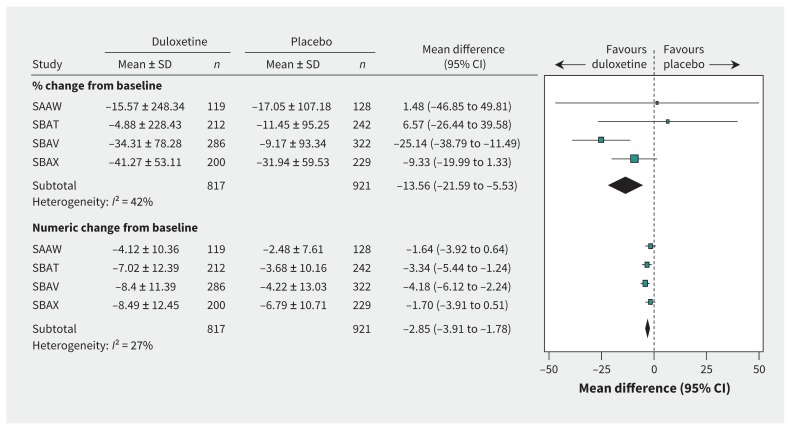
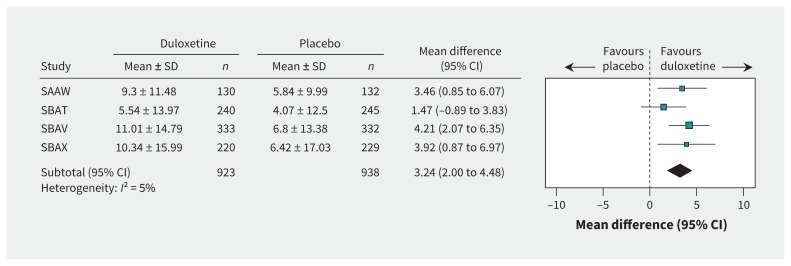
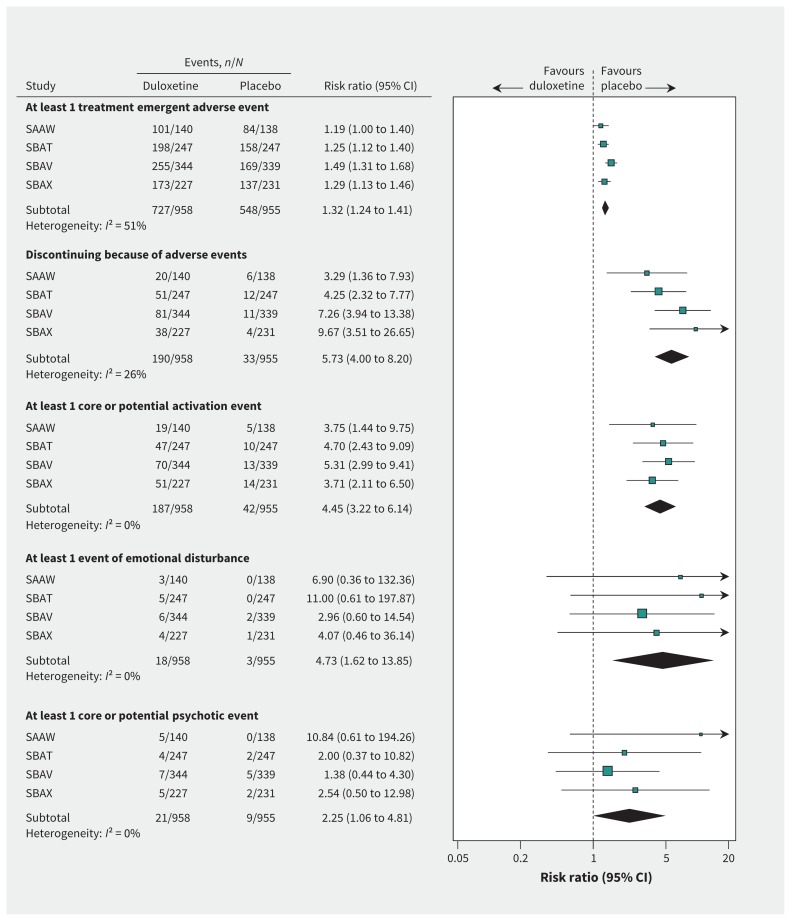
Results: Duloxetine was significantly better than placebo in terms of percentage change in weekly incontinence episodes (mean difference -13.56%, 95% confidence interval [CI] -21.59% to -5.53%) and change in Incontinence Quality of Life total score (mean difference 3.24, 95% CI 2.00 to 4.48). However, the effect sizes were small, and a sensitivity analysis (with removal of one trial) showed that the number needed to treat for a Patient Global Impression of Improvement rating of "much better or very much better" was 8 (95% CI 6 to 13). The numbers needed to harm were 7 (95% CI 6 to 8) for discontinuing because of an adverse event and 7 (95% CI 6 to 9) for experiencing an activation event. No suicidality, violence or akathisia events were noted.
Interpretation: Although duloxetine is effective for stress urinary incontinence in women, the rates of associated harm were high when individual patient data were analyzed, and the harms outweighed the benefits.
© 2017 Canadian Medical Association or its licensors.
Figures
Comment in
-
Secrecy or transparency? The future of regulatory trial data.CMAJ. 2017 Feb 6;189(5):E185-E186. doi: 10.1503/cmaj.161088. Epub 2016 Nov 14. CMAJ. 2017. PMID: 28246263 Free PMC article. No abstract available.
-
Duloxetine: urinary incontinence and marketing authorization incontinence.CMAJ. 2017 Mar 6;189(9):E373. doi: 10.1503/cmaj.732561. CMAJ. 2017. PMID: 28280069 Free PMC article. No abstract available.
References
-
- ICH harmonised tripartite guideline: the common technical document for the registration of pharmaceuticals for human use. Efficacy — M4E(R1). Clinical overview and clinical summary of module 2. Module 5: Clinical study reports. Geneva (Switzerland): International Conference on Harmonisation of Technical Requirements for Registration of Pharmaceuticals for Human Use; 2002. Available: www.ich.org/fileadmin/Public_Web_Site/ICH_Products/CTD/M4__R1__Efficacy/... (accessed 2012 Mar. 6).
-
- AllTrials: Supporters — organisation list. London (UK): AllTrials; 2016. Available: www.alltrials.net/supporters/supporters-organisation-list/ (accessed 2016 May 2).
Publication types
MeSH terms
Substances
LinkOut - more resources
Full Text Sources
Other Literature Sources
Medical