Altered Circulating Inflammatory Cytokines Are Associated with Anovulatory Polycystic Ovary Syndrome (PCOS) Women Resistant to Clomiphene Citrate Treatment
- PMID: 28246376
- PMCID: PMC5344282
- DOI: 10.12659/msm.901194
Altered Circulating Inflammatory Cytokines Are Associated with Anovulatory Polycystic Ovary Syndrome (PCOS) Women Resistant to Clomiphene Citrate Treatment
Abstract
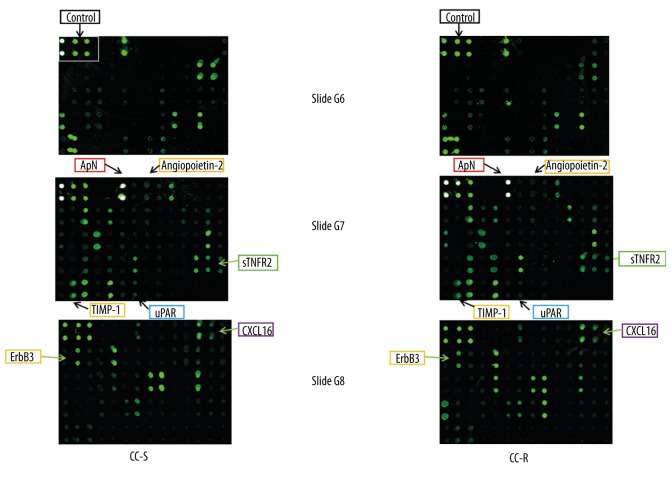
BACKGROUND Polycystic ovary syndrome (PCOS) is a common gynecological disease characterized by chronic oligoanovulation, clinical/biochemical hyperandrogenism, polycystic ovaries, and insulin resistance. Accumulating evidence has shown that PCOS-related ovarian dysfunction is the main cause of anovulatory infertility. Clomiphene citrate (CC) is the first-line therapy for PCOS patients; however, approximately 15-40% PCOS patients are resistant to CC treatment. It has been demonstrated that PCOS is a chronic pro-inflammatory state, as some pro-inflammatory cytokines were elevated in the peripheral circulation of PCOS patients, but whether altered inflammatory cytokines expression in PCOS patients is associated with blunted response to CC remains unknown. MATERIAL AND METHODS We recruited 44 CC-resistant PCOS patients, along with 55 age and body mass index (BMI)-matched CC-sensitive PCOS patients. Ovulation was induced by administrating 50-100 mg/day CC on days 5 to 9 of each menstrual cycle. The cytokine profiles were detected by cytokine antibody microarrays and further validated by ELISAs. RESULTS CC-resistant patients had higher levels of high-sensitivity C-reactive protein (hsCRP) than the CC-sensitive individuals. A growth factor, angiopoietin-2, was significantly reduced [1.64 (0.93-1.95) vs. 1.08 (0.85-1.34), p<0.05], while a chemokine CXCL-16 was significantly increased (9.10±2.35 vs. 10.41±2.82, p<0.05) in CC-resistant patients compared to the CC-sensitive subjects. CXCL-16 was positively correlated with hsCRP (r=0.33, p<0.01). Logistic regression analysis showed that angiopoietin-2 and CXCL-16 are associated with CC resistance. CONCLUSIONS Circulating cytokines are disturbed in CC-resistant PCOS patients. Altered angiopoietin-2 and CXCL-16 levels might compromise the responsiveness of the ovary to CC through up-regulating angiogenesis and inflammation.
Conflict of interest statement
The authors declare that they have no competing interests.
Figures
References
-
- Ehrmann DA. Polycystic ovary syndrome. N Engl J Med. 2005;352:1223–36. - PubMed
-
- Azziz R, Woods KS, Reyna R, et al. The prevalence and features of the polycystic ovary syndrome in an unselected population. J Clin Endocrinol Metab. 2004;89:2745–49. - PubMed
-
- Palomba S, Orio F, Jr, Russo T, et al. Is ovulation induction still a therapeutic problem in patients with polycystic ovary syndrome? J Endocrinol Invest. 2004;27:796–805. - PubMed
-
- Hughes E, Collins J, Vandekerckhove P. Clomiphene citrate for ovulation induction in women with oligo-amenorrhoea. Cochrane Database Syst Rev. 2000;(2):CD000056. - PubMed
-
- Beck JI, Boothroyd C, Proctor M, et al. Oral anti-oestrogens and medical adjuncts for subfertility associated with anovulation. Cochrane Database Syst Rev. 2005;(1):CD002249. - PubMed
MeSH terms
Substances
LinkOut - more resources
Full Text Sources
Medical
Research Materials