


Splanchnic vein thrombosis in myeloproliferative neoplasms: pathophysiology and molecular mechanisms of disease
- PMID: 28246554
- PMCID: PMC5305004
- DOI: 10.1177/2040620716680333
Splanchnic vein thrombosis in myeloproliferative neoplasms: pathophysiology and molecular mechanisms of disease
Abstract
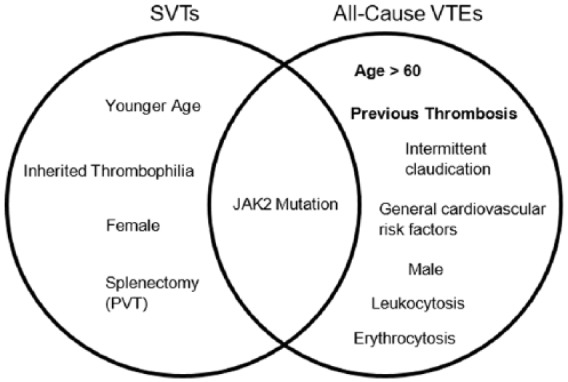
Myeloproliferative neoplasms (MPNs) are the most common underlying prothrombotic disorder found in patients with splanchnic vein thrombosis (SVT). Clinical risk factors for MPN-associated SVTs include younger age, female sex, concomitant hypercoagulable disorders, and the JAK2 V617F mutation. These risk factors are distinct from those associated with arterial or deep venous thrombosis (DVT) in MPN patients, suggesting disparate disease mechanisms. The pathophysiology of SVT is thought to derive from local interactions between activated blood cells and the unique splanchnic endothelial environment. Other mutations commonly found in MPNs, including CALR and MPL, are rare in MPN-associated SVT. The purpose of this article is to review the clinical and molecular risk factors for MPN-associated SVT, with particular focus on the possible mechanisms of SVT formation in MPN patients.
Keywords: Budd-Chiari syndrome; JAK2; essential thrombocythemia; myeloproliferative neoplasm; polycythemia vera; portal vein thrombosis; primary myelofibrosis; splanchnic vein thrombosis.
Conflict of interest statement
Conflict of interest statement: The authors declare that there is no conflict of interest.
Figures
References
-
- Ageno W., Dentali F., Squizzato A. (2014) How I treat splanchnic vein thrombosis. Blood 124: 3685–3691. - PubMed
-
- Aird W. (2007a) Phenotypic heterogeneity of the endothelium: II. representative vascular beds. Circ Res 100: 174–190. - PubMed
-
- Aird W. (2007b) Vascular bed-specific thrombosis. J Thromb Haemost 5(Suppl. 1): 283–291. - PubMed
Publication types
LinkOut - more resources
Full Text Sources
Other Literature Sources
Medical
Research Materials
Miscellaneous
