Review
. 2017:59:101-123.
doi: 10.1007/978-3-319-44820-6_4.

Signaling-Mediated Regulation of Meiotic Prophase I and Transition During Oogenesis

Affiliations
Review

Signaling-Mediated Regulation of Meiotic Prophase I and Transition During Oogenesis

Swathi Arur. Results Probl Cell Differ. 2017.

Abstract

Generation of healthy oocytes requires coordinated regulation of multiple cellular events and signaling pathways. Oocytes undergo a unique developmental growth and differentiation pattern interspersed with long periods of arrest. Oocytes from almost all species arrest in prophase I of oogenesis that allows for long period of growth and differentiation essential for normal oocyte development. Depending on species, oocytes that transit from prophase I to meiosis I also arrest at meiosis I for fairly long periods of time and then undergo a second arrest at meiosis II that is completed upon fertilization. While there are species-specific differences in C. elegans, D. melanogaster, and mammalian oocytes in stages of prophase I, meiosis I, or meiosis II arrest, in all cases cell signaling pathways coordinate the developmental events controlling oocyte growth and differentiation to regulate these crucial phases of transition. In particular, the ERK MAP kinase signaling pathway, cyclic AMP second messengers, and the cell cycle regulators CDK1/cyclin B are key signaling pathways that seem evolutionarily conserved in their control of oocyte growth and meiotic maturation across species. Here, I identify the common themes and differences in the regulation of key meiotic events during oocyte growth and maturation.


Figures
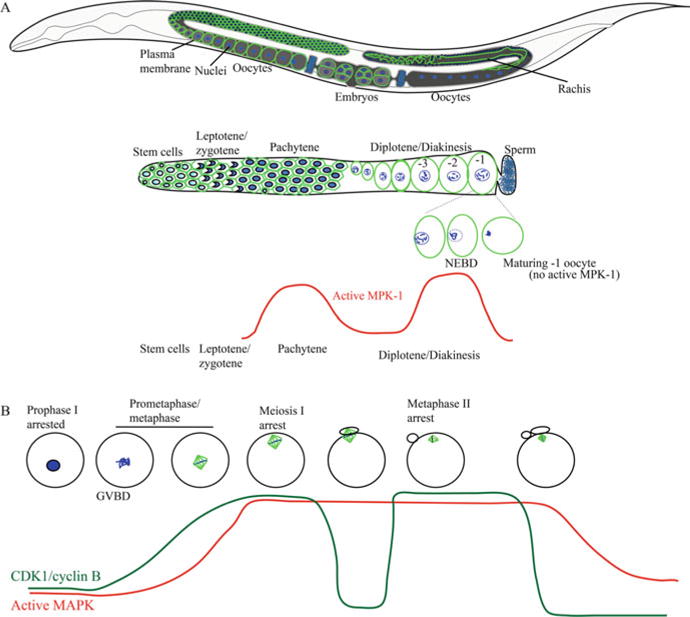
Fig. 4.1
Fig. 4.1
MAP kinase signaling pathway regulates varied aspects of oocyte growth and maturation in worms and mammals. (a) (Top) An adult C. elegans hermaphroditic animal carries two U-shaped gonad arms. In the figure, the arm on the left represents the surface view of the gonad with plasma membranes in green and nuclei in blue. The right arm represents an internal view of the gonad, with plasma membranes that open into a common cytoplasm, rachis, and each growing oocyte is connected to the rachis via an opening. (Middle) Oogenic germ cells in one gonad arm of C. elegans, from stem cell pool on the left to growing oocytes on the right. In C. elegans, oocytes arrest in prophase I. (Bottom) MPK-1 ERK MAP kinase is active in two regions of the meiotic prophase in C. elegans: pachytene and growing oocytes. MPK-1 signal in pachytene is maintained by insulin like receptor DAF-2 and in growing oocytes by MSP signal from sperm. (Figure Adapted from Lee et al., Genetics, 2007. Express permission to reproduce the figure obtained from Tim Schedl and Genetics.) (b) Various stages of mammalian oocyte development and arrest periods. Active MAP kinase (red) and Maturation Promotion Factor (CDK1/cyclin B) are regulated dynamically during the various stages of mammalian oocyte development
Fig. 4.2
Fig. 4.2
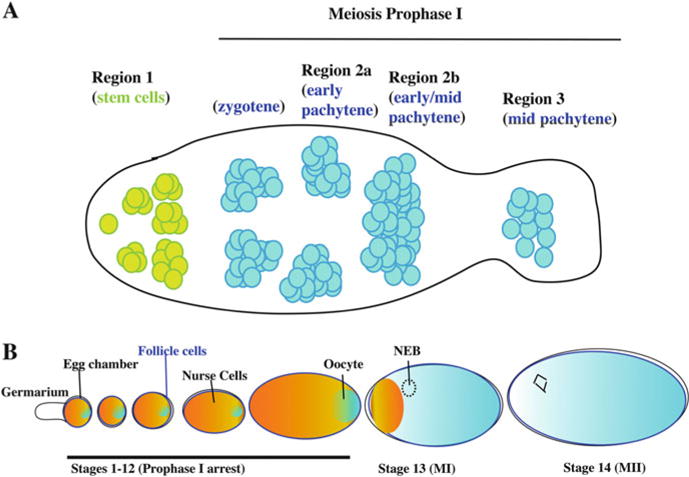
Stages in Drosophila oogenesis. (a) Mature germarium with the various regions containing cells in differing stage of mitosis (left, green) or meiotic prophase I. (b) Once a germarium matures, it is surrounded by follicle cells (blue line, orange) that surround the maturing oocyte (green). A mature oocyte surrounded by the follicle cells makes an egg chamber. As newer oocytes are born, the older egg chambers progress through different stages of meiosis. At stage 13, the oocyte starts to undergo the process of meiotic maturation, marked by the nuclear envelope breakdown. The oocyte arrests in meiosis II at stage 14, until it passes through the oviduct, during which time the oocyte undergoes maturation in the absence of sperm
Fig. 4.3
Fig. 4.3
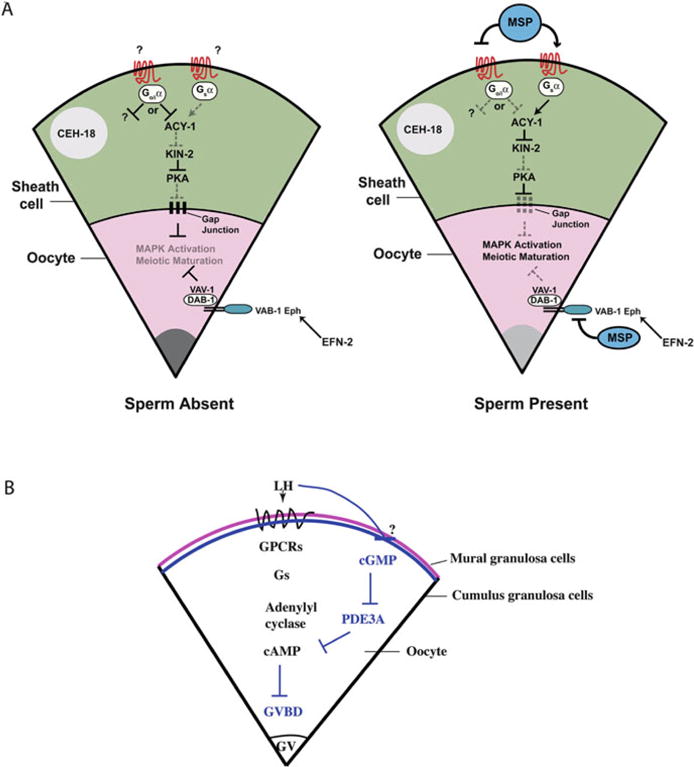
Cell–cell communication and cyclic AMP coordinates oocyte meiotic maturation in worms and mammals. (a) In C. elegans, in the absence of the sperm signal, the Gαo/i pathway in somatic sheath cells surrounding the oocyte (pink) leads to the inactivation of adenylate cyclase 4 (ACY-4) and protein kinase A (PKA). This inhibition blocks MAP kinase (MAPK) activation and oocyte meiotic maturation. Additionally, the VAB-1/Ephrin Receptor in the oocyte also inhibits MAPK and oocyte maturation. Presence of the major sperm protein (MSP) antagonizes both the somatic Gαo/i and oocyte VAB-1 signaling pathways and activates Gαs pathway in the somatic sheath cells resulting in MAPK activation and meiotic maturation. (Adapted from Govindan et al. 2006 reprinted with express permission from David Greenstein and Current Biology.) (b) Cyclic AMP in the oocyte inhibits meiotic maturation in mammals. cGMP produced by the cumulus somatic cells enters the oocyte via the gap junctions (via currently unknown mechanisms) to inhibit PDE3A. PDE3A hydrolyses cAMP. Binding of luteinizing hormone (LH) to its G protein-coupled receptor (GPCR) (blue) activates the cAMp pathway and enables meiotic maturation via promoting GVBD

References

    1. Amsterdam A, Koch Y, Lieberman ME, Lindner HR. Distribution of binding sites for human chorionic gonadotropin in the preovulatory follicle of the rat. J Cell Biol. 1975;67:894–900. - PMC - PubMed
    1. Archambault V, Zhao X, White-Cooper H, Carpenter AT, Glover DM. Mutations in Drosophila Greatwall/Scant reveal its roles in mitosis and meiosis and interdependence with Polo kinase. PLoS Genet. 2007;3:e200. - PMC - PubMed
    1. Arur S, Ohmachi M, Nayak S, Hayes M, Miranda A, Hay A, Golden A, Schedl T. Multiple ERK substrates execute single biological processes in Caenorhabditis elegans germ-line development. Proc Natl Acad Sci U S A. 2009;106:4776–4781. - PMC - PubMed
    1. Arur S, Ohmachi M, Berkseth M, Nayak S, Hansen D, Zarkower D, Schedl T. MPK-1 ERK controls membrane organization in C. elegans oogenesis via a sex-determination module. Dev Cell. 2011;20:677–688. - PMC - PubMed
    1. Bohrmann J, Zimmermann J. Gap junctions in the ovary of Drosophila melanogaster: localization of innexins 1, 2, 3 and 4 and evidence for intercellular communication via innexin-2 containing channels. BMC Dev Biol. 2008;8:111. - PMC - PubMed

Publication types

LinkOut - more resources