. 2017 Mar;11(1):41-47.
doi: 10.1007/s12105-017-0793-2. Epub 2017 Feb 28.

Update from the 4th Edition of the World Health Organization Classification of Head and Neck Tumours: Oropharynx

Affiliations

Update from the 4th Edition of the World Health Organization Classification of Head and Neck Tumours: Oropharynx

William H Westra et al. Head Neck Pathol. 2017 Mar.

Abstract

The changes for oropharyngeal lesions in the 2017 edition of the WHO/IARC Classification of Head and Neck Tumours reference book are dramatic and significant, largely due to the growing impact of high risk human papillomavirus (HPV). The upcoming edition divides tumours of the oral cavity and oropharynx into separate chapters, classifies squamous cell carcinomas (SCC) of the oropharynx on the basis of HPV status, abandons the practice of histologic grading for oropharyngeal SCCs that are HPV positive, recognizes small cell carcinoma of the oropharynx, and combines polymorphous low grade adenocarcinoma and cribriform adenocarcinoma of tongue and minor salivary glands under the single term "polymorphous adenocarcinoma." This review not only calls attention to these changes, but describes the rationale driving these changes and highlights their implications for routine clinical practice.

Keywords: Human papillomavirus; Oropharynx; Polymorphous adenocarcinoma; Small cell carcinoma; Squamous cell carcinoma; World Health Organization.


Conflict of interest statement

Conflict of interest

Neither author has any conflicts of interest to disclose.

Ethical approval

This article does not contain any studies with human participants or animals performed by any of the authors.

Figures

Fig. 1
Fig. 1
The right side of this tonsillar crypt is colonized by an HPV-positive squamous cell carcinoma. The carcinoma retains many of the features of the crypt epithelium, making it very difficult to distinguish neoplastic from non-neoplastic epithelium by routine H&E staining (a). A p16 immunohistochemical stain is helpful in confirming the presence and distribution of the HPV-positive squamous cell carcinoma (b)
Fig. 2
Fig. 2
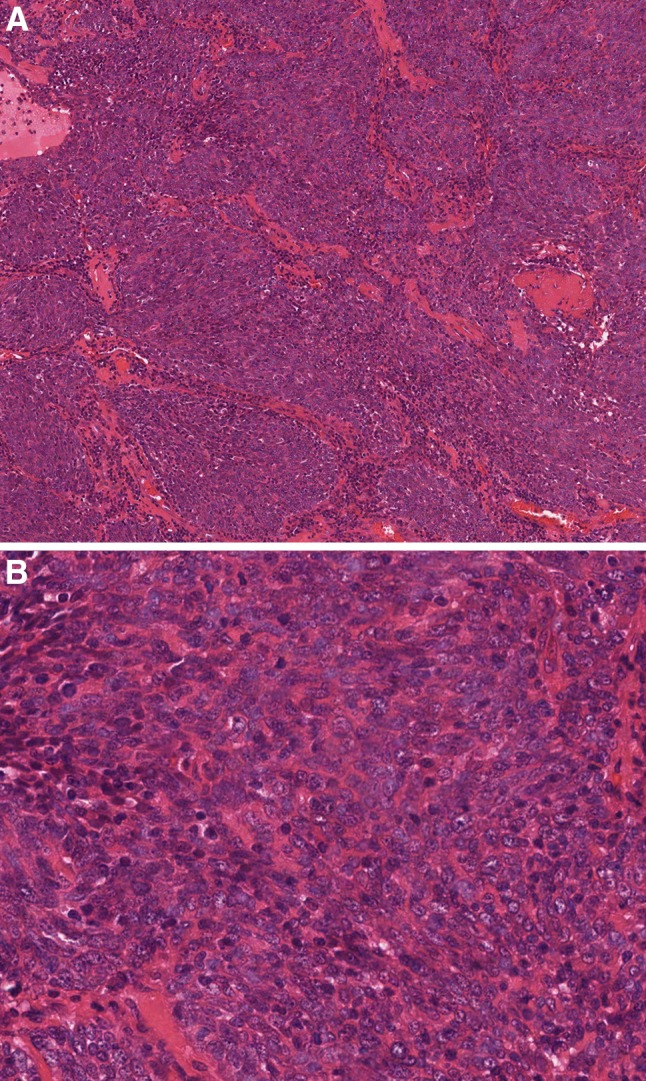
Most HPV-related squamous cell carcinomas have a nonkeratinizing morphology with tumor in large nests with smooth edges and little stromal reaction (a). Tumor cells have little cytoplasm and have round to oval to spindled nuclei with inconspicuous nucleoli and brisk mitotic activity (b). In this tumor, there is no maturing squamous differentiation. HPV human papillomavirus
Fig. 3
Fig. 3
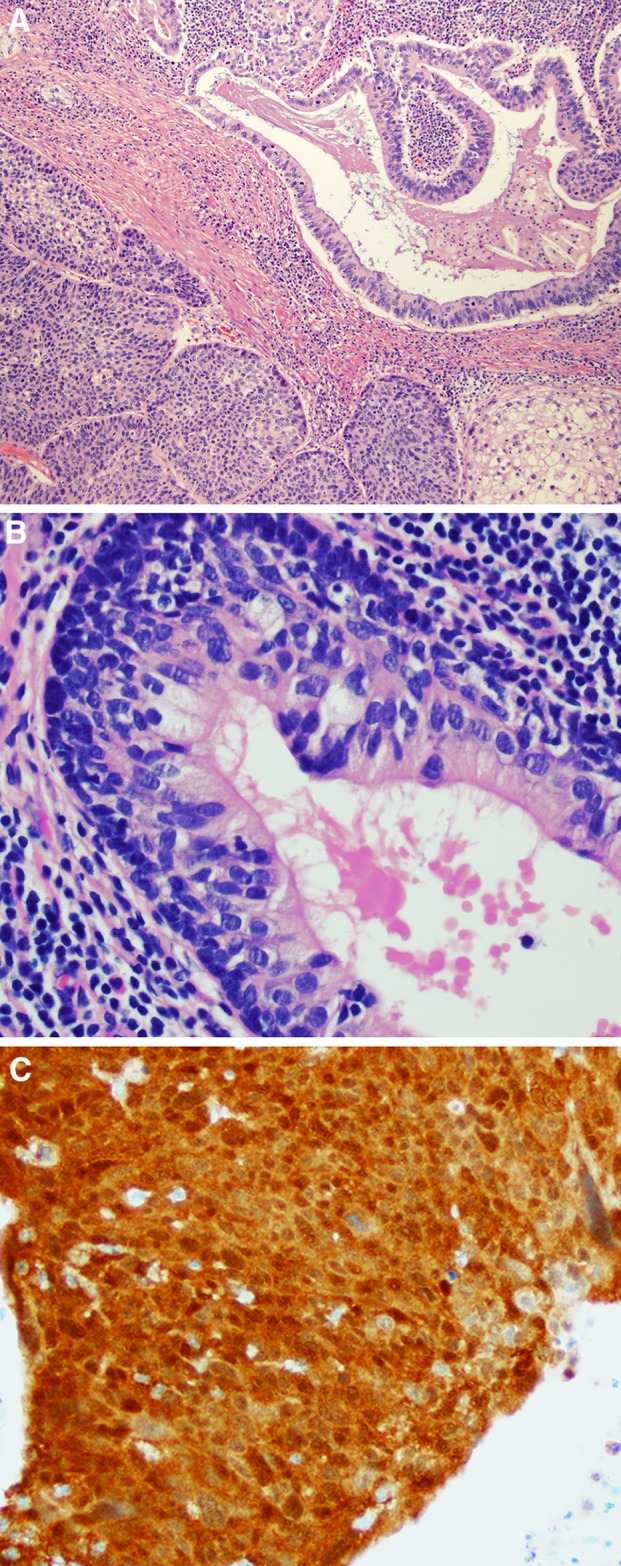
Adenosquamous carcinoma showing well-formed glands with rounded, “punched out” luminal spaces, focal globular basophilic and eosinophilic mucin, and a surrounding component of nonkeratinizing squamous cell carcinoma (a). Rare cases of adenosquamous carcinoma are ciliated, with tumor cells with terminal bars and apical cilia (b). The tumor cells of both of these were strongly diffusely positive for p16, a surrogate marker of high risk HPV (c)
Fig. 4
Fig. 4
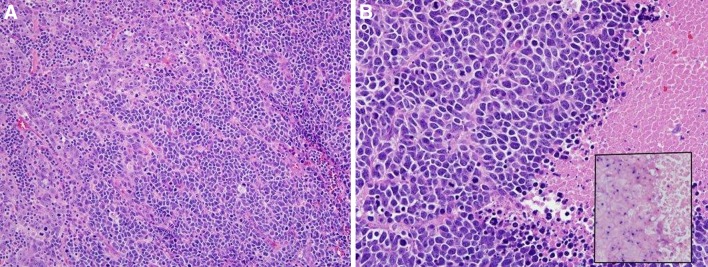
Some small cell carcinomas of the oropharynx represent HPV-positive squamous cell carcinomas (a, upper left) that have undergone small cell transformation (a, right). Like small cell carcinoma of the lung and other sites, oropharyngeal small cell carcinomas are comprised of small anaplastic cells with a high mitotic rate and necrosis (b). HPV is retained in the small cell component (inset, high risk HPV DNA in situ hybridization) but the finding of HPV may be of little if any prognostic significance
Fig. 5
Fig. 5
Polymorphous adenocarcinoma incorporates both the classic, low grade tumor (a) characterized by a nodular, but unencapsulated low power appearance, with tumor cells in cords, tubules, and cribriform nests with a blue-gray stroma. On high power (b), the tumor consists of cells with oval nuclei that are bland and isomorphic. The cribriform variant shows more extensive cribriform growth (c) and nests with spaces around them giving a “glomeruloid” appearance. The individual tumor cells (d) are round to oval with irregular contours and fine chromatin, mimicking papillary thyroid carcinoma

References

    1. Lyford-Pike S, Peng S, Young GD, Taube JM, Westra WH, Akpeng B, et al. Evidence for a role of the PD-1:PD-L1 pathway in immune resistance of HPV-associated head and neck squamous cell carcinoma. Cancer Res. 2013;73(6):1733–1741. doi: 10.1158/0008-5472.CAN-12-2384. - DOI - PMC - PubMed
    1. Chaturvedi AK. Epidemiology and clinical aspects of HPV in head and neck cancers. Head Neck Pathol. 2012;6(Suppl 1):S16–S24. doi: 10.1007/s12105-012-0377-0. - DOI - PMC - PubMed
    1. Hayes DN, Van Waes C, Seiwert TY. Genetic landscape of human papillomavirus-associated head and neck cancer and comparison to tobacco-related tumors. J Clin Oncol. 2015;33(29):3227–3234. doi: 10.1200/JCO.2015.62.1086. - DOI - PMC - PubMed
    1. Gillison ML, Chaturvedi AK, Anderson WF, Fakhry C. Epidemiology of human papillomavirus-positive head and neck squamous cell carcinoma. J Clin Oncol. 2015;33(29):3235–3242. doi: 10.1200/JCO.2015.61.6995. - DOI - PMC - PubMed
    1. Gondim DD, Haynes W, Wang X, Chernock RD, El-Mofty SK, Lewis JS Jr. Histologic typing in oropharyngeal squamous cell carcinoma: A 4-year prospective practice study with p16 and high-risk HPV mRNA testing correlation. Am J Surg Pathol. 2016. - PubMed

MeSH terms

LinkOut - more resources