


Adiposity, Change in Adiposity, and Cognitive Decline in Mid- and Late Life
- PMID: 28248413
- PMCID: PMC5478448
- DOI: 10.1111/jgs.14786
Adiposity, Change in Adiposity, and Cognitive Decline in Mid- and Late Life
Abstract
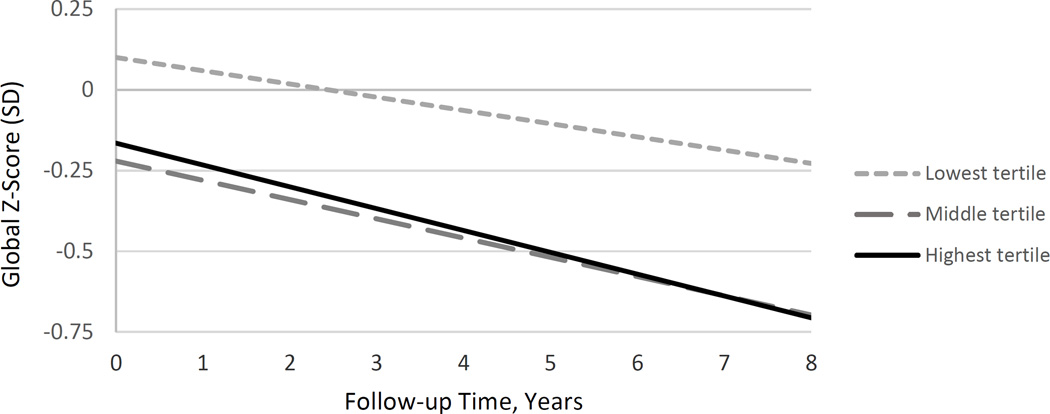
Objectives: To examine associations between adiposity and adiposity change (loss, stable, gain) and subsequent longitudinal cognitive performance in African Americans in mid and late life.
Design: Cohort study using linear mixed models.
Setting: Genetic Epidemiology Network of Arteriopathy.
Participants: African-American sibships with hypertension in Jackson, Mississippi (N = 1,108).
Measurements: Waist circumference and body mass index (BMI) were measured at two examinations 5 years apart. Stable adiposity was defined as values within 5% of the first measure. A composite cognitive Z-score was derived from individual cognitive test Z-scores at two study visits 6 years apart.
Results: Larger waist circumference was associated with greater rate of cognitive decline during follow-up (beta = -0.0009 per year, P = .001); BMI, change in waist circumference, and change in BMI were not associated with rate of decline. Loss of adiposity in midlife was associated with higher cognitive Z-scores in middle-aged individuals, and loss of adiposity in late life was associated with lower Z-scores in older adults (P = .01 for interaction between waist circumference and age; P = .04 for interaction between BMI and age). Simultaneous inclusion of waist circumference and BMI in the cross-sectional model suggested an association between larger waist circumference and poorer cognitive performance (beta = -0.009, P = .006) and between higher BMI and better cognitive performance (beta = 0.014, P = .06).
Conclusion: The results suggested a differential pattern of the relationship between adiposity and cognition according to age (mid- or late life) and regional distribution of adiposity.
Keywords: body mass index; cognitive decline; ethnicity; longitudinal; waist circumference.
© 2017, Copyright the Authors Journal compilation © 2017, The American Geriatrics Society.
Conflict of interest statement
Figures
References
-
- Emmerzaal TL, Kiliaan AJ, Gustafson DR. 2003–2013: a decade of body mass index, Alzheimer's disease, and dementia. Journal of Alzheimer's disease : JAD. 2015;43(3):739–755. - PubMed
-
- Atti AR, Palmer K, Volpato S, et al. Late-life body mass index and dementia incidence: nine-year follow-up data from the Kungsholmen Project. Journal of the American Geriatrics Society. 2008;56(1):111–116. - PubMed
-
- Stewart R, Masaki K, Xue Q-L, et al. A 32-year prospective study of change in body weight and incident dementia: The Honolulu-Asia Aging Study. Arch Neurol. 2005;62(1):55–60. - PubMed
MeSH terms
Grants and funding
LinkOut - more resources
Full Text Sources
Other Literature Sources
Medical
