


Acupuncture therapy in the management of the clinical outcomes for temporomandibular disorders: A PRISMA-compliant meta-analysis
- PMID: 28248862
- PMCID: PMC5340435
- DOI: 10.1097/MD.0000000000006064
Acupuncture therapy in the management of the clinical outcomes for temporomandibular disorders: A PRISMA-compliant meta-analysis
Abstract
Purpose: The purpose of this study was to evaluate conventional acupuncture therapy in the management of clinical outcomes for temporomandibular disorders (TMD) in adults.
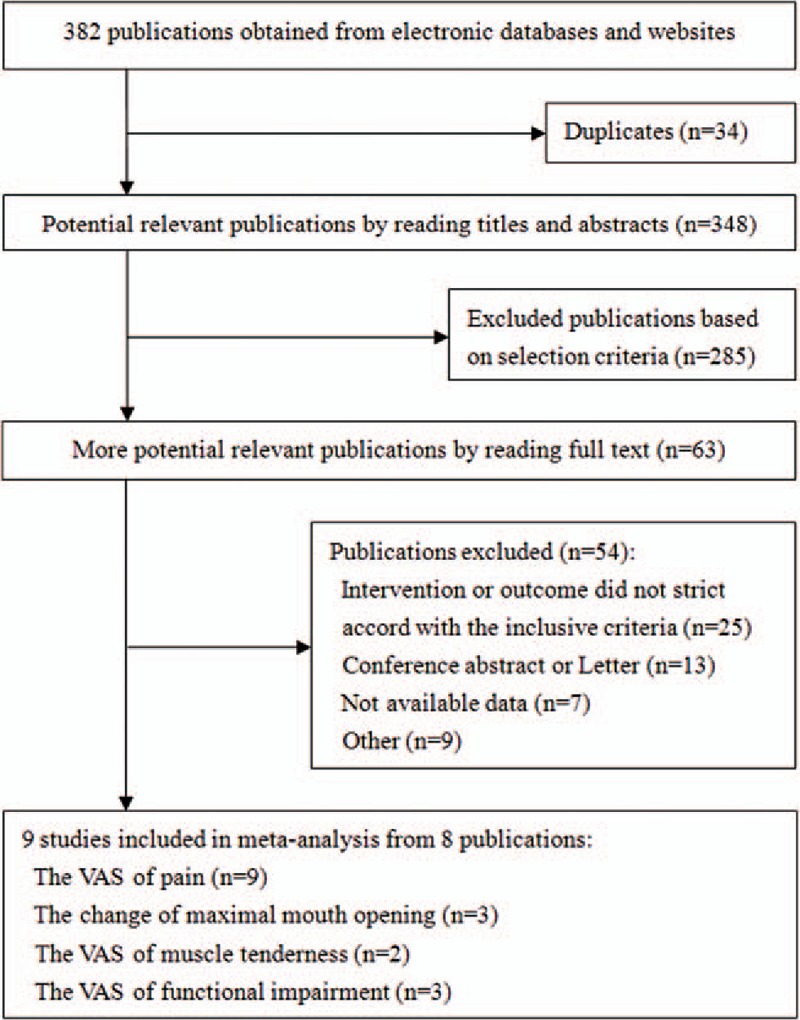
Methods: The electronic databases PubMed, EMBASE, Cochrane Central Register of Controlled Trials, and Clinical Trails.gov were searched for reports published until March 31, 2016.
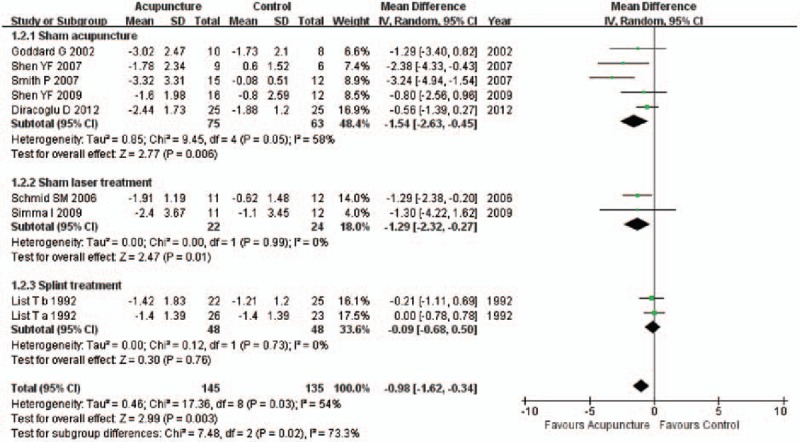
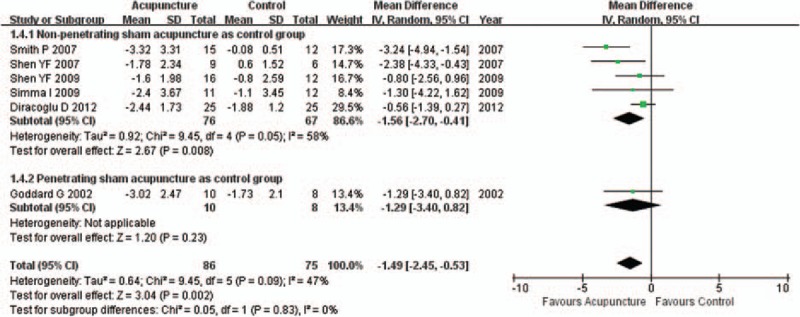
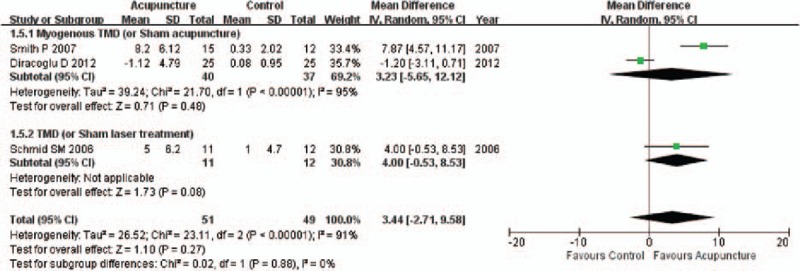
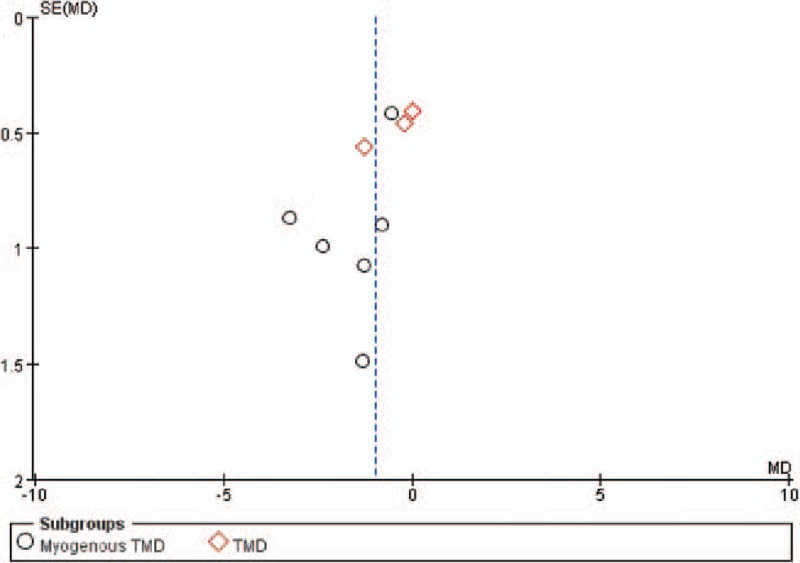
Results: Nine eligible studies from 8 publications involving 231 patients were included in the meta-analysis. A comparison of the main outcome of visual analog scale (VAS) values of pain between the acupuncture group and control group showed a significant decrease (MD = -0.98, 95% CI [-1.62, -0.34], I=54%, P = 0.003) in the VAS following acupuncture treatment. However, subgroup analysis according to the type of sham control group indicated that there were significant differences in the results when sham acupuncture was used as the control group (MD = -1.54, 95% CI [-2.63, -0.45], I=58%, P = 0.006) as well as when sham laser treatment was used as the control group (MD = -1.29, 95% CI [-2.32, -0.27], I = 0%, P = 0.01). However, there was no significant difference when the splint treatment group was used as the control group (MD = -0.09, 95% CI [-0.69, 0.50], I = 0%, P = 0.76). Subgroup analyses of VAS for pain by the classification of diseases indicated that the myogenous TMD subgroup demonstrated a significant difference (MD = -1.49, 95% CI [-2.45, -0.53], I = 47%, P = 0.002), and TMD showed no statistically significant difference (MD = -0.42, 95% CI [-1.14, 0.30], I = 46%, P = 0.25). Subgroup analysis according to whether the subgroup penetrated the skin showed that nonpenetrating sham acupuncture as the control group showed a significant difference (MD = -1.56, 95% CI [-2.70, -0.41], I = 58%, P = 0.008) compared with the conventional acupuncture as the treatment modality, while penetrating sham acupuncture as the control group showed no significant difference (MD = -1.29, 95% CI [-3.40, 0.82], I = not applicable, P = 0.23). No publication bias was observed considering the symmetry of the funnel plots.
Conclusions: Our results indicate that conventional acupuncture therapy is effective in reducing the degree of pain in patients with TMD, especially those with myofascial pain symptoms.
Conflict of interest statement
The authors have no conflicts of interest to disclose.
Figures



References
-
- Goldstein BH. Temporomandibular disorders: a review of current understanding. Oral Surg Oral Med Oral Pathol Oral Radiol Endod 1999;88:379–85. - PubMed
-
- Magnusson T, Egermark I, Carlsson GE. Treatment received, treatment demand, and treatment need for temporomandibular disorders in 35-year-old subjects. Cranio 2002;20:11–7. - PubMed
-
- Al-Jundi MA, John MT, Setz JM, et al. Meta-analysis of treatment need for temporomandibular disorders in adult nonpatients. J Orofac Pain 2008;22:97–107. - PubMed
-
- Dworkin SF, Huggins KH, LeResche L, et al. Epidemiology of signs and symptoms in temporomandibular disorders: clinical signs in cases and controls. J Am Dent Assoc 1990;120:273–81. - PubMed
-
- Chen YW, Chiu YW, Chen CY, et al. Botulinum toxin therapy for temporomandibular joint disorders: a systematic review of randomized controlled trials. Int J Oral Maxillofac Surg 2015;44:1018–26. - PubMed
Publication types
MeSH terms
LinkOut - more resources
Full Text Sources
Other Literature Sources
Medical
