


Effective cataract surgical coverage: An indicator for measuring quality-of-care in the context of Universal Health Coverage
- PMID: 28249047
- PMCID: PMC5382971
- DOI: 10.1371/journal.pone.0172342
Effective cataract surgical coverage: An indicator for measuring quality-of-care in the context of Universal Health Coverage
Abstract
Objective: To define and demonstrate effective cataract surgical coverage (eCSC), a candidate UHC indicator that combines a coverage measure (cataract surgical coverage, CSC) with quality (post-operative visual outcome).
Methods: All Rapid Assessment of Avoidable Blindness (RAAB) surveys with datasets on the online RAAB Repository on April 1 2016 were downloaded. The most recent study from each country was included. By country, cataract surgical outcome (CSOGood, 6/18 or better; CSOPoor, worse than 6/60), CSC (operated cataract as a proportion of operable plus operated cataract) and eCSC (operated cataract and a good outcome as a proportion of operable plus operated cataract) were calculated. The association between CSC and CSO was assessed by linear regression. Gender inequality in CSC and eCSC was calculated.
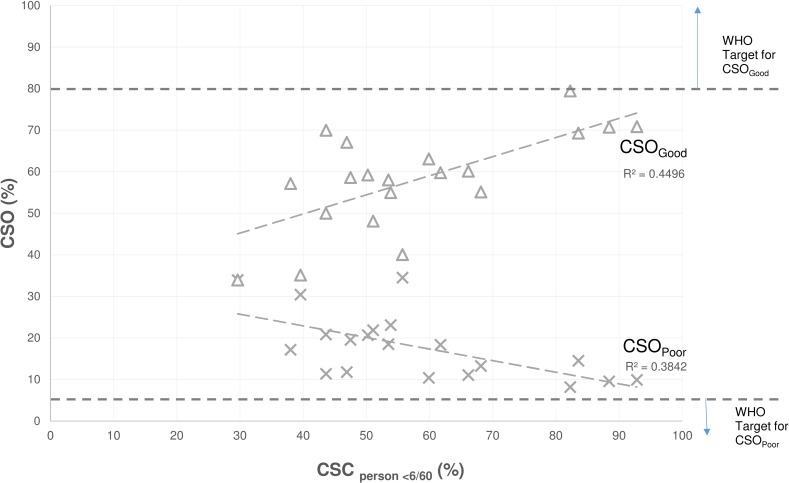
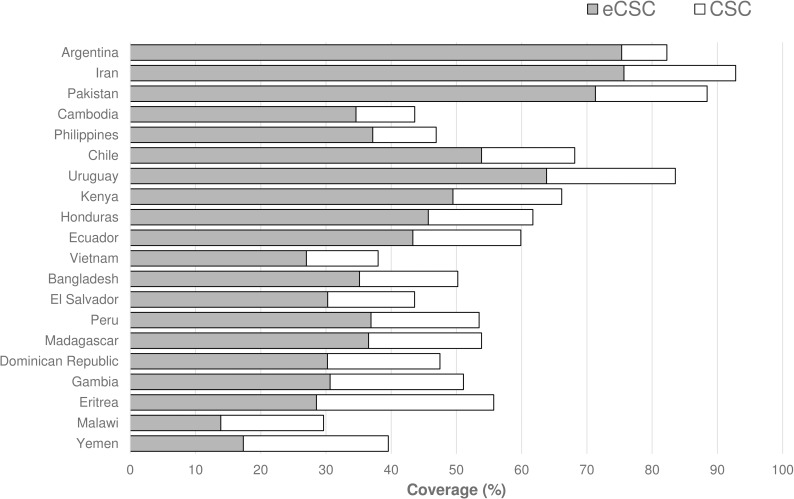
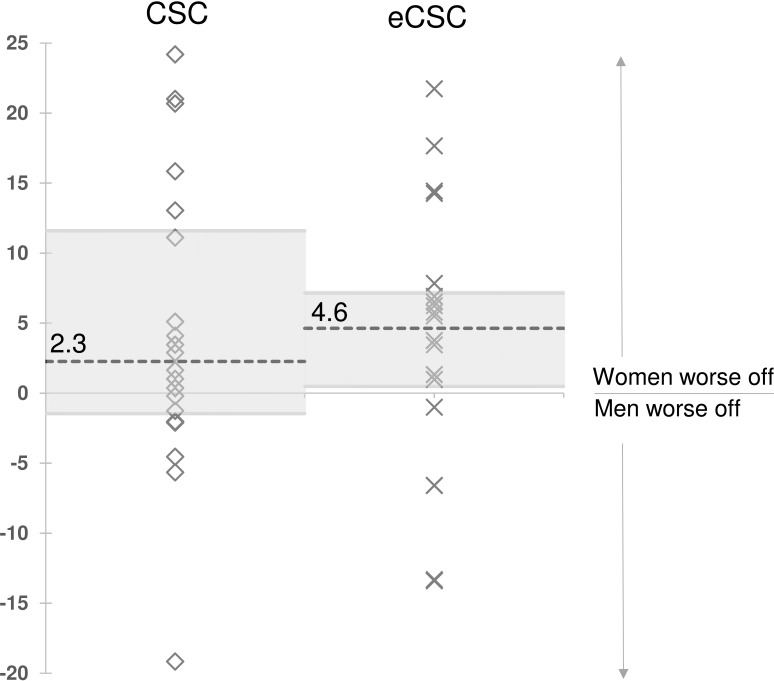
Findings: Datasets from 20 countries were included (2005-2013; 67,337 participants; 5,474 cataract surgeries). Median CSC was 53.7% (inter-quartile range[IQR] 46.1-66.6%), CSOGood was 58.9% (IQR 53.7-67.6%) and CSOPoor was 17.7% (IQR 11.3-21.1%). Coverage and quality of cataract surgery were moderately associated-every 1% CSC increase was associated with a 0.46% CSOGood increase and 0.28% CSOPoor decrease. Median eCSC was 36.7% (IQR 30.2-50.6%), approximately one-third lower than the median CSC. Women tended to fare worse than men, and gender inequality was slightly higher for eCSC (4.6% IQR 0.5-7.1%) than for CSC (median 2.3% IQR -1.5-11.6%).
Conclusion: eCSC allows monitoring of quality in conjunction with coverage of cataract surgery. In the surveys analysed, on average 36.7% of people who could benefit from cataract surgery had undergone surgery and obtained a good visual outcome.
Conflict of interest statement
Figures
References
-
- Donabedian A. The quality of care: how can it be assessed? JAMA. 1988;260(12):1743–8. - PubMed
-
- World Health Organization. What is universal coverage? 2016. Available from: http://www.who.int/health_financing/universal_coverage_definition/en/.
-
- Donabedian A. The seven pillars of quality. Arch Pathol Lab Med. 1990;114(11):1115–8. - PubMed
-
- World Health Organization. Background paper for the technical consultation on effective coverage of health systems. Geneva: World Health Organization; 2001.
-
- Hogan D, Hosseinpoor AR, Boerma T. Developing an index for the coverage of essential health services Technical note for World health statistics 2016. Geneva: World Health Organization; 2016.
MeSH terms
LinkOut - more resources
Full Text Sources
Other Literature Sources
Medical
Miscellaneous
