. 2017 Feb 28;18(9):2088-2095.
doi: 10.1016/j.celrep.2017.02.022.

Pharmacologic Targeting of S6K1 in PTEN-Deficient Neoplasia

Affiliations

Pharmacologic Targeting of S6K1 in PTEN-Deficient Neoplasia

Hongqi Liu et al. Cell Rep. .

Abstract

Genetic S6K1 inactivation can induce apoptosis in PTEN-deficient cells. We analyzed the therapeutic potential of S6K1 inhibitors in PTEN-deficient T cell leukemia and glioblastoma. Results revealed that the S6K1 inhibitor LY-2779964 was relatively ineffective as a single agent, while S6K1-targeting AD80 induced cytotoxicity selectively in PTEN-deficient cells. In vivo, AD80 rescued 50% of mice transplanted with PTEN-deficient leukemia cells. Cells surviving LY-2779964 treatment exhibited inhibitor-induced S6K1 phosphorylation due to increased mTOR-S6K1 co-association, which primed the rapid recovery of S6K1 signaling. In contrast, AD80 avoided S6K1 phosphorylation and mTOR co-association, resulting in durable suppression of S6K1-induced signaling and protein synthesis. Kinome analysis revealed that AD80 coordinately inhibits S6K1 together with the TAM family tyrosine kinase AXL. TAM suppression by BMS-777607 or genetic knockdown potentiated cytotoxic responses to LY-2779964 in PTEN-deficient glioblastoma cells. These results reveal that combination targeting of S6K1 and TAMs is a potential strategy for treatment of PTEN-deficient malignancy.

Keywords: AD80; AXL; BMS-777607; LY-2779964; PF4708671; Pten; S6K1; TAM; glioblastoma; leukemia.


Conflict of interest statement

Conflicts of interest: The authors declare no conflicts of interest.

Figures
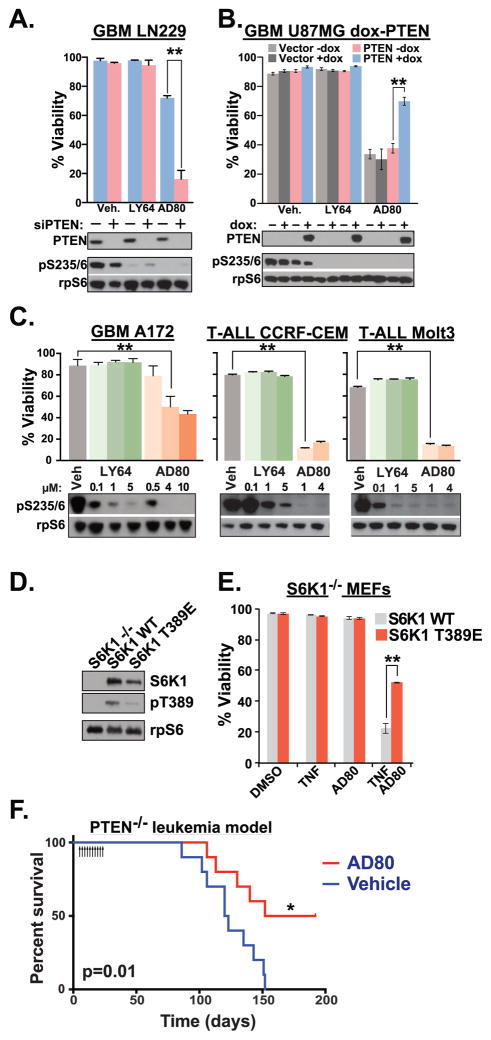
FIGURE 1
FIGURE 1
Pharmacologic targeting of S6K1 in PTEN-deficient cells. (a) PTEN-expressing LN229 glioblastoma cells were transfected with Non-Targeting siRNA (siNT) or siPTEN duplexes, then cultured in 5 μM LY-2779964 (LY64), 10 μM AD80, or vehicle control (Veh). Mean cell viability was determined after 72 hours of culture in indicated conditions (top). Immunoblot of cell lysates from parallel wells after 3 hours demonstrated knockdown of PTEN and inhibition of ribosomal protein S6 (rpS6) phosphorylation (bottom) n=4. (b) PTEN-deficient U87 glioblastoma cells were transduced with vector or doxycycline-regulated PTEN expression constructs. After 48 hours of doxycycline, cells were treated with vehicle, 5 μM LY-2779964, or 10 μM AD80. n=3 viability; n=2 immunoblots. (c) Viability and immunoblot analysis of PTEN-deficient and T-ALL cells treated as in (a). n=4 viability analyses; n=2 immunoblot analyses. (d) Expression of S6K1-WT or S6K1 T389E in S6K1−/− MEFs after viral transduction and selection by sorting. (e) S6K1−/− MEFs reconstituted with WT S6K1 or S6K1 T389E were treated with 30ng/ml TNFα, 10 μM AD80 or combined agents as indicated. S6K1 T389E mediated resistance to TNFα + AD80. n=4. See also Figure S1. (f) CD45.2+ PTEN-deficient bone marrow cells were transplanted into CD45.1+ congenic recipient mice. Groups of 10 mice were injected i.p. with 20 mg/kg AD80 or vehicle control for 10 consecutive days starting at day 5 post transplant, then monitored for signs of leukemia. * p=0.01 Log-Rank test. See also Figure S2. **p<0.01 by two-tailed t-test (a–e).
FIGURE 2
FIGURE 2
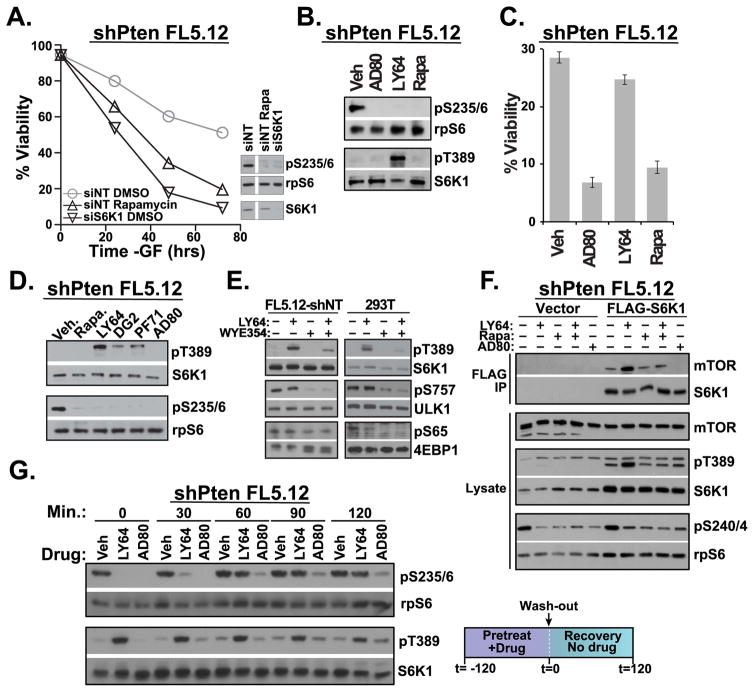
S6K1 inhibitor pathway dynamics. (a) IL-3-dependent FL5.12 cells that had been stably transduced with shPTEN were cultured in full medium lacking only IL-3. Transfection of siS6K1 siRNA, or treatment with 20 nM rapamycin induced apoptosis in PTEN-deficient cells. n=3. (b) PTEN-deficient FL5.12 cells cultured –IL-3 for 1 hour in the presence of 4 μM AD80, 1 μM LY-2779964 (LY64) or 20 nM rapamycin (Rapa) revealed reduced rpS6 phosphorylation yet substantial differences in S6K1 T389 phosphorylation. n=2. (c) Viability of cells treated as in (b) for 72 hours. (d) 1 μM LY-2779964, 10 μM DG2, and 10 μM PF-4708671 share an ability to increase pT389 when added to PTEN-deficient FL5.12 cell cultures for 2 hours. 4 μM AD80 avoids the induction of pT389. n=2. (e) shNT FL5.12 cells or serum-starved 293T cells were incubated with 1 μM LY-2779964 or the mTOR ATP-competitive inhibitor WYE354 (1 μM) for 30 minutes. n=4, FL5.12-shNT; n=2, 293T. (f) PTEN-deficient FL5.12 cells transduced with either vector or FLAG-S6K1 were cultured in the indicated inhibitors for 3 hours, prior to lysis and FLAG-IP. n=3. (g) PTEN-deficient FL5.12 cells were preincubated with vehicle control or 1 μM LY-2779964 or 10 μM AD80 for 2 hours. Cells were then washed and phosphorylation kinetics determined by immunoblot. n=3. See also Figure S3.
FIGURE 3
FIGURE 3
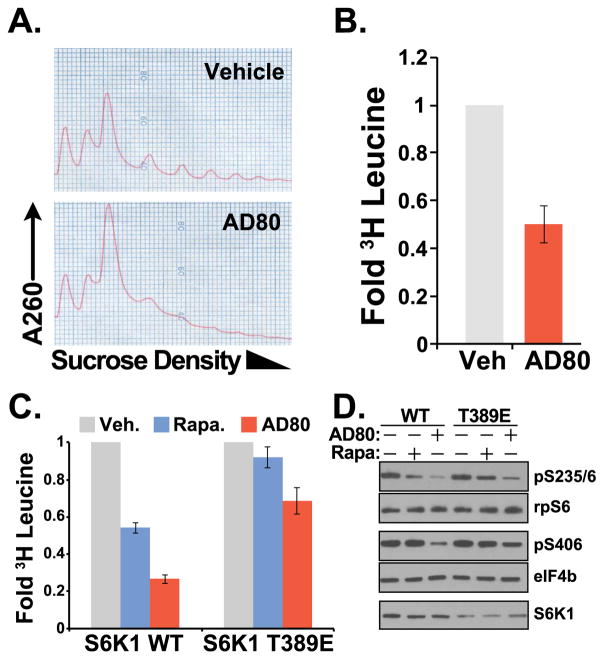
Targeting translation through S6K1. (a) rRNA polysome assembly in PTEN-deficient FL5.12 cells cultured –growth factor for 3 hours ± 4 μM AD80, n=4. (b) 3H-leucine incorporation into the TCA-precipitated protein fraction from PTEN-deficient FL5.12 cells treated ±4 μM AD80. Measurements are mean±SD cpm from triplicate wells cultured in parallel and standardized to Vehicle control. n=5. (c) S6K1−/− MEFs reconstituted with WT-S6K1 or S6K1 T389E were incubated with vehicle control, 20 nM rapamycin or 4 μM AD80. Measurements are as in (b), n=4. (d) Immunoblot analysis of cells cultured as in (c) for 2 hours reveals that S6K1 T389E sustained phosphorylation of the S6K1 substrates rpS6 and eIF4b, indicating a mechanism for AD80 regulation of S6K1-dependent translation control; n=3.
FIGURE 4
FIGURE 4
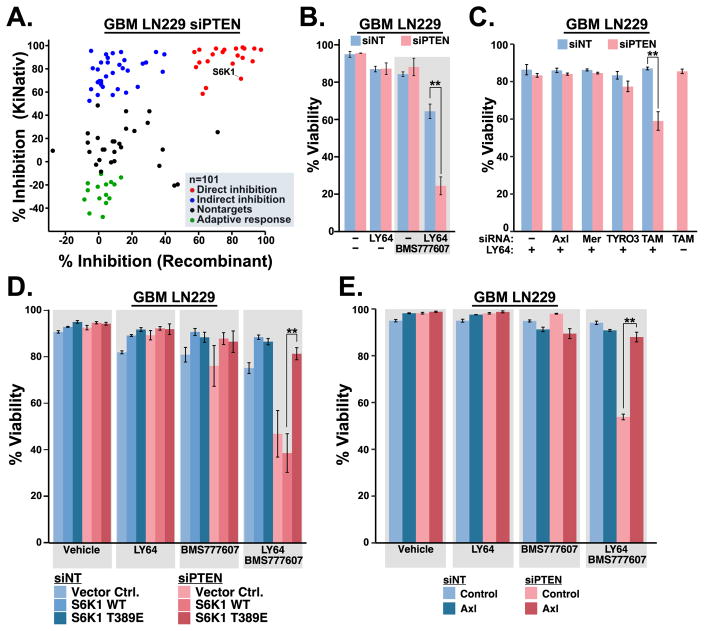
S6K1/TAM kinase combination targeting. (a) siPTEN LN229 cells were cultured for 3 hours in vehicle control or 10 μM AD80, then submitted for ATP-binding site occupancy analysis (KiNativ analysis, ActivX). The % inhibition by AD80 was matched and plotted with previously published activity using recombinant enzyme assays (Dar et al., 2012). Kinase responses to AD80 were classified as indicated. (b) PTEN-selective cytotoxic effects of 5 μM LY-2779964 +/− 10 μM BMS-777607, n=3 (c) Knockdown of TAM kinases sensitizes PTEN-deficient cells to 5 μM LY-2779964, n=3. (d) Activated S6K1 T389E but not S6K1 WT mediates resistance to 5 μM LY-2779964 + 10 μM BMS-777607, n=3. (e) AXL expression mediates resistance of PTEN-deficient cells to 5 μM LY-2779964 + 10 μM BMS-777607, n=3. Mean ±SD viability was measured after 72 hours of culture; ** indicates p<0.01 by two tailed t-test (b–e). See also Figure S4.

References

    1. Ben-Sahra I, Howell JJ, Asara JM, Manning BD. Stimulation of de novo pyrimidine synthesis by growth signaling through mTOR and S6K1. Science. 2013;339:1323–1328. - PMC - PubMed
    1. Cerami E, Gao J, Dogrusoz U, Gross BE, Sumer SO, Aksoy BA, Jacobsen A, Byrne CJ, Heuer ML, Larsson E, et al. The cBio cancer genomics portal: an open platform for exploring multidimensional cancer genomics data. Cancer Discov. 2012;2:401–404. - PMC - PubMed
    1. Dar AC, Das TK, Shokat KM, Cagan RL. Chemical genetic discovery of targets and anti-targets for cancer polypharmacology. Nature. 2012;486:80–84. - PMC - PubMed
    1. Dorrello NV, Peschiaroli A, Guardavaccaro D, Colburn NH, Sherman NE, Pagano M. S6K1- and betaTRCP-mediated degradation of PDCD4 promotes protein translation and cell growth. Science. 2006;314:467–471. - PubMed
    1. Elkabets M, Pazarentzos E, Juric D, Sheng Q, Pelossof RA, Brook S, Benzaken AO, Rodon J, Morse N, Yan JJ, et al. AXL mediates resistance to PI3Kalpha inhibition by activating the EGFR/PKC/mTOR axis in head and neck and esophageal squamous cell carcinomas. Cancer Cell. 2015;27:533–546. - PMC - PubMed

MeSH terms

Substances