


Costs and Efficiency of Online and Offline Recruitment Methods: A Web-Based Cohort Study
- PMID: 28249833
- PMCID: PMC5352857
- DOI: 10.2196/jmir.6716
Costs and Efficiency of Online and Offline Recruitment Methods: A Web-Based Cohort Study
Abstract
Background: The Internet is widely used to conduct research studies on health issues. Many different methods are used to recruit participants for such studies, but little is known about how various recruitment methods compare in terms of efficiency and costs.
Objective: The aim of our study was to compare online and offline recruitment methods for Internet-based studies in terms of efficiency (number of recruited participants) and costs per participant.
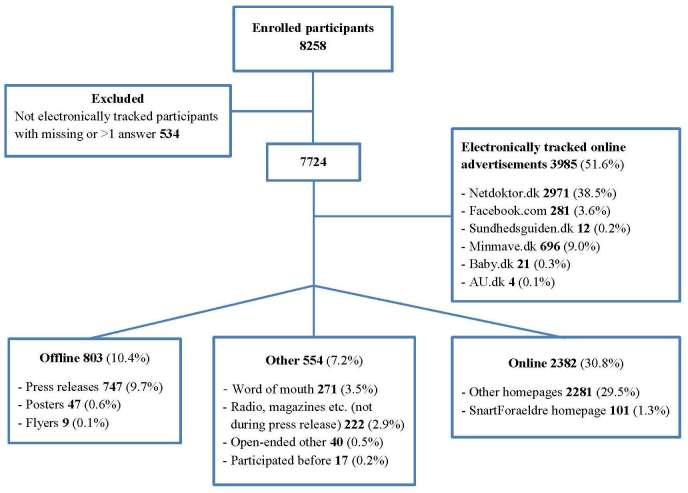
Methods: We employed several online and offline recruitment methods to enroll 18- to 45-year-old women in an Internet-based Danish prospective cohort study on fertility. Offline methods included press releases, posters, and flyers. Online methods comprised advertisements placed on five different websites, including Facebook and Netdoktor.dk. We defined seven categories of mutually exclusive recruitment methods and used electronic tracking via unique Uniform Resource Locator (URL) and self-reported data to identify the recruitment method for each participant. For each method, we calculated the average cost per participant and efficiency, that is, the total number of recruited participants.
Results: We recruited 8252 study participants. Of these, 534 were excluded as they could not be assigned to a specific recruitment method. The final study population included 7724 participants, of whom 803 (10.4%) were recruited by offline methods, 3985 (51.6%) by online methods, 2382 (30.8%) by online methods not initiated by us, and 554 (7.2%) by other methods. Overall, the average cost per participant was €6.22 for online methods initiated by us versus €9.06 for offline methods. Costs per participant ranged from €2.74 to €105.53 for online methods and from €0 to €67.50 for offline methods. Lowest average costs per participant were for those recruited from Netdoktor.dk (€2.99) and from Facebook (€3.44).
Conclusions: In our Internet-based cohort study, online recruitment methods were superior to offline methods in terms of efficiency (total number of participants enrolled). The average cost per recruited participant was also lower for online than for offline methods, although costs varied greatly among both online and offline recruitment methods. We observed a decrease in the efficiency of some online recruitment methods over time, suggesting that it may be optimal to adopt multiple online methods.
Keywords: Internet; Web-based study; advertising; costs per participant; participant recruitment.
©Tina Christensen, Anders H Riis, Elizabeth E Hatch, Lauren A Wise, Marie G Nielsen, Kenneth J Rothman, Henrik Toft Sørensen, Ellen M Mikkelsen. Originally published in the Journal of Medical Internet Research (http://www.jmir.org), 01.03.2017.
Conflict of interest statement
Conflicts of Interest: None declared.
Figures





References
-
- van Gelder MM, Bretveld RW, Roeleveld N. Web-based questionnaires: the future in epidemiology? Am J Epidemiol. 2010 Dec 1;172(11):1292–8. doi: 10.1093/aje/kwq291. http://aje.oxfordjournals.org/cgi/pmidlookup?view=long&pmid=20880962 kwq291 - DOI - PubMed
-
- Olsen J, Melbye M, Olsen SF, Sørensen TI, Aaby P, Andersen AM, Taxbøl D, Hansen KD, Juhl M, Schow TB, Sørensen HT, Andresen J, Mortensen EL, Olesen AW, Søndergaard C. The Danish National Birth Cohort--its background, structure and aim. Scand J Public Health. 2001 Dec;29(4):300–7. - PubMed
-
- Sjöström M, Umefjord G, Stenlund H, Carlbring P, Andersson G, Samuelsson E. Internet-based treatment of stress urinary incontinence: a randomised controlled study with focus on pelvic floor muscle training. BJU Int. 2013 Jan 25;112(3):362–372. doi: 10.1111/j.1464-410X.2012.11713.x. - DOI - PMC - PubMed
Publication types
MeSH terms
Grants and funding
LinkOut - more resources
Full Text Sources
Other Literature Sources
