Maternal Stress and Anxiety in the Pediatric Cardiac Intensive Care Unit
- PMID: 28249863
- PMCID: PMC5426478
- DOI: 10.4037/ajcc2017266
Maternal Stress and Anxiety in the Pediatric Cardiac Intensive Care Unit
Abstract
Background: Mothers whose infants are born with complex congenital heart disease (CCHD) experience stress during their infant's hospitalization in a pediatric cardiac intensive care unit (PCICU).
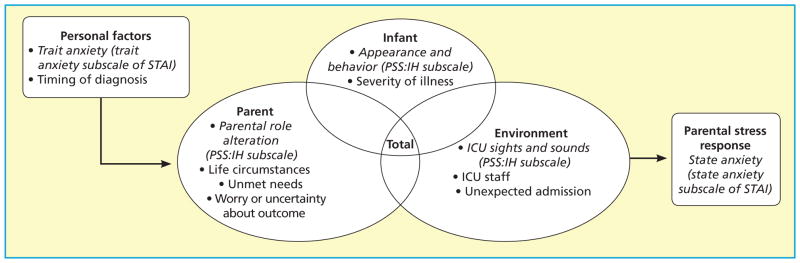
Objectives: This study addressed 2 research questions: (1) What are the parental stressors for mothers whose infants with CCHD are in the PCICU? And (2) What are the relationships of trait anxiety and 3 parental stressors to the parental stress response of state anxiety in mothers whose infants with CCHD are in the PCICU?
Methods: This descriptive correlational study included 62 biological mothers of infants admitted to a PCICU within 1 month of birth who had undergone cardiac surgery for CCHD. Maternal and infant demographics and responses to the Parental Stressor Scale: Infant Hospitalization and the State-Trait Anxiety Inventory were collected at 3 major PCICUs across the United States.
Results: Mothers' scores revealed that infant appearance and behavior was the greatest stressor, followed by parental role alteration, then sights and sounds. The combination of trait anxiety and parental role alteration explained 26% of the variance in maternal state anxiety. Mothers with other children at home had significantly higher state anxiety than did mothers with only the hospitalized infant.
Conclusions: Results from this study revealed factors that contribute to the stress of mothers whose infants are born with CCHD and are hospitalized in a PCICU. Nurses are in a critical position to provide education and influence care to reduce maternal stressors in the PCICU, enhance mothers' parental role, and mitigate maternal state anxiety.
©2017 American Association of Critical-Care Nurses.
Figures
Comment in
-
Evidence-Based Review and Discussion Points.Am J Crit Care. 2017 Mar;26(2):126-127. doi: 10.4037/ajcc2017698. Am J Crit Care. 2017. PMID: 28249864 No abstract available.
References
-
- The impact of congenital heart defects. American Heart Association website; 2015. [Accessed December 19, 2016.]. http://www.heart.org/HEARTORG/Conditions/CongenitalHeartDefects/TheImpac....
-
- Brosig CL, Whitstone BN, Frommelt MA, Frisbee SJ, Leuthner SR. Psychological distress in parents of children with severe congenital heart disease: The impact of prenatal versus postnatal diagnosis. J Perinatol. 2007;27:687–692. - PubMed
-
- Franck LS, Mcquillan A, Wray J, Grocott MPW, Goldman A. Parent stress levels during children’s hospital recovery after congenital heart surgery. Pediatr Cardiol. 2010;31:961–968. - PubMed
-
- Rychik J, Donaghue D, Levy S, et al. Maternal psychological stress after prenatal diagnosis of congenital heart disease. J Pediatr. 2013;162:302–307. - PubMed
-
- Johnson PA, Nelson GL, Brunnquell DJ. Parent and nurse perceptions of parent stressors in the pediatric intensive care unit. Child Health Care. 1988;17:98–105. - PubMed
MeSH terms
Grants and funding
LinkOut - more resources
Full Text Sources
Other Literature Sources
Medical