


Inequalities in tobacco outlet density by race, ethnicity and socioeconomic status, 2012, USA: results from the ASPiRE Study
- PMID: 28249990
- PMCID: PMC5458784
- DOI: 10.1136/jech-2016-208475
Inequalities in tobacco outlet density by race, ethnicity and socioeconomic status, 2012, USA: results from the ASPiRE Study
Abstract
Background: Evidence of racial/ethnic inequalities in tobacco outlet density is limited by: (1) reliance on studies from single counties or states, (2) limited attention to spatial dependence, and (3) an unclear theory-based relationship between neighbourhood composition and tobacco outlet density.
Methods: In 97 counties from the contiguous USA, we calculated the 2012 density of likely tobacco outlets (N=90 407), defined as tobacco outlets per 1000 population in census tracts (n=17 667). We used 2 spatial regression techniques, (1) a spatial errors approach in GeoDa software and (2) fitting a covariance function to the errors using a distance matrix of all tract centroids. We examined density as a function of race, ethnicity, income and 2 indicators identified from city planning literature to indicate neighbourhood stability (vacant housing, renter-occupied housing).
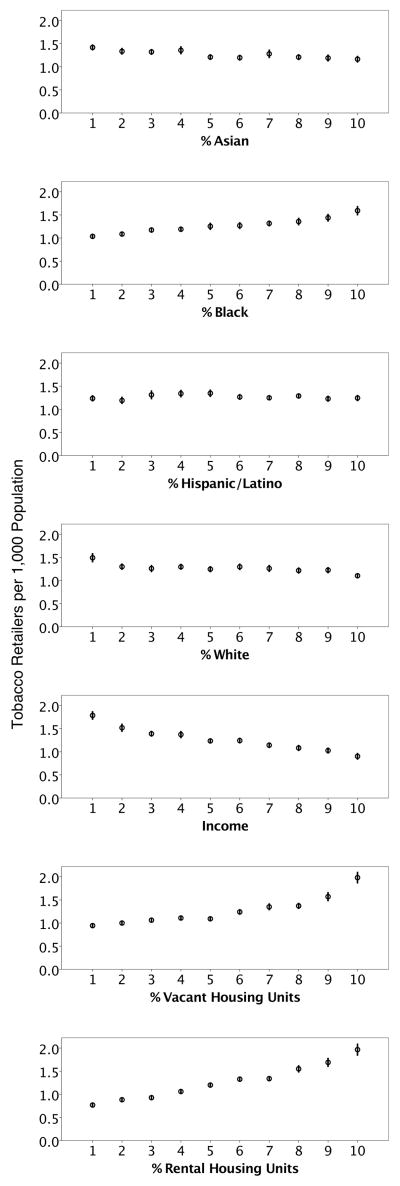
Results: The average density was 1.3 tobacco outlets per 1000 persons. Both spatial regression approaches yielded similar results. In unadjusted models, tobacco outlet density was positively associated with the proportion of black residents and negatively associated with the proportion of Asian residents, white residents and median household income. There was no association with the proportion of Hispanic residents. Indicators of neighbourhood stability explained the disproportionate density associated with black residential composition, but inequalities by income persisted in multivariable models.
Conclusions: Data from a large sample of US counties and results from 2 techniques to address spatial dependence strengthen evidence of inequalities in tobacco outlet density by race and income. Further research is needed to understand the underlying mechanisms in order to strengthen interventions.
Keywords: Health inequalities; PUBLIC HEALTH POLICY; SMOKING; Tobacco.
Published by the BMJ Publishing Group Limited. For permission to use (where not already granted under a licence) please go to http://www.bmj.com/company/products-services/rights-and-licensing/.
Figures
References
-
- Center for Public Health Systems Science. [Accessed October 3, 2014];Point-of-Sale Report to the Nation: The Tobacco Retail and Policy Landscape. 2014 http://cphss.wustl.edu/Products/Documents/ASPiRE_2014_ReportToTheNation.pdf.
-
- Halonen JI, Kivimaki M, Kouvonen A, et al. Proximity to a tobacco store and smoking cessation: a cohort study. Tob Control. 2014;23(2):146–151. - PubMed
Publication types
MeSH terms
Grants and funding
LinkOut - more resources
Full Text Sources
Other Literature Sources
