. 2017 Mar;27(3):440-450.
doi: 10.1101/gr.210740.116.

Genome-wide analysis of differential RNA editing in epilepsy

Affiliations

Genome-wide analysis of differential RNA editing in epilepsy

Prashant Kumar Srivastava et al. Genome Res. 2017 Mar.

Abstract

The recoding of genetic information through RNA editing contributes to proteomic diversity, but the extent and significance of RNA editing in disease is poorly understood. In particular, few studies have investigated the relationship between RNA editing and disease at a genome-wide level. Here, we developed a framework for the genome-wide detection of RNA sites that are differentially edited in disease. Using RNA-sequencing data from 100 hippocampi from mice with epilepsy (pilocarpine-temporal lobe epilepsy model) and 100 healthy control hippocampi, we identified 256 RNA sites (overlapping with 87 genes) that were significantly differentially edited between epileptic cases and controls. The degree of differential RNA editing in epileptic mice correlated with frequency of seizures, and the set of genes differentially RNA-edited between case and control mice were enriched for functional terms highly relevant to epilepsy, including "neuron projection" and "seizures." Genes with differential RNA editing were preferentially enriched for genes with a genetic association to epilepsy. Indeed, we found that they are significantly enriched for genes that harbor nonsynonymous de novo mutations in patients with epileptic encephalopathy and for common susceptibility variants associated with generalized epilepsy. These analyses reveal a functional convergence between genes that are differentially RNA-edited in acquired symptomatic epilepsy and those that contribute risk for genetic epilepsy. Taken together, our results suggest a potential role for RNA editing in the epileptic hippocampus in the occurrence and severity of epileptic seizures.


Figures

Figure 1.
Figure 1.
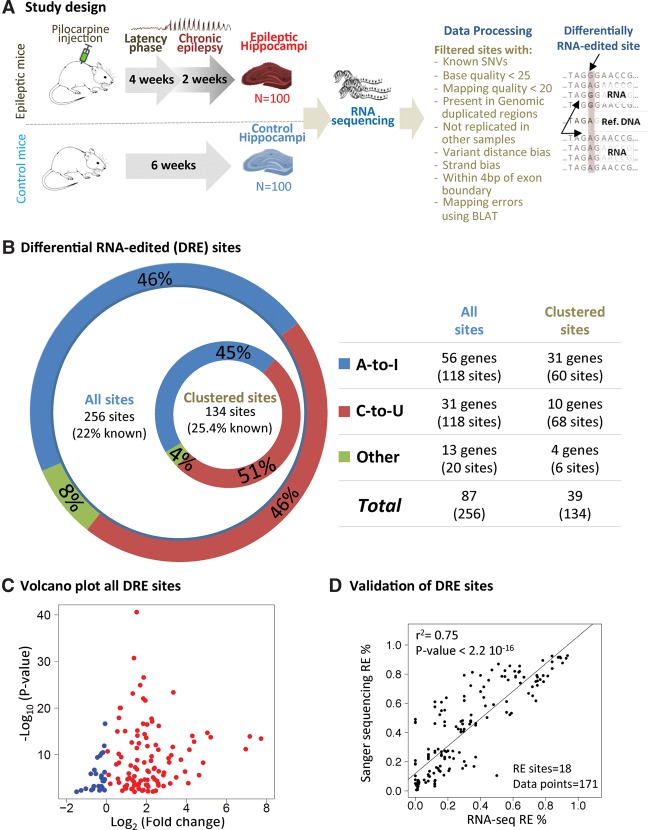
(A) Summary of study design for detecting significant differential RNA editing events associated with epilepsy. (B) The figure summarizes the results for the different categories of differential RNA editing analyzed. These categories were generated using two approaches: (1) predicted RNA-editing sites, represented in the outer circle, and (2) predicted and clustered RNA-edited sites, represented in the inner circle and table. The percentages were calculated with respect to unique genes. The outer circle refers to “all” sites, while the inner circle refers to “clustered” sites. A-to-I and C-to-U editing are represented in blue and red, respectively, while all other sites are represented in green. (C) Volcano plot summarizing mean RNA-editing percentages differences in epileptic and control mice and their significance levels. (D) Concordance between RNA-editing events detected using RNA-seq and Sanger sequencing.
Figure 2.
Figure 2.
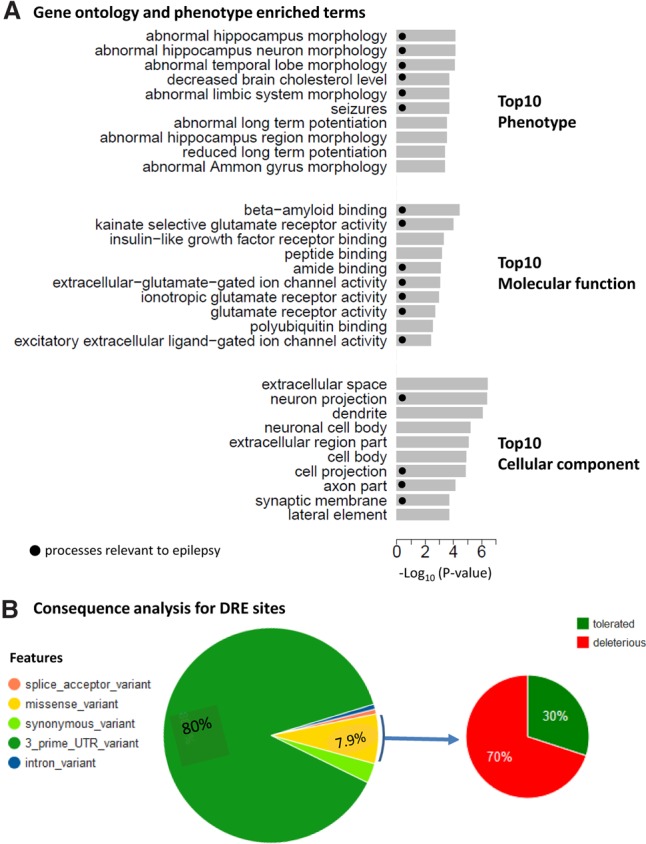
(A) Functional annotation of genes harboring differential RNA-edited clustered sites for Gene Ontology (GO) categories phenotype, molecular function, and cellular component. (B) Consequence analysis of the differential RNA-edited clustered sites.
Figure 3.
Figure 3.
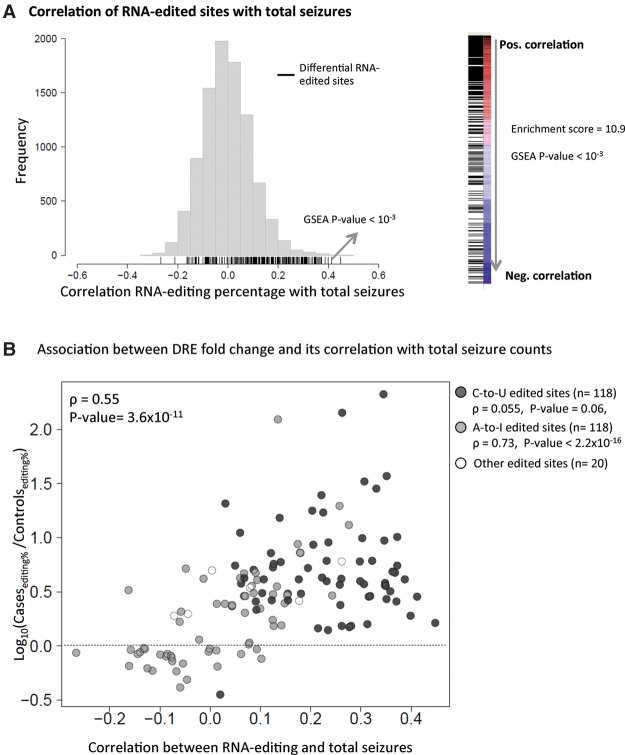
Relationship between RNA editing in the hippocampus and seizure frequency (here, measured as total seizure counts over a standardized period of 14 continuous days of monitoring). (A) Correlation between RNA-editing percentages and total seizure counts in the 100 epileptic mice. (B) Association between RNA-editing fold change and correlation between RNA-editing percentage and total seizures in epileptic mice. C-to-U sites are represented as solid black circles, while A-to-I sites are solid gray circles. All other sites are represented as white circles with a black outline.
Figure 4.
Figure 4.
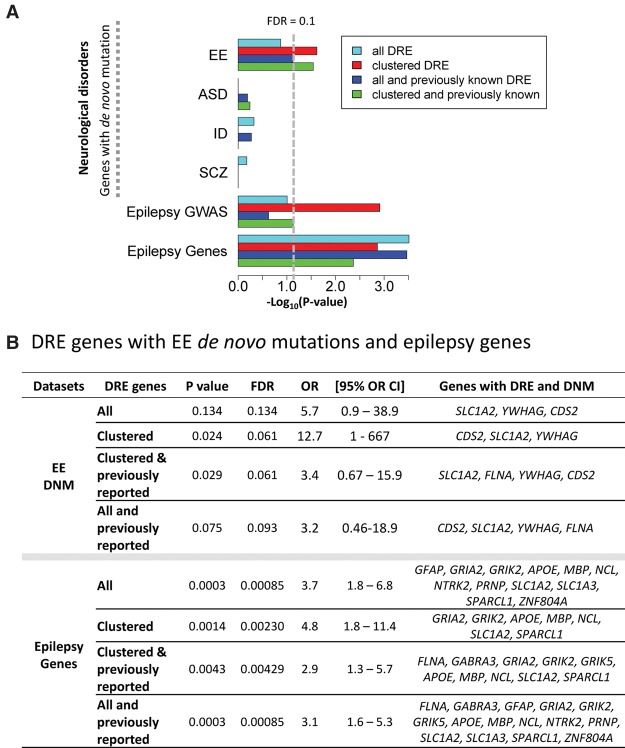
(A) For genes impacted by differential RNA editing, enrichment for de novo mutations from patients with epileptic encephalopathy (EE), autism spectrum disorder (ASD), intellectual disability (ID), and schizophrenia (SCZ); enrichment of association to genetic generalized epilepsy (“Epilepsy GWAS”) and enrichment for known epilepsy genes (Epilepsy Genes) (as defined by DisGeNET). (B) Table summarizes the enrichment P-value, odds ratio (OR), and 95th percentile of the confidence interval of the OR and lists the genes contributing to the enrichment of EE de novo mutations (top) and known epilepsy genes (bottom) among genes differentially RNA-edited in epilepsy.

References

    1. Akbarian S, Smith MA, Jones EG. 1995. Editing for an AMPA receptor subunit RNA in prefrontal cortex and striatum in Alzheimer's disease, Huntington's disease and schizophrenia. Brain Res 699: 297–304. - PubMed
    1. Allen AS, Berkovic SF, Cossette P, Delanty N, Dlugos D, Eichler EE, Epstein MP, Glauser T, Goldstein DB, Han Y, et al. 2013. De novo mutations in epileptic encephalopathies. Nature 501: 217–221. - PMC - PubMed
    1. Anders S, Pyl PT, Huber W. 2015. HTSeq—a Python framework to work with high-throughput sequencing data. Bioinformatics 31: 166–169. - PMC - PubMed
    1. Balik A, Penn AC, Nemoda Z, Greger IH. 2013. Activity-regulated RNA editing in select neuronal subfields in hippocampus. Nucleic Acids Res 41: 1124–1134. - PMC - PubMed
    1. Bauer-Mehren A, Rautschka M, Sanz F, Furlong LI. 2010. DisGeNET: a Cytoscape plugin to visualize, integrate, search and analyze gene-disease networks. Bioinformatics 26: 2924–2926. - PubMed