


Evaluation of a Screening Program to Detect Critical Congenital Heart Defects in Newborns
- PMID: 28250095
- PMCID: PMC5924700
- DOI: 10.1542/hpeds.2016-0176
Evaluation of a Screening Program to Detect Critical Congenital Heart Defects in Newborns
Abstract
Objectives: To report the results of and to identify problems with implementing a screening program to detect critical congenital heart defects (CCHDs) in newborns by using differential pulse oximetry (POx).
Methods: Charts of all live-born infants from 4 Yale-New Haven health system hospitals in Connecticut between January 1 and December 31, 2014, were reviewed.
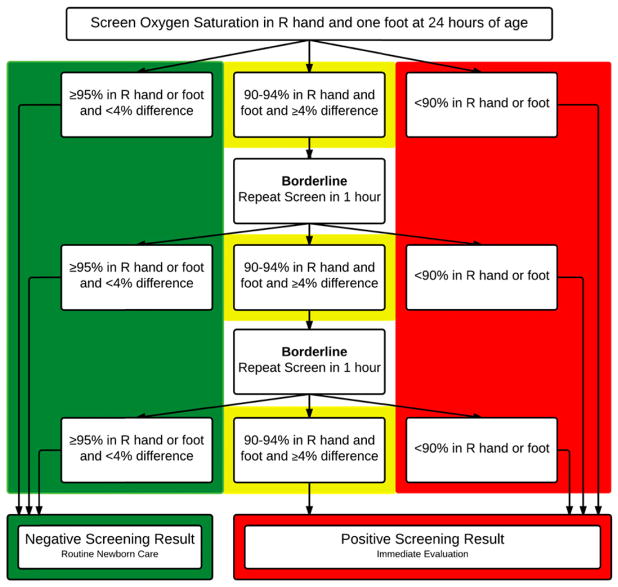
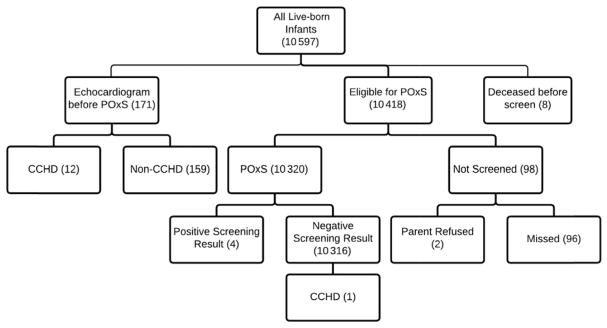
Results: Of 10 589 newborns, 171 (1.6%) underwent an echocardiogram before screening, 10 320 (97.5%) were screened by POx, and 98 (0.9%) were not screened. Thirteen newborns (0.1%) were diagnosed with a CCHD. No infants with CCHDs were identified through POx screening (POxS) alone. Eleven (85%) were already suspected of having a CCHD lesion on the basis of prenatal ultrasound, 1 (8%) was diagnosed because of clinical concern before undergoing screening, and 1 (8%) had a false-negative screening result, but a CCHD was identified after an echocardiogram was performed because a murmur was heard. Four infants with a positive POx screen showed noncritical cardiac lesions by echocardiogram. The majority of infants were screened within the recommended 24 to 72 hours of age interval and had POx screens that were interpreted and documented correctly. Of 10 316 infants with negative POx screens, 52.1% were still in the Yale-New Haven Hospital health system at 1 year of age and no CCHD lesions were listed in their charts.
Conclusions: Although a CCHD screening program was effectively implemented, perhaps because most children with a CCHD (85%) were detected antenatally by ultrasound, in our hospital system POxS did not lead to a substantial increase in the early identification of CCHDs.
Copyright © 2017 by the American Academy of Pediatrics.
Conflict of interest statement
Figures
References
-
- Mahle WT, Newburger JW, Matherne GP, et al. American Heart Association Congenital Heart Defects Committee of the Council on Cardiovascular Disease in the Young; ; Council on Cardiovascular Nursing; and Interdisciplinary Council on Quality of Care and Outcomes Research; American Academy of Pediatrics Section on Cardiology and Cardiac Surgery; Committee on Fetus and Newborn. Role of pulse oximetry in examining newborns for congenital heart disease: a scientific statement from the AHA and AAP. Pediatrics. 2009;124(2):823–836. - PubMed
-
- Johnson LC, Lieberman E, O’Leary E, Geggel RL. Prenatal and newborn screening for critical congenital heart disease: findings from a nursery. Pediatrics. 2014;134(5):916–922. - PubMed
-
- Mahle WT, Martin GR, Beekman RH, III, Morrow WR Section on Cardiology and Cardiac Surgery Executive Committee. Endorsement of Health and Human Services recommendation for pulse oximetry screening for critical congenital heart disease. Pediatrics. 2012;129(1):190–192. - PubMed
-
- Garg LF, Van Naarden Braun K, Knapp MM, et al. Results from the New Jersey statewide critical congenital heart defects screening program. Pediatrics. 2013;132(2) Available at: www.pediatrics.org/cgi/content/full/132/2/e314. - PMC - PubMed
-
- State of Connecticut Department of Public Health. Senate Bill no. 56. Public Act no. 12–13. [Accessed May 23, 2016];An act concerning critical congenital heart disease screening for newborns. Available at: www.ct.gov/dph/cwp/view.asp?a=3138&q=531512.
MeSH terms
Grants and funding
LinkOut - more resources
Full Text Sources
Other Literature Sources
Medical
