. 2017 May;40(3):357-368.
doi: 10.1007/s10545-017-0022-x. Epub 2017 Mar 1.

Expanding the phenotype in argininosuccinic aciduria: need for new therapies

Affiliations

Expanding the phenotype in argininosuccinic aciduria: need for new therapies

Julien Baruteau et al. J Inherit Metab Dis. 2017 May.

Abstract

Objectives: This UK-wide study defines the natural history of argininosuccinic aciduria and compares long-term neurological outcomes in patients presenting clinically or treated prospectively from birth with ammonia-lowering drugs.

Methods: Retrospective analysis of medical records prior to March 2013, then prospective analysis until December 2015. Blinded review of brain MRIs. ASL genotyping.

Results: Fifty-six patients were defined as early-onset (n = 23) if symptomatic < 28 days of age, late-onset (n = 23) if symptomatic later, or selectively screened perinatally due to a familial proband (n = 10). The median follow-up was 12.4 years (range 0-53). Long-term outcomes in all groups showed a similar neurological phenotype including developmental delay (48/52), epilepsy (24/52), ataxia (9/52), myopathy-like symptoms (6/52) and abnormal neuroimaging (12/21). Neuroimaging findings included parenchymal infarcts (4/21), focal white matter hyperintensity (4/21), cortical or cerebral atrophy (4/21), nodular heterotopia (2/21) and reduced creatine levels in white matter (4/4). 4/21 adult patients went to mainstream school without the need of additional educational support and 1/21 lives independently. Early-onset patients had more severe involvement of visceral organs including liver, kidney and gut. All early-onset and half of late-onset patients presented with hyperammonaemia. Screened patients had normal ammonia at birth and received treatment preventing severe hyperammonaemia. ASL was sequenced (n = 19) and 20 mutations were found. Plasma argininosuccinate was higher in early-onset compared to late-onset patients.

Conclusions: Our study further defines the natural history of argininosuccinic aciduria and genotype-phenotype correlations. The neurological phenotype does not correlate with the severity of hyperammonaemia and plasma argininosuccinic acid levels. The disturbance in nitric oxide synthesis may be a contributor to the neurological disease. Clinical trials providing nitric oxide to the brain merit consideration.


Conflict of interest statement

None.

Figures
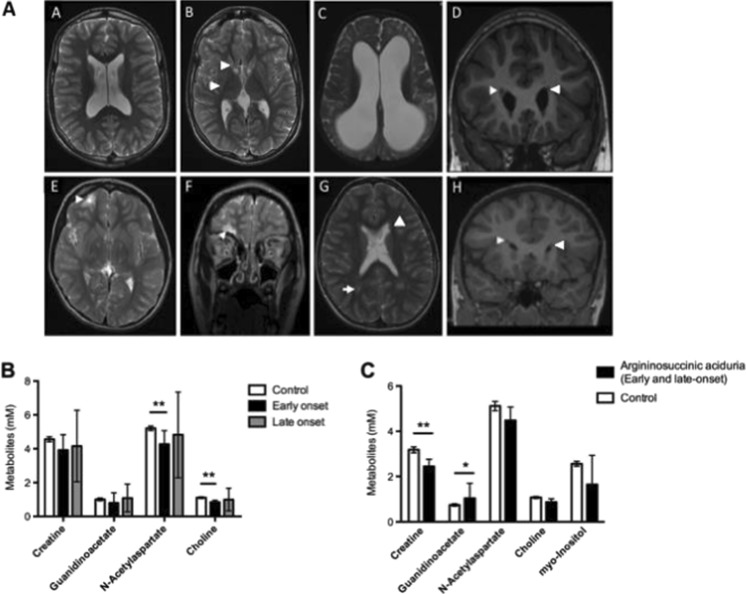
Fig. 1
Fig. 1
Neuroimaging. A: Morphological brain MRI features. A, B: T2-weighted axial images showing brain matter volume loss and mild ex vacuo dilatation of ventricles (A) and high signal in bilateral caudate heads and posterior putamina (arrows). C: T2-weighted axial images with severe diffuse cerebral atrophy and ventricular dilatation. D, H: T1-weighted coronal image with right periventricular heterotopia (arrowheads). E, F: T2-weighted axial (E) and coronal (F) images with evidence of right inferior frontal lobe infarct (arrow). G: T2-weighted axial image with bilateral high signal of the peritrigonal white matter (arrow). B 1 H MR spectroscopy features in basal ganglia. Assessment in early-onset (n = 5), late-onset (n = 3) and control (n = 63) patients analysed using a paired t test. c 1 H MR spectroscopy features in white matter. Patients affected by argininosuccinic aciduria (n = 4) and controls (n = 53) analysed with one way ANOVA. Graphs represent mean ± 95% confidence interval. * p < 0.05; ** p < 0.01
Fig. 2
Fig. 2
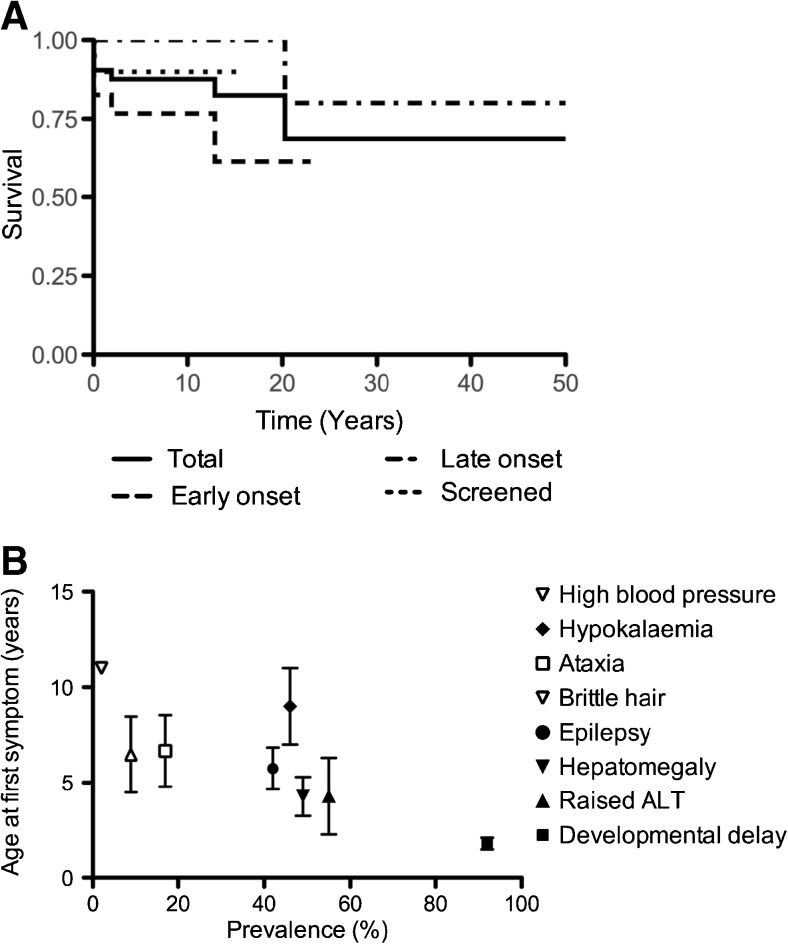
Natural history of argininosuccinic aciduria. A Kaplan-Meier survival curves for all (solid line), early-onset (dashed line), late-onset (dashed dotted line) and screened (dotted line) patients. B Natural history of the systemic phenotype of argininosuccinic aciduria. Mean ± standard error of age of onset of each symptom from data of the whole cohort when information available: developmental delay (n = 7), abnormal LFTs (n = 8), hepatomegaly (n = 18), epilepsy (n = 15), brittle hair (n = 4), ataxia (n = 6), hypokalaemia (n = 2), high blood pressure (n = 1). Symptom frequency in the total population of patients studied is presented in brackets. ALT: plasma alanine aminotransferase activity. It was assumed that patients had normal blood pressure if hypertension was not specifically mentioned in medical records

References

    1. Ah Mew N, Krivitzky L, McCarter R, Batshaw M, Tuchman M, Urea Cycle Disorders Consortium of the Rare Diseases Clinical Research Network (2013) Clinical outcomes of neonatal onset proximal versus distal urea cycle disorders do not differ. J Pediatr 162:324–329 e321 - PMC - PubMed
    1. Aoyagi K, Shahrzad S, Iida S, et al. Role of nitric oxide in the synthesis of guanidinosuccinic acid, an activator of the N-methyl-D-aspartate receptor. Kidney Int Suppl. 2001;78:S93–S96. doi: 10.1046/j.1523-1755.2001.59780093.x. - DOI - PubMed
    1. Balmer C, Pandey AV, Rufenacht V, et al. Mutations and polymorphisms in the human argininosuccinate lyase (ASL) gene. Hum Mutat. 2014;35:27–35. doi: 10.1002/humu.22469. - DOI - PubMed
    1. Boenzi S, Pastore A, Martinelli D, et al. Creatine metabolism in urea cycle defects. J Inherit Metab Dis. 2012;35:647–653. doi: 10.1007/s10545-012-9494-x. - DOI - PubMed
    1. Bogdan C. Nitric oxide synthase in innate and adaptive immunity: an update. Trends Immunol. 2015;36:161–178. doi: 10.1016/j.it.2015.01.003. - DOI - PubMed

Publication types

MeSH terms