Review
. 2017 Jul;174(13):1945-1960.
doi: 10.1111/bph.13763. Epub 2017 Mar 31.

Pathological overproduction: the bad side of adenosine

Affiliations
Review

Pathological overproduction: the bad side of adenosine

Pier Andrea Borea et al. Br J Pharmacol. 2017 Jul.

Abstract

Adenosine is an endogenous ubiquitous purine nucleoside, which is increased by hypoxia, ischaemia and tissue damage and mediates a number of physiopathological effects by interacting with four GPCRs, identified as A1 , A2A , A2B and A3 . Physiological and acutely increased adenosine is mostly associated with beneficial effects that include vasodilatation and a decrease in inflammation. In contrast, chronic overproduction of adenosine occurs in important pathological states, where long-lasting increases in the nucleoside levels are responsible for the bad side of adenosine associated with chronic inflammation, fibrosis and organ damage. In this review, we describe and critically discuss the pathological overproduction of adenosine and analyse when, where and how adenosine exerts its detrimental effects throughout the body.


Conflict of interest statement

The authors declare no conflicts of interest.

Figures
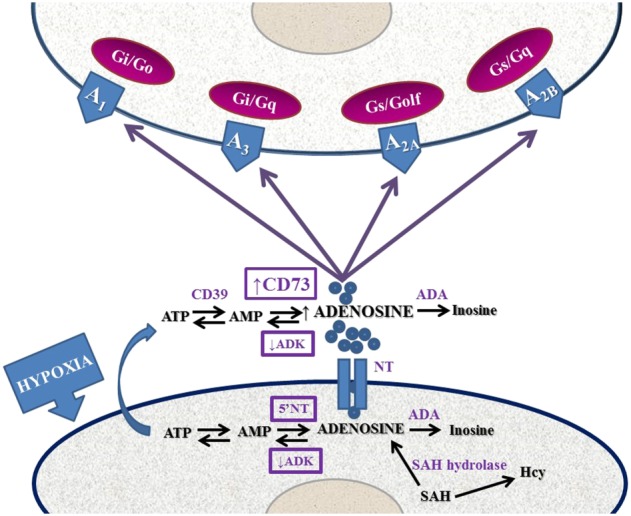
Figure 1
Figure 1
Schematic representation of the adenosinergic system from adenosine formation and release to signalling and removal from the extracellular space. Alterations occurring during hypoxia are shown. 5′NT, 5′‐nucleotidase; ADA, adenosine deaminase; SAH, S‐adenosylhomocysteine.
Figure 2
Figure 2
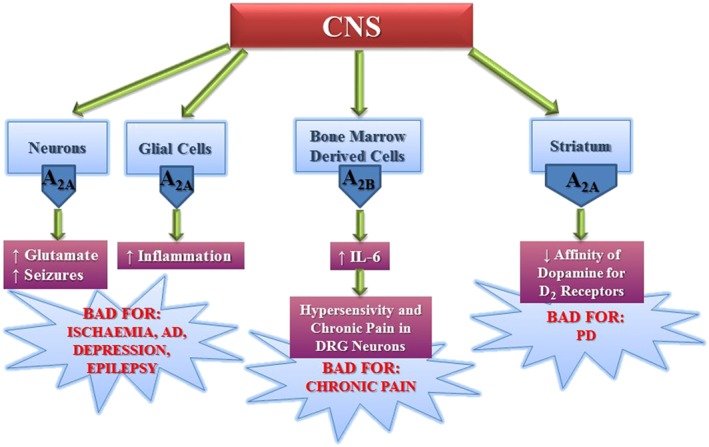
Deleterious effects of adenosine mediated through A2A and A2B receptors expressed in different areas of the CNS. DRG, dorsal root ganglion.
Figure 3
Figure 3
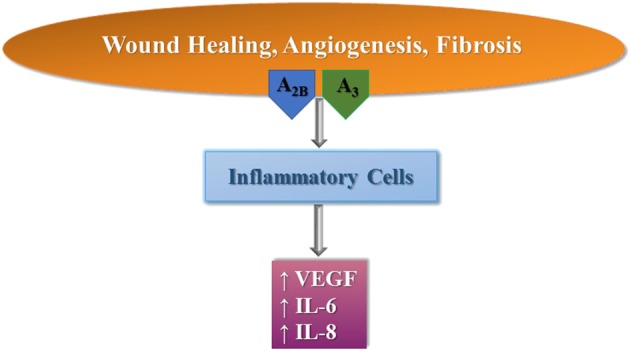
Modulation of wound healing, angiogenesis and fibrosis by A2B and A3 receptors in inflammatory cells.
Figure 4
Figure 4
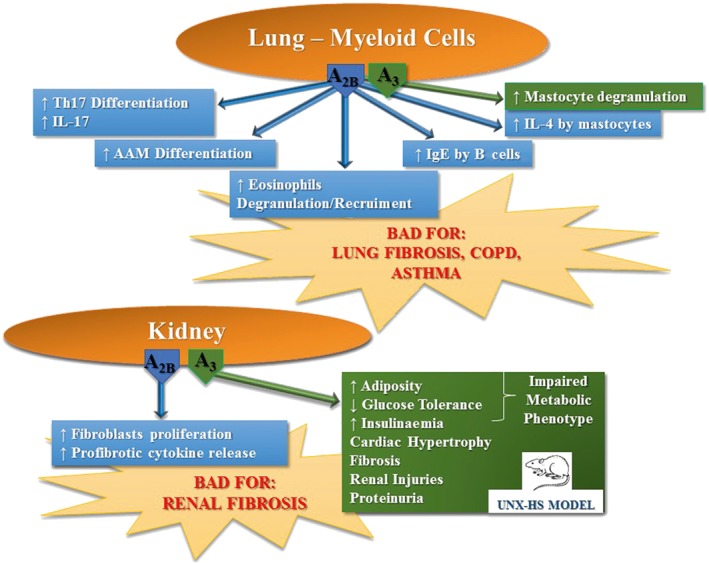
Deleterious effects of adenosine mediated through A2B and A3 receptors expressed in the lung and kidney. AAM, alternatively activated macrophages; HS, high salt; UNX, uninephrectomy.
Figure 5
Figure 5
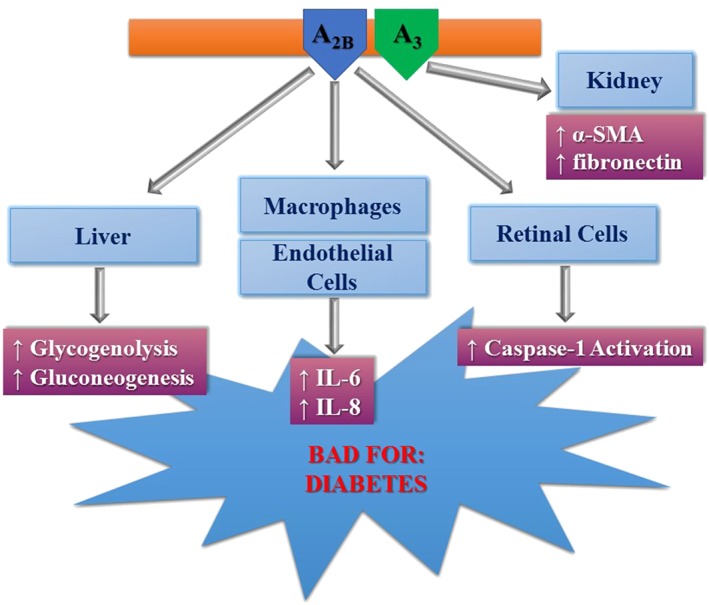
Deleterious effects of adenosine mediated through A2B and A3 receptors in diabetes. α‐SMA, α‐smooth muscle actin.
Figure 6
Figure 6
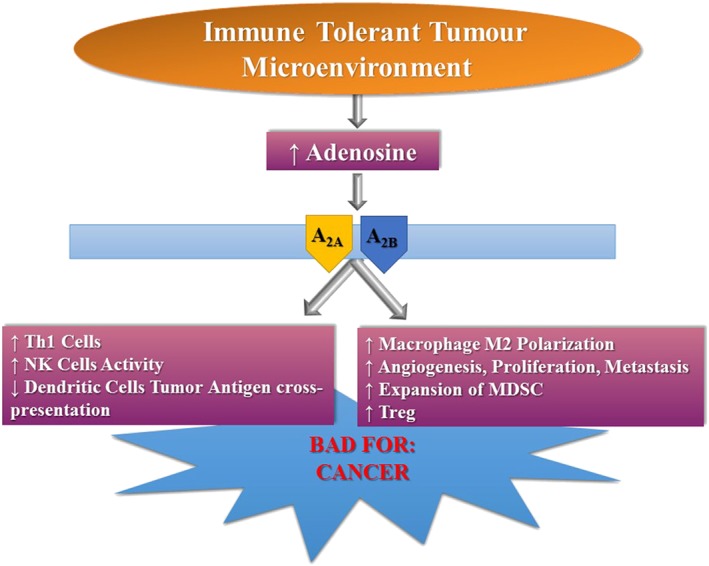
Deleterious effects of adenosine mediated through A2A and A2B receptors in cancer.

References

    1. Aherne CM, Saeedi B, Collins CB, Masterson JC, McNamee EN, Perrenoud L et al. (2015). Epithelial‐specific A2B adenosine receptor signaling protects the colonic epithelial barrier during acute colitis. Mucosal Immunol 8: 1324–1338. - PMC - PubMed
    1. Alexander SP, Davenport AP, Kelly E, Marrion N, Peters JA, Benson HE et al. (2015a). The Concise Guide to PHARMACOLOGY 2015/16: G protein‐coupled receptors. Br J Pharmacol 172: 5744–5869. - PMC - PubMed
    1. Alexander SP, Fabbro D, Kelly E, Marrion N, Peters JA, Benson HE et al. (2015b). The Concise Guide to PHARMACOLOGY 2015/16: Enzymes. Br J Pharmacol 172: 6024–6109. - PMC - PubMed
    1. Alexander SP, Kelly E, Marrion N, Peters JA, Benson HE, Faccenda E et al. (2015c). The concise guide to PHARMACOLOGY 2015/16: Transporters. Br J Pharmacol 172: 6110–6202. - PMC - PubMed
    1. Allard B, Beavis PA, Darcy PK, Stagg J (2016). Immunosuppressive activities of adenosine in cancer. Curr Opin Pharmacol 29: 7–16. - PubMed