Randomized Controlled Trial
. 2017 Mar 27;31(6):797-806.
doi: 10.1097/QAD.0000000000001427.

Effects of pitavastatin and pravastatin on markers of immune activation and arterial inflammation in HIV

Affiliations
Randomized Controlled Trial

Effects of pitavastatin and pravastatin on markers of immune activation and arterial inflammation in HIV

Mabel Toribio et al. AIDS. .

Abstract

Objective: Persistent immune activation is thought to contribute to increased cardiovascular disease risk in HIV and statins may help modulate systemic immune activation. We aimed to compare the effects of two key statins on markers of systemic immune activation and arterial inflammation in the HIV population.

Design: Double-blind, active-controlled, parallel-group comparative trial performed in 45 sites.

Methods: Two hundred and fifty-two antiretroviral therapy-treated HIV-infected participants with dyslipidemia were randomized (1 : 1) to pitavastatin 4 mg daily vs. pravastatin 40 mg daily in the HIV-infected patieNts and TREatment with PItavastatin vs. pravastatin for Dyslipidemia (INTREPID) trial. In this analysis of the INTREPID trial, we assessed markers of immune activation and arterial inflammation using a modified intent-to-treat population. This trial is registered with ClinicalTrials.gov (NCT01301066).

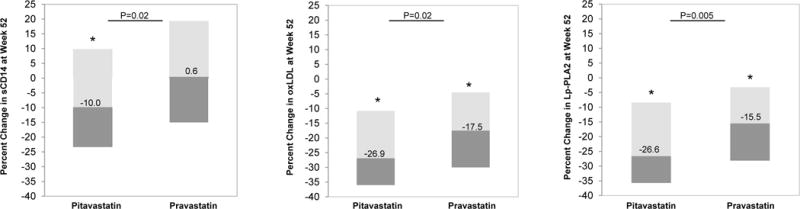
Results: One hundred and twenty-six participants were randomized to receive pitavastatin and 126 to pravastatin. Ninety-nine participants in the pitavastatin group and 91 participants in the pravastatin group completed the study. Median age was 50 (45, 56) years [median (interquartile range)]. Baseline, low-density lipoprotein-cholestrol (LDL-C) was 153 (135, 171) mg/dl, log HIV-1 viral load was 1.1 ± 0.2 copies/ml, and CD4 cell count was 580 (439, 794) cells/μl. At week 52, the pitavastatin group had a significantly greater reduction (% change) compared with pravastatin in soluble CD14 (sCD14), (-10.0 vs. 0.6%, P = 0.02), oxidized LDL (oxLDL) (-26.9 vs. -17.5%, P = 0.02), and lipoprotein-associated phospholipase 2 (Lp-PLA2) (-26.6 vs. -15.5%, P = 0.005) (pitavastatin vs. pravastatin).

Conclusion: Fifty-two weeks of pitavastatin 4 mg daily (vs. pravastatin 40 mg daily) led to a greater reduction in select markers of immune activation and arterial inflammation (sCD14, oxLDL, and LpPLA2) among HIV-infected participants. Further work is needed to assess whether immune-modulatory effects of pitavastatin reduce cardiovascular disease risk in HIV.


Conflict of interest statement

Declaration of interests:

KCW served on the scientific advisory board and was paid by Macrophage Therapeutics LLC, unrelated to this study. CAS and MMP are employees of KOWA Pharmaceuticals America, Inc. JAA received grants from KOWA Pharmaceuticals America, Inc during the conduct of the study, served in scientific advisory board personal from Janssen, Merck, and ViiV Healthcare, and received grants from Bristol-Myers Squibb and Gilead Sciences. MVZ participated in a scientific advisory board meeting for Roche Diagnostics and received grant support from Gilead Sciences, both unrelated to this study. SKG served as a paid consultant to Gilead Sciences, Theratechnologies, BMS, NovoNordisk, Merck, Navidea, and AstraZeneca and received grant support from Amgen, BMS, Gilead Sciences, KOWA Pharmaceuticals America, Inc and Theratechnologies unrelated to this study. SKG also received a grant to perform this project from KOWA Pharmaceuticals America, Inc. No other competing interests were reported.

Figures
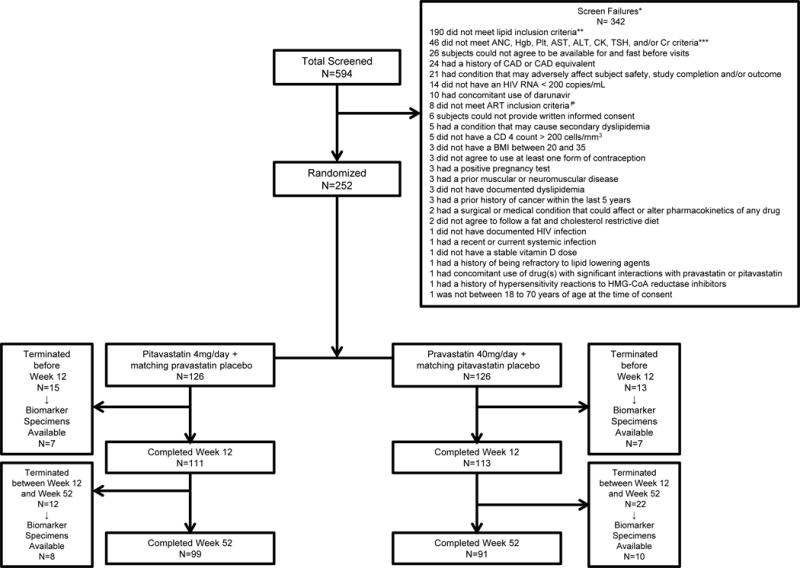
Figure 1
Figure 1. Consort diagram
Five hundred and ninety-four participants were screened for enrollment; 342 participants were screen failures. Two-hundred and fifty-two participants were enrolled and randomized. * Out of the 342 screen failures, 27 participants had at least 2 or more criteria for inclusion that were not met and/or exclusion criteria that were met ** Lipid inclusion criteria: elevated fasting plasma LDL-C≥130 mg/dL and ≤220 mg/dL, and TG levels ≤400 mg/dL, following statin washout and dietary lead-in period of a minimum of 4 weeks. *** Additional lab inclusion criteria: absolute neutrophil count >750 cells/mm3, hemoglobin≥9.0 g/dL for female participants and ≥10.0 g/dL for male participants, platelets ≥100,000/mm3, ALT and AST ≤2.5 × upper limit of normal (ULN); note: participants co-infected with Hepatitis B or C were required to have ALT and AST ≤1.5 ULN, fasting serum glucose ≤125 mg/dL, CK ≤ × ULN. If a transient increase in CK level was suspected due to exercise or trauma, CK may have been repeated at screening after an “exercise washout” at the discretion of the Investigator, serum creatinine ≤1.3 × ULN and estimated glomerular filtration rate (eGFR) ≥60 mL/min/1.73m2 based on the modification of diet in renal disease (MDRD) equation at http://www.nephron.com/MDRD_GFR.cgi. if a creatinine level was suspected to be temporarily increased due to factors such as dehydration, creatinine testing may have been repeated and the eGFR may have been recalculated at screening at the discretion of the Investigator, and TSH <1.5 × ULN ART inclusion criteria: On ART, except for darunavir, for at least 6 months prior to randomization and no change to the ART regimen within 3 months prior to randomization or anticipated need to change ART during the first 12 weeks of the study. Abbreviations: ANC, absolute neutrophil count; hgb, hemoglobin; plt, platelet; AST, aspartate aminotransferase; ALT, alanine transferase; CK, creatinine kinase; TSH, thyroid stimulating hormone; Cr, creatinine; CAD, coronary heart disease; HIV RNA, Human Immunodeficiency Virus ribonucleic acid; ART, anti-retroviral therapy; BMI, body mass index; HMG-CoA, 3-hydroxy-3-methylglutaryl-coenzyme A; AE, adverse event; SAE, serious adverse event
Figure 2
Figure 2. Percent change in sCD14, oxLDL, and Lp-PLA2 at Week 52 in Pitavastatin group compared to Pravastatin group (mITT Population)
At Week 52, the pitavastatin group had a significantly greater reduction (% change) in sCD14, oxLDL, and Lp-PLA2 (sCD14: −10.0 vs. 0.6%, P=0.02; oxLDL −26.9 vs. −17.5%, P=0.02; Lp-PLA2 −26.6 vs. −15.5%, P=0.005). Data are median (IQR). P-values shown are for between group difference in percent change at Week 52. Data are shown for mITT population with biomarker specimens available for Week 52. Abbreviations: sCD14, soluble CD14; oxLDL, oxidized low density lipoprotein; Lp-PLA2, lipoprotein-associated phospholipase A2 * P<0.05 for within group difference

References

    1. Freiberg MS, Chang CC, Kuller LH, Skanderson M, Lowy E, Kraemer KL, et al. HIV Infection and the Risk of Acute Myocardial Infarction. JAMA Intern Med. 2013:1–9. - PMC - PubMed
    1. Subramanian S, Tawakol A, Burdo TH, Abbara S, Wei J, Vijayakumar J, et al. Arterial inflammation in patients with HIV. JAMA. 2012;308:379–386. - PMC - PubMed
    1. Burdo TH, Lo J, Abbara S, Wei J, DeLelys ME, Preffer F, et al. Soluble CD163, a novel marker of activated macrophages, is elevated and associated with noncalcified coronary plaque in HIV-infected patients. J Infect Dis. 2011;204:1227–1236. - PMC - PubMed
    1. Sandler NG, Wand H, Roque A, Law M, Nason MC, Nixon DE, et al. Plasma levels of soluble CD14 independently predict mortality in HIV infection. J Infect Dis. 2011;203:780–790. - PMC - PubMed
    1. Funderburg NT, Jiang Y, Debanne SM, Labbato D, Juchnowski S, Ferrari B, et al. Rosuvastatin reduces vascular inflammation and T-cell and monocyte activation in HIV-infected subjects on antiretroviral therapy. J Acquir Immune Defic Syndr. 2015;68:396–404. - PMC - PubMed

Publication types

MeSH terms

Associated data