


Pru p 3, a marker allergen for lipid transfer protein sensitization also in Central Europe
- PMID: 28252802
- PMCID: PMC5573991
- DOI: 10.1111/all.13151
Pru p 3, a marker allergen for lipid transfer protein sensitization also in Central Europe
Abstract
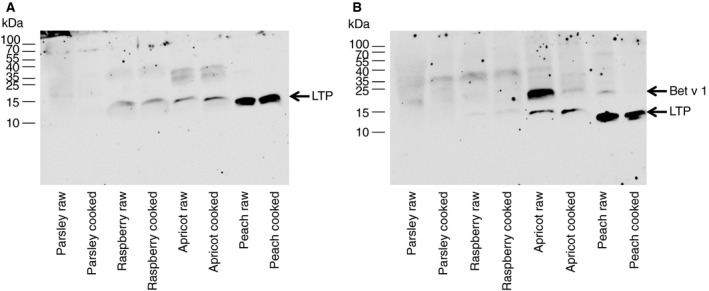
In the Mediterranean area, lipid transfer proteins (LTPs) are important causes of plant-food allergies often associated with severe allergic reactions. There, peach LTP (Pru p 3) seems to be the primary sensitizer, whereas in Central Europe, little is known about the importance of LTP sensitization. In this region, allergen extract-based diagnosis is often complicated by co-sensitization to Bet v 1, the major birch pollen allergen, its cross-reactive food allergens, and profilins. We investigated the role of LTP sensitization in Central European patients displaying strong allergic reactions to plant-derived food. Analysis of IgE reactivity revealed that ten of thirteen patients were sensitized to Pru p 3, nine to Bet v 1, and two to profilin. Our results showed that LTP sensitization represents a risk factor for severe allergic symptoms in Central Europe. Furthermore, the strong IgE reactivity detected in immunoblots of plant-food extracts indicated that Pru p 3 can be used as a marker allergen for LTP sensitization also in Central European patients.
Keywords: Pru p 3; component resolved diagnosis; food allergy; immunologic tests; lipid transfer protein.
© 2017 The Authors Allergy Published by John Wiley & Sons Ltd.
Figures
References
-
- Fernández‐Rivas M. The place of lipid transfer proteins (LTP) in the cross‐reactivity of plant foods. Rev Fr Allergol 2009;49:433‐436.
-
- Brenna O, Pompei C, Ortolani C, Pravettoni V, Farioli L, Pastorello EA. Technological processes to decrease the allergenicity of peach juice and nectar. J Agric Food Chem 2000;48:493‐497. - PubMed
-
- Asero R, Mistrello G, Roncarolo D, De Vries SC, Gautier MF, Ciurana CLF, et al. Lipid transfer protein: a pan‐allergen in plant‐derived foods that is highly resistant to pepsin digestion. Int Arch Allergy Immunol 2001;124:67‐69. - PubMed
-
- Salcedo G, Sánchez‐Monge R, Barber D, Díaz‐Perales A. Plant non‐specific lipid transfer proteins: an interface between plant defence and human allergy. Biochim. Biophys. Acta ‐ Mol. Cell Biol. Lipids 2007;1771:781‐791. - PubMed
-
- Matricardi PM, Kleine‐Tebbe J, Hoffmann HJ, Valenta R, Hilger C, Hofmaier S, et al. EAACI molecular allergology user's guide. Pediatr Allergy Immunol 2016;27:1‐250. - PubMed
MeSH terms
Substances
Grants and funding
LinkOut - more resources
Full Text Sources
Other Literature Sources
