


Association Between Lateral Posterior Tibial Slope, Body Mass Index, and ACL Injury Risk
- PMID: 28255568
- PMCID: PMC5315236
- DOI: 10.1177/2325967116688664
Association Between Lateral Posterior Tibial Slope, Body Mass Index, and ACL Injury Risk
Abstract
Background: While body mass index (BMI), a modifiable parameter, and knee morphology, a nonmodifiable parameter, have been identified as risk factors for anterior cruciate ligament (ACL) rupture, the interaction between them remains unknown. An understanding of this interaction is important because greater compressive axial force (perhaps due to greater BMI) applied to a knee that is already at an increased risk because of its geometry, such as a steep lateral posterior tibial slope, could further increase the probability of ACL injury.
Purpose: To quantify the relationship between BMI and select knee morphological parameters as potential risk factors for ACL injury.
Study design: Case-control study; Level of evidence, 3.
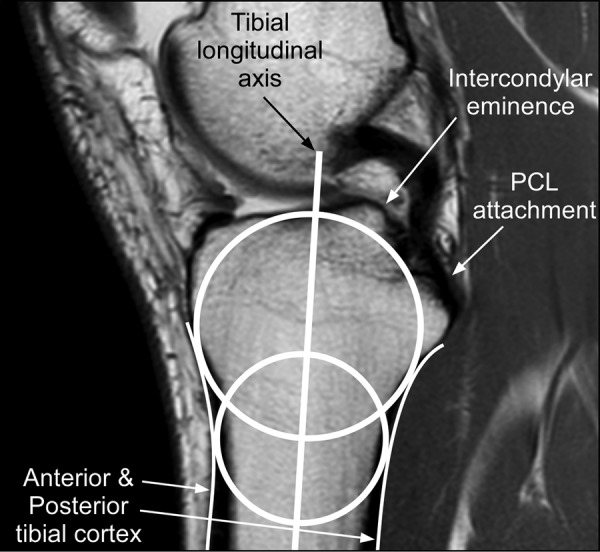
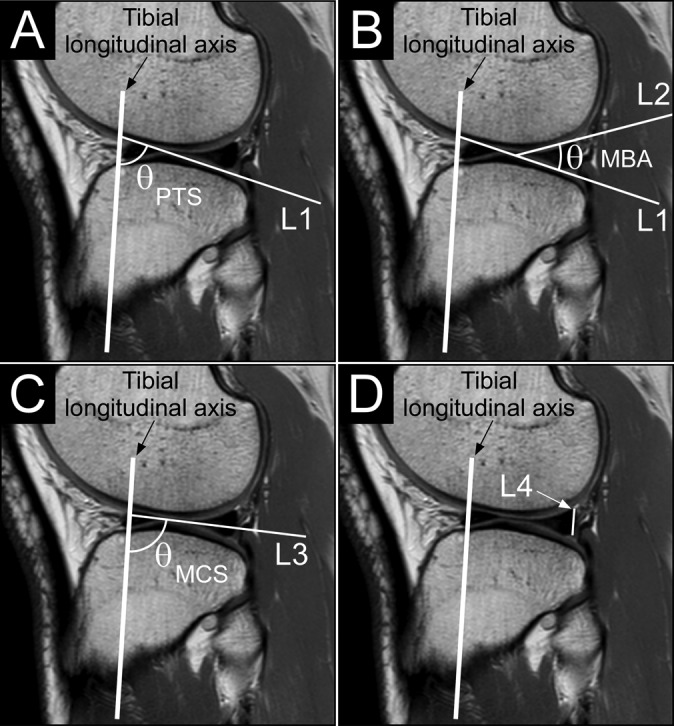
Methods: Sagittal knee magnetic resonance imaging (MRI) files from 76 ACL-injured and 42 uninjured subjects were gathered from the University of Michigan Health System's archive. The posterior tibial slope (PTS), middle cartilage slope (MCS), posterior meniscus height (PMH), and posterior meniscus bone angle (MBA) in the lateral compartment were measured using MRI. BMI was calculated from demographic data. The association between the knee structural factors, BMI, and ACL injury risk was explored using univariate and multivariate logistic regression.
Results: PTS (P = .043) and MCS (P = .037) significantly predicted ACL injury risk. As PTS and MCS increased by 1°, odds of sustaining an ACL injury increased by 12% and 13%, respectively. The multivariate logistic regression analysis, which included PTS, BMI centered around the mean (cBMI), and their interaction, showed that this interaction predicted the odds of ACL rupture (P = .050; odds ratio, 1.03). For every 1-unit increase in BMI from the average that is combined with a 1° increase in PTS, the odds of an ACL tear increased by 15%.
Conclusion: An increase in BMI was associated with increased risk of ACL tear in the presence of increased lateral posterior tibial slope. Larger values of PTS or MCS were associated with an increased risk of ACL tear.
Keywords: ACL; BMI; anatomy; injury prevention; knee; ligament.
Conflict of interest statement
One or more of the authors has declared the following potential conflict of interest or source of funding: Funding for this study was provided by United States Public Health Service grant R01 AR054821 and the University of Michigan Medical School Student Biomedical Research Program.
Figures
References
-
- Agel J, Rockwood T, Klossner D. Collegiate ACL injury rates across 15 sports: National Collegiate Athletic Association Injury Surveillance System data update (2004-2005 through 2012-2013). Clin J Sport Med. 2016;26:518–523. - PubMed
-
- Alentorn-Geli E, Mendiguchía J, Samuelsson K, et al. Prevention of anterior cruciate ligament injuries in sports. Part I: systematic review of risk factors in male athletes. Knee Surg Sports Traumatol Arthrosc. 2014;22:3–15. - PubMed
-
- Beynnon BD, Hall JS, Sturnick DR, et al. Increased slope of the lateral tibial plateau subchondral bone is associated with greater risk of noncontact ACL injury in females but not in males: a prospective cohort study with a nested, matched case-control analysis. Am J Sports Med. 2014;42:1039–1048. - PMC - PubMed
-
- Brophy RH, Wright RW, Matava MJ. Cost analysis of converting from single-bundle to double-bundle anterior cruciate ligament reconstruction. Am J Sports Med. 2009;37:683–687. - PubMed
-
- Dare DM, Fabricant PD, McCarthy MM, et al. Increased lateral tibial slope is a risk factor for pediatric anterior cruciate ligament injury: an MRI-based case-control study of 152 patients. Am J Sports Med. 2015;43:1632–1639. - PubMed
Grants and funding
LinkOut - more resources
Full Text Sources
Other Literature Sources
Research Materials
