. 2017 Nov;75(5):1133-1170.
doi: 10.1007/s00285-017-1111-z. Epub 2017 Mar 2.

Towards quantitative root hydraulic phenotyping: novel mathematical functions to calculate plant-scale hydraulic parameters from root system functional and structural traits

Affiliations

Towards quantitative root hydraulic phenotyping: novel mathematical functions to calculate plant-scale hydraulic parameters from root system functional and structural traits

F Meunier et al. J Math Biol. 2017 Nov.

Abstract

Predicting root water uptake and plant transpiration is crucial for managing plant irrigation and developing drought-tolerant root system ideotypes (i.e. ideal root systems). Today, three-dimensional structural functional models exist, which allows solving the water flow equation in the soil and in the root systems under transient conditions and in heterogeneous soils. Yet, these models rely on the full representation of the three-dimensional distribution of the root hydraulic properties, which is not always easy to access. Recently, new models able to represent this complex system without the full knowledge of the plant 3D hydraulic architecture and with a limited number of parameters have been developed. However, the estimation of the macroscopic parameters a priori still requires a numerical model and the knowledge of the full three-dimensional hydraulic architecture. The objective of this study is to provide analytical mathematical models to estimate the values of these parameters as a function of local plant general features, like the distance between laterals, the number of primaries or the ratio of radial to axial root conductances. Such functions would allow one to characterize the behaviour of a root system (as characterized by its macroscopic parameters) directly from averaged plant root traits, thereby opening new possibilities for developing quantitative ideotypes, by linking plant scale parameters to mean functional or structural properties. With its simple form, the proposed model offers the chance to perform sensitivity and optimization analyses as presented in this study.

Keywords: Hydraulic architecture; Plant-scale parameters; Root water uptake; Water flow equation in root.


Figures
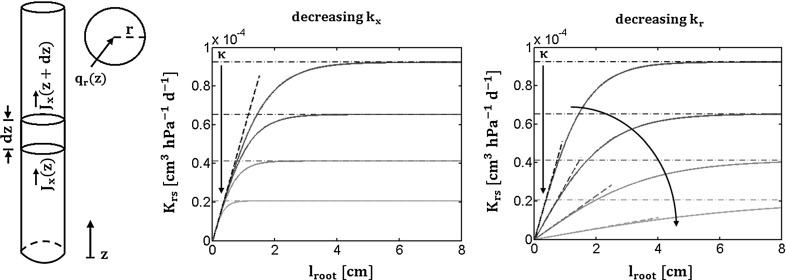
Fig. 1
Fig. 1
Continuous model for a homogeneous root: Layout of the uniform root simulated (left). The second (center) and third (right) panels illustrate the sensitivity of the Krs macroscopic parameter decreasing the axial intrinsic conductance and radial conductivity, respectively. For details, see text
Fig. 2
Fig. 2
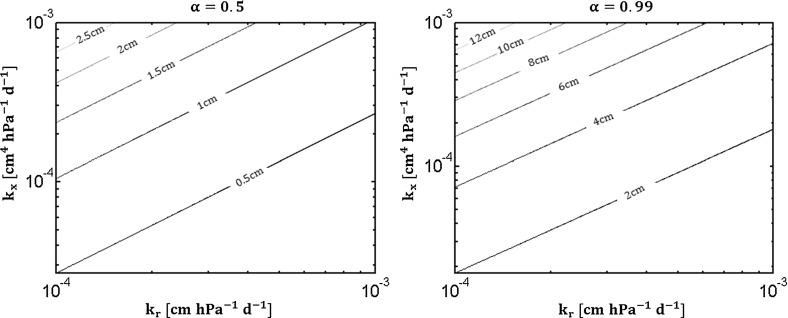
l(α): Root length necessary to reach two different α fractions of κ as a function of the root local conductivities
Fig. 3
Fig. 3
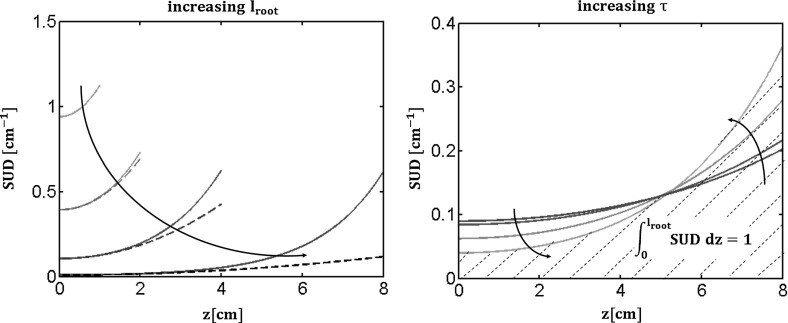
Continuous model for a homogeneous root: sensitivity analysis of the SUD macroscopic parameter according to changes in lroot and τ parameters. For details, see text
Fig. 4
Fig. 4
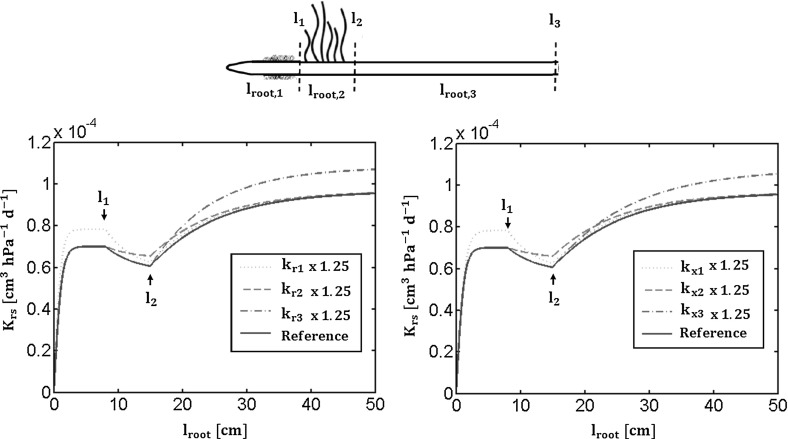
Root with heterogeneous properties: the top-drawn root is a layout of a three-compartmented root. The two subplots represent the root global conductance as a function of different local properties (dark blue solid line) and its sensitivity to the local radial (lighter blue lines, left subplot) or axial (lighter blue lines, right subplot) conductivities
Fig. 5
Fig. 5
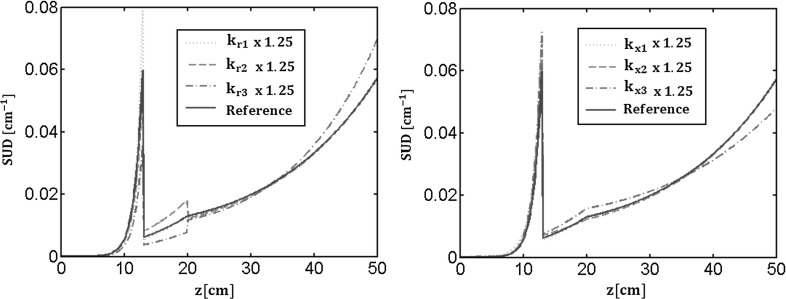
Root with heterogeneous properties: SUD along a three-zones root (dark solid line) and sensitivity of the normalized uptake to the local radial (left subplot) and axial (right subplot) hydraulic conductivities (lighter blue lines)
Fig. 6
Fig. 6
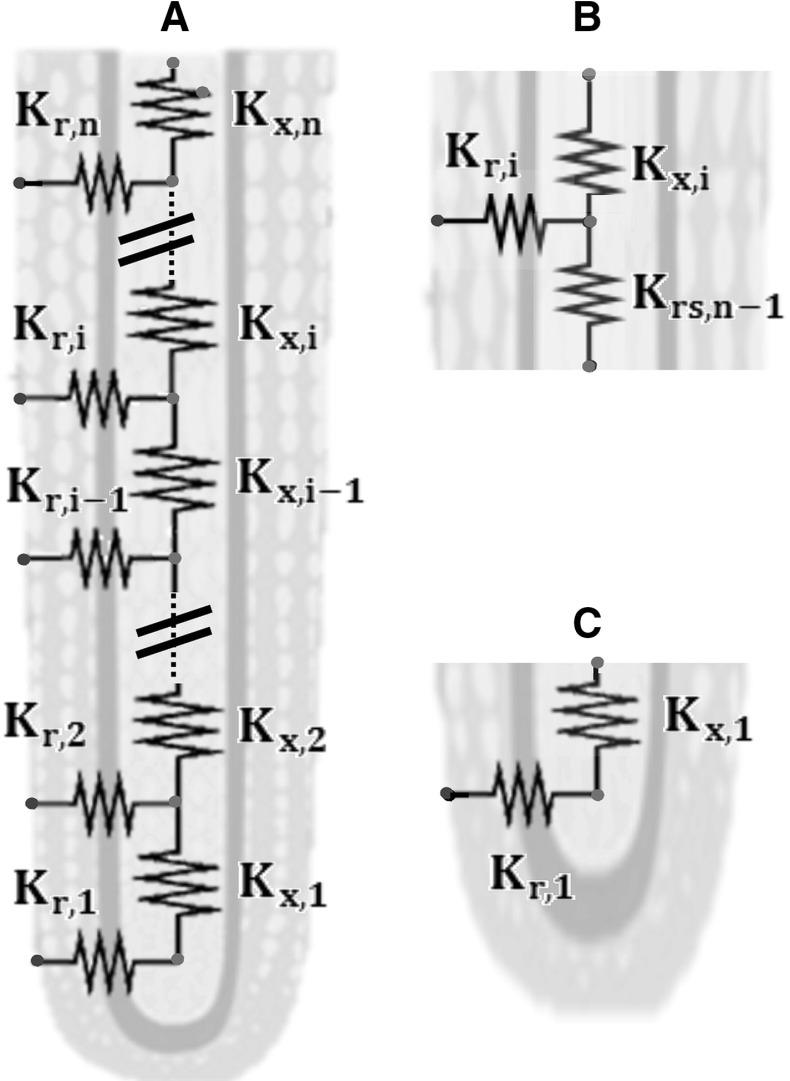
Conceptual models used for the discrete model of the homogeneous root: overview of the simple homogeneous root made of n segments (a) with details on the recurrence relationship (b) and the first recurrence (c)
Fig. 7
Fig. 7
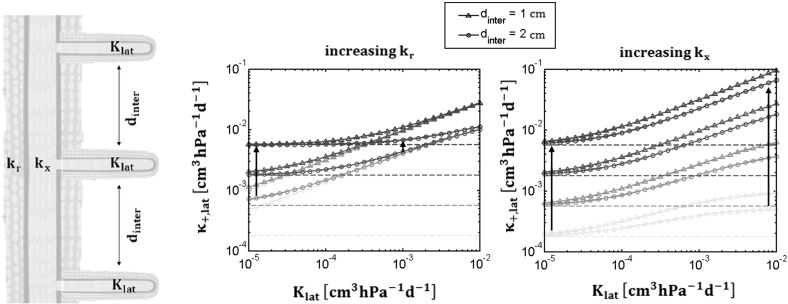
Root system with laterals: the left panel illustrate the conceptual root system. The two other subplots show κ+,lat as a function of Klat, dinter with increasing kr (left) and increasing kx (right) (from light to dark blue in both figures). The asymptotic conductance of an unbranched root system is given by the horizontal dashed lines
Fig. 8
Fig. 8
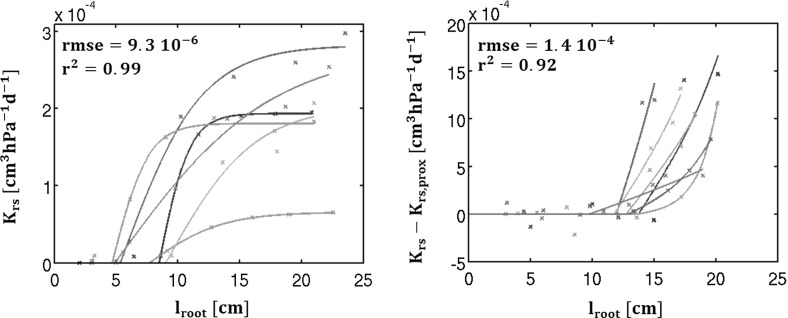
Application of the model to retrieve root local properties (experiments from Zwieniecki et al. 2002): experimental results (symbols, each colour stand for one particular root) as compared to model best fit (solid lines, with the corresponding colours) for both experiments (left panel proximal end cut, right panel distal end cut)
Fig. 9
Fig. 9
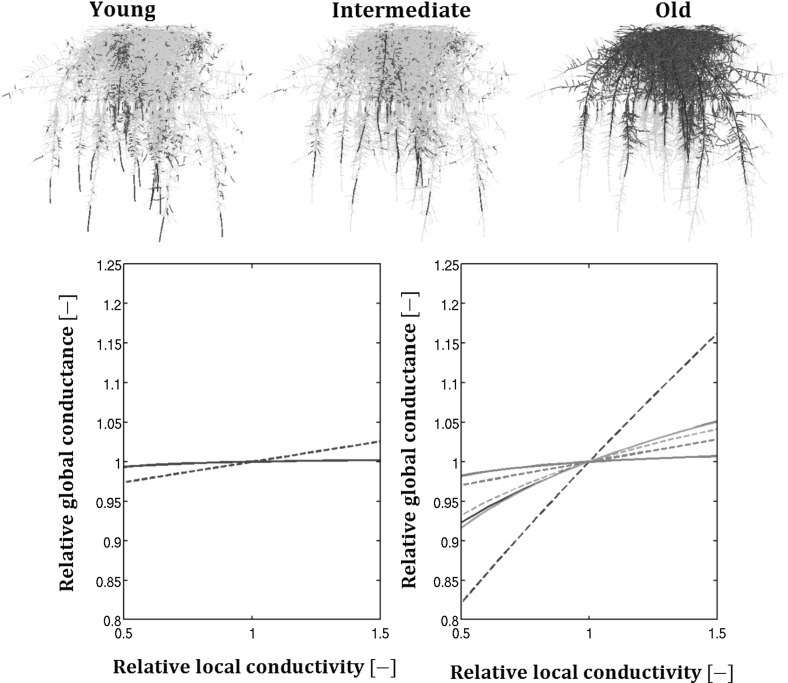
Sensitivity analysis of a maize root system: the top panels represent a maize root system architecture highlighting the different root zones: young (left), intermediate (center) and old (right) root zones for both primaries (blue) and lateral (red) roots. Bottom subplots show the effect of modifying local radial (dashed) or axial (solid) conductivities of the primary (left) or lateral (right) roots on the RS conductance in a one-by-one sensitivity analysis. The curves are coloured as a function of the segment ages and consequently their hydraulic conductivities: the darker, the younger
Fig. 10
Fig. 10
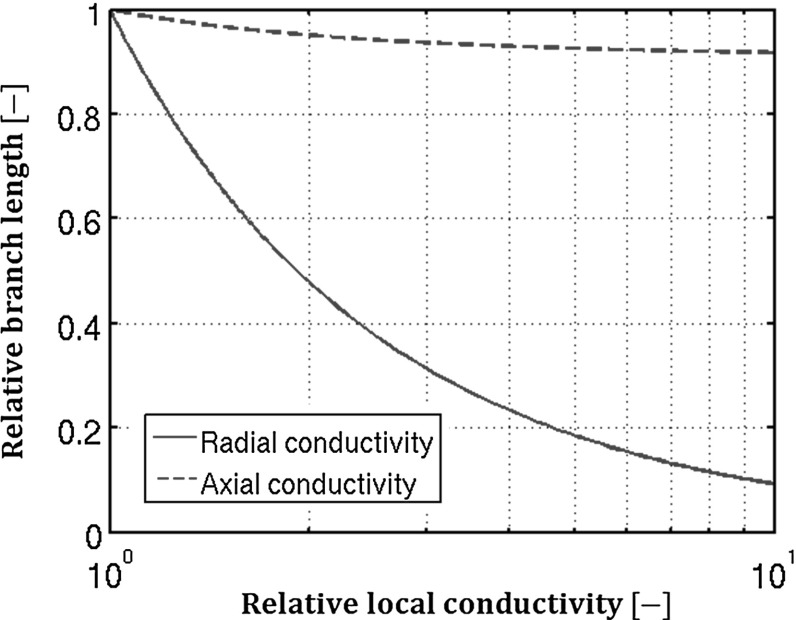
Quantitative phenotyping illustration: ratio of new to old root branch length needed to reach half the original asymptotic conductance when increasing the radial conductivity by a factor a (solid line) or the axial conductivity when increasing the axial conductivity by a factor b (dashed line). The horizontal axis represents the factor a or b
Fig. 11
Fig. 11
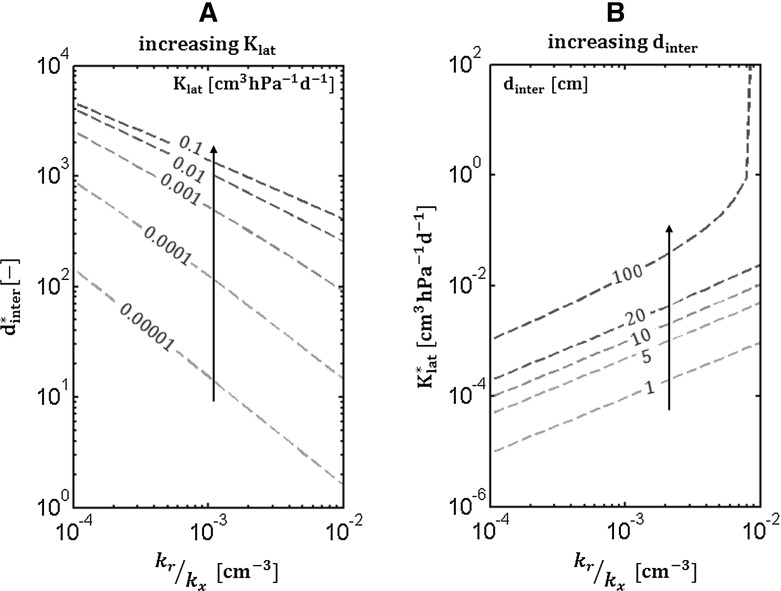
Example of relationship between architecture and hydraulics: maximal internodal distance dinter (left) and minimal Klat (right) that allows increasing the RS asymptotic conductance by 5% as compared to an unbranched root branch as a function of krkx ratio of the main root

References

    1. Alm DM, Cavelier J, Nobel PS. A finite-element model of radial and axial conductivities for individual roots: development and validation for two desert succulents. Ann Bot. 1992;69(1):87–92. doi: 10.1093/oxfordjournals.aob.a088311. - DOI
    1. Biondini M. Allometric scaling laws for water uptake by plant roots. J Theor Biol. 2008;251(1):35–59. doi: 10.1016/j.jtbi.2007.11.018. - DOI - PubMed
    1. Blum A. Plant breeding for water-limited environments. Berlin: Springer; 2010. - PubMed
    1. Cattivelli L, Rizza F, Badeck F-W, Mazzucotelli E, Mastrangelo AM, Francia E, Mar C, Tondelli A, Stanca AM. Drought tolerance improvement in crop plants: an integrated view from breeding to genomics. Field Crops Res. 2008;105(12):1–14. doi: 10.1016/j.fcr.2007.07.004. - DOI
    1. Comas LH, Becker SR, Cruz VMV, Byrne PF, Dierig DA. Root traits contributing to plant productivity under drought. Front Plant Sci. 2013;4:442. doi: 10.3389/fpls.2013.00442. - DOI - PMC - PubMed

LinkOut - more resources