


Family studies to find rare high risk variants in migraine
- PMID: 28255817
- PMCID: PMC5334193
- DOI: 10.1186/s10194-017-0729-y
Family studies to find rare high risk variants in migraine
Abstract
Introduction: Migraine has long been known as a common complex disease caused by genetic and environmental factors. The pathophysiology and the specific genetic susceptibility are poorly understood. Common variants only explain a small part of the heritability of migraine. It is thought that rare genetic variants with bigger effect size may be involved in the disease. Since migraine has a tendency to cluster in families, a family approach might be the way to find these variants. This is also indicated by identification of migraine-associated loci in classical linkage-analyses in migraine families. A single migraine study using a candidate-gene approach was performed in 2010 identifying a rare mutation in the TRESK potassium channel segregating in a large family with migraine with aura, but this finding has later become questioned. The technologies of next-generation sequencing (NGS) now provides an affordable tool to investigate the genetic variation in the entire exome or genome. The family-based study design using NGS is described in this paper. We also review family studies using NGS that have been successful in finding rare variants in other common complex diseases in order to argue the promising application of a family approach to migraine.
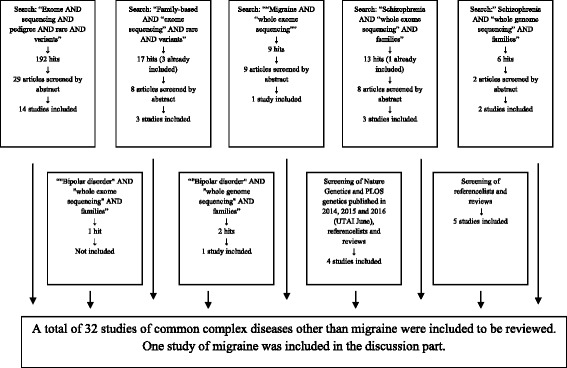
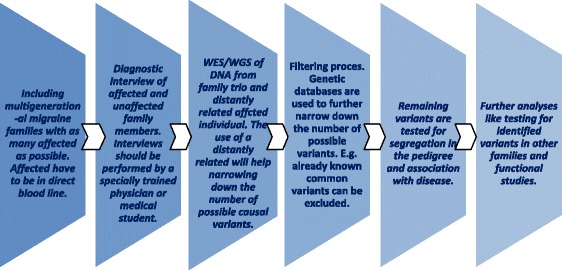
Method: PubMed was searched to find studies that looked for rare genetic variants in common complex diseases through a family-based design using NGS, excluding studies looking for de-novo mutations, or using a candidate-gene approach and studies on cancer. All issues from Nature Genetics and PLOS genetics 2014, 2015 and 2016 (UTAI June) were screened for relevant papers. Reference lists from included and other relevant papers were also searched. For the description of the family-based study design using NGS an in-house protocol was used.
Results: Thirty-two successful studies, which covered 16 different common complex diseases, were included in this paper. We also found a single migraine study. Twenty-three studies found one or a few family specific variants (less than five), while other studies found several possible variants. Not all of them were genome wide significant. Four studies performed follow-up analyses in unrelated cases and controls and calculated odds ratios that supported an association between detected variants and risk of disease. Studies of 11 diseases identified rare variants that segregated fully or to a large degree with the disease in the pedigrees.
Conclusion: It is possible to find rare high risk variants for common complex diseases through a family-based approach. One study using a family approach and NGS to find rare variants in migraine has already been published but with strong limitations. More studies are under way.
Keywords: Common complex disease; Migraine genetics; Next generation sequencing; Whole exome sequencing; Whole genome sequencing; family approach.
Figures
References
Publication types
MeSH terms
LinkOut - more resources
Full Text Sources
Other Literature Sources
Medical
Miscellaneous
