Review
. 2017 May;108(5):824-830.
doi: 10.1111/cas.13222. Epub 2017 May 18.

Extracellular vesicles as trans-genomic agents: Emerging roles in disease and evolution

Affiliations
Review

Extracellular vesicles as trans-genomic agents: Emerging roles in disease and evolution

Yumi Kawamura et al. Cancer Sci. 2017 May.

Abstract

The composition of genetic material in extracellular vesicles (EV) has sparked interest particularly in the potential for horizontal gene transfer by EV. Although the RNA content of EV has been studied extensively, few reports have examined the DNA content of EV. It is still unclear how DNA is packaged inside EV, and whether they are functional in recipient cells. In this review, we describe the biological significance of genetic material in EV and their possible impacts in recipient cells, with focus on DNA from cancer cell-derived EV and the potential roles they may play in the cancer microenvironment. Another important feature of the genetic content of EV is the presence of retrotransposon elements. In this review, we discuss the possibility of an EV-mediated mechanism for the dispersal of retrotransposon elements, and their potential involvement in the development of genetically influenced diseases. In addition to this, we discuss the potential involvement of EV in the transfer of genetic material across species, and their possible impacts in modulating genome evolution.

Keywords: Cancer microenvironment; evolution; extracellular vesicle; horizontal gene transfer; retrotransposon element.


Figures

Figure 1
Figure 1
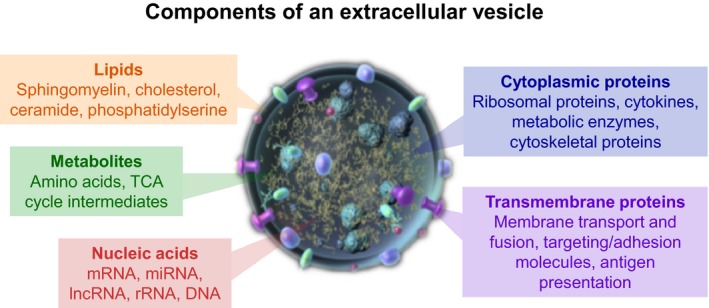
Extracellular vesicles (EV) are composed of a variety of cellular components. The EV membrane comprises lipids such as sphingomyelin, cholesterol, ceramide, and phosphatidylserine. Early metabolomic studies have shown that EV contain various amino acids and tricarboxylic acid cycle (TCA) intermediates. Nucleic acids, particularly RNA species such as mRNA and miRNA, have been consistently detected from EV. DNA has also been detected from EV; however, it is still unclear whether they are found inside the EV compartment. Extensive proteomic analyses have shown that EV are abundant in cytoplasmic and transmembrane proteins such as enzymes, cytokines, proteins for membrane transport and fusion, as well as molecules for targeting and antigen presentation. In addition to this, tetraspanins such as CD9, CD63 and CD81 are frequently identified proteins in EV, and are commonly used as markers for detecting EV.
Figure 2
Figure 2
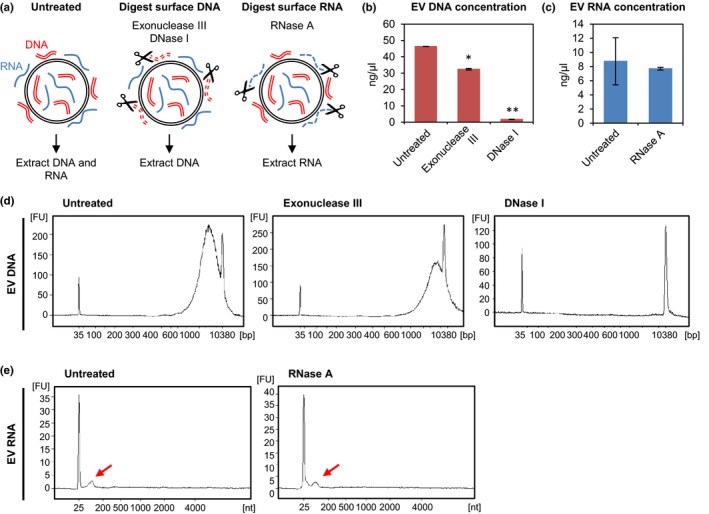
DNA is abundant on the outer surface of extracellular vesicles (EV). (a) HCT116 EV were untreated or pretreated with DNase I, Exonuclease III, or RNase A, and extracted for DNA and/or RNA. (b) Concentration of DNA from HCT116 EV was significantly reduced after treatment with Exonuclease III and DNase I. (c) RNA concentration was unchanged after RNase A treatment of EV. The size of DNA and RNA extracted was measured with Bioanalyzer (Agilent Technologies, Santa Clara, CA, USA). (d) DNA size was reduced after treatment with Exonuclease III and DNase I. (e) Detection of small RNA species in EV was unaffected by RNase A treatment, as indicated by red arrows. *P < 0.05; **P < 0.01.
Figure 3
Figure 3
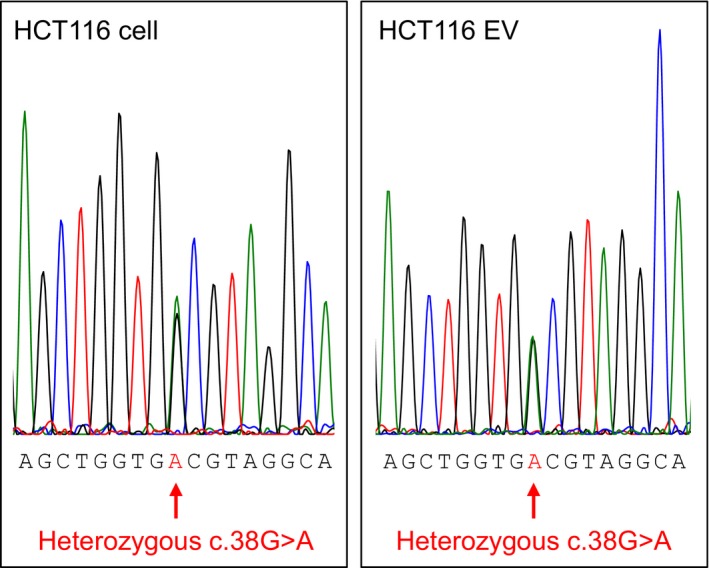
KRAS mutations are present in extracellular vesicle (EV)‐DNA from the HCT116 cell line. DNA was extracted from DNase I‐ and Exonuclease III‐untreated HCT116 EV and sequenced. Both HCT116 cell DNA and EVDNA have the heterozygous mutation in the KRAS gene, a substitution of the G nucleotide to A at c.38. However, the KRAS gene was not detected in EVDNA when HCT116 EV were pretreated with DNase I before DNA extraction.
Figure 4
Figure 4
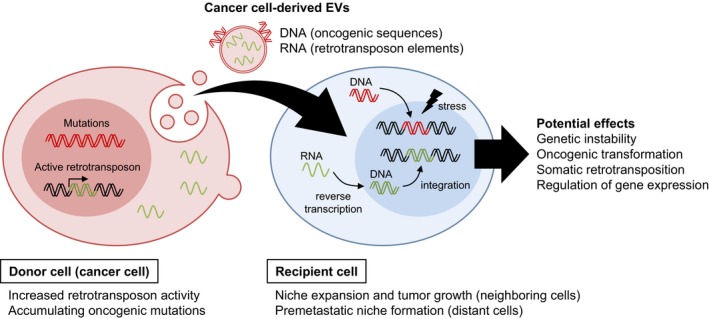
Proposed model of the horizontal transfer of genetic material by extracellular vesicles (EV) in the cancer microenvironment. Genetic material such as oncogenic sequences and retrotransposon elements can be propagated by cancer cell‐derived EV. Upon uptake at recipient cells, DNA may be integrated into the genome of the recipient cell and cause phenotypic changes leading to niche expansion and tumor growth in neighboring cells, or the generation of the premetastatic niche at distant sites.

References

    1. Lötvall J, Hill AF, Hochberg F et al Minimal experimental requirements for definition of extracellular vesicles and their functions: A position statement from the International Society for Extracellular Vesicles. J Extracell Vesicles 2014; 3: 26913. - PMC - PubMed
    1. Cocucci E, Meldolesi J. Ectosomes and exosomes: Shedding the confusion between extracellular vesicles. Trends Cell Biol 2015; 25: 364–72. - PubMed
    1. Srinivasan S, Vannberg FO, Dixon JB. Lymphatic transport of exosomes as a rapid route of information dissemination to the lymph node. Sci Rep 2016; 6: 24436. - PMC - PubMed
    1. Guescini M, Genedani S, Stocchi V, Agnati LF. Astrocytes and Glioblastoma cells release exosomes carrying mtDNA. J Neural Transm 2010; 117: 1–4. - PubMed
    1. Balaj L, Lessard R, Dai L et al Tumour microvesicles contain retrotransposon elements and amplified oncogene sequences. Nat Commun 2011; 2: 180. - PMC - PubMed

LinkOut - more resources