Review
. 2017 Mar;5(2):10.1128/microbiolspec.funk-0015-2016.
doi: 10.1128/microbiolspec.FUNK-0015-2016.

Molecular Mechanisms Regulating Cell Fusion and Heterokaryon Formation in Filamentous Fungi

Affiliations
Review

Molecular Mechanisms Regulating Cell Fusion and Heterokaryon Formation in Filamentous Fungi

Asen Daskalov et al. Microbiol Spectr. 2017 Mar.

Abstract

For the majority of fungal species, the somatic body of an individual is a network of interconnected cells sharing a common cytoplasm and organelles. This syncytial organization contributes to an efficient distribution of resources, energy, and biochemical signals. Cell fusion is a fundamental process for fungal development, colony establishment, and habitat exploitation and can occur between hyphal cells of an individual colony or between colonies of genetically distinct individuals. One outcome of cell fusion is the establishment of a stable heterokaryon, culminating in benefits for each individual via shared resources or being of critical importance for the sexual or parasexual cycle of many fungal species. However, a second outcome of cell fusion between genetically distinct strains is formation of unstable heterokaryons and the induction of a programmed cell death reaction in the heterokaryotic cells. This reaction of nonself rejection, which is termed heterokaryon (or vegetative) incompatibility, is widespread in the fungal kingdom and acts as a defense mechanism against genome exploitation and mycoparasitism. Here, we review the currently identified molecular players involved in the process of somatic cell fusion and its regulation in filamentous fungi. Thereafter, we summarize the knowledge of the molecular determinants and mechanism of heterokaryon incompatibility and place this phenomenon in the broader context of biotropic interactions and immunity.


Figures

FIGURE 1
FIGURE 1
Germling and hyphal fusion in Neurospora crassa. (A–C) Germinating spores undergo mutual attraction and fusion (A: 0 min; B: 40 min; C: 80 min). (D) Consecutive fusion events result in network formation. (E, F) Hyphal branches fuse and form cross connections. (E: DIC; F: cell walls stained with calcofluor white). Asterisks in all images indicate fusion points. Adapted from reference .
FIGURE 2
FIGURE 2
Working model of the molecular events governing germling and hyphal fusion. The signal-emitting cell releases the ligand in a pulse-like manner, probably by exocytosis. Binding of the signal molecules to their cognate receptors results in assembly and activation of the MAK-2 module at the plasma membrane. MAK-2 phosphorylates MOB-3 of the STRIPAK complex, thereby promoting nuclear entry of MAK-1. In the nucleus MAK-2 activates the transcription factor PP-1, which controls cell fusion factor-encoding genes. Activation of MAK-2 involves reactive oxygen species production by the NADPH oxidase (NOX) complex either upstream or downstream of the MAP kinase cascade. Adapted from reference .
FIGURE 3
FIGURE 3
Heterokaryosis and its possible outcomes. Genetically distinct individuals can undergo hyphal anastomosis. If there are no allelic specificity differences at het loci, a viable heterokaryon is established and nuclei (blue and brown dots) are exchanged. If allelic specificity is different between the two strains for any of the het loci, septal plugging isolates the heterokaryotic compartments and cell death occurs.
FIGURE 4
FIGURE 4
Macroscopic visualization of vegetative incompatibility. The heterokaryon (vegetative) incompatibility reaction is visualized by the occurrence of a demarcation line called “barrage” that separates the incompatible strains. (A) Evidence of barrage on wood (spalted wood) occurring in the wild. (B) Barrage reaction (black arrows) between genetically incompatible Podospora anserina strains. Identical individuals fuse without inducing allorecognition PCD and do not form the barrage (white arrows).
FIGURE 5
FIGURE 5
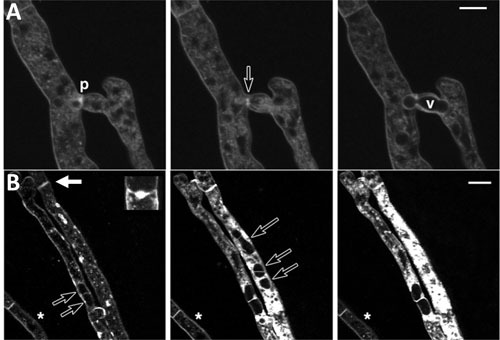
Microscopic visualization of programmed cell death during vegetative incompatibility. A time course of compatible and incompatible hyphal fusion in Neurospora crassa. The programmed cell death reaction is followed by the fluorescent vital dye (membrane staining) FM4-64. (A) Fusion between two N. crassa strains that have identical specificities at all het loci. Arrow shows the fusion pore (p). Nuclei or large vacuoles (v) are transported through the pore with the cytoplasmic flow. (B) Fusion between two N. crassa strains that differ in het specificity. Heterokaryotic cells are compartmentalized by septal plugs (solid arrow and insert). Permeabilization of the plasma membrane leads to increased cytoplasmic staining and vacuolization. Open arrows show large vacuoles within incompatible fusion cells, while the asterisk shows a nearby healthy cell. Bar = 10 μM. Adapted from reference .
FIGURE 6
FIGURE 6
Incompatibility systems and genetically identified het (vic) loci in model filamentous ascomycete species. Round-headed arrows connecting the het/vic genes indicate nonallelic HI systems, and square-headed arrows indicate allelic HI systems. Blue arrows indicate that the incompatibility reaction influences the distribution of mycoviruses that result in hypovirulence in Cryphonectria parasitica. Genes in red encode for proteins with a HET domain, and boxed genes (loci) are still not identified molecularly.
FIGURE 7
FIGURE 7
Domain organization of fungal and metazoan NLRs (NOD-like receptors) and NLR-like proteins. The heterokaryon determinants HET-E (also HET-D and HET-R as paralogues of HET-E) and VIC4 present a typical NLR-like domain organization. NLRs have a tripartite domain organization with a central nucleotide-binding and oligomerization (NOD) domain, an N-terminal effector domain, and a C-terminal sensor domain. The sensor domain can be composed of various repeated motifs (LRR or WD40, in the examples presented here) that trigger the activation of the receptors upon recognition of defined molecular cues. The recognition of the signal activates the formation by the receptors of multimeric protein platforms. The oligomerization of the receptors is mediated by the NOD domain (NACHT or NB-ARC type) in characterized cases, such as APAF-1 (the human apoptosis-controlling factor) and NLRC4 (an innate immunity receptor). Abbreviations: CARD, caspase recruitment domain; LRR, leucine rich repeats.

References

    1. Huppertz B, Bartz C, Kokozidou M. 2006. Trophoblast fusion: fusogenic proteins, syncytins and ADAMs, and other prerequisites for syncytial fusion. Micron 37:509–517. 10.1016/j.micron.2005.12.011 - DOI - PubMed
    1. Read ND, Goryachev AB, Lichius A. 2012. The mechanistic basis of self-fusion between conidial anastomosis tubes during fungal colony initiation. Fungal Biol Rev 26:1–11. 10.1016/j.fbr.2012.02.003 - DOI
    1. Richardson BE, Nowak SJ, Baylies MK. 2008. Myoblast fusion in fly and vertebrates: new genes, new processes and new perspectives. Traffic 9:1050–1059. 10.1111/j.1600-0854.2008.00756.x - DOI - PMC - PubMed
    1. Vignery A. 2008. Macrophage fusion: molecular mechanisms. Methods Mol Biol 475:149–161. 10.1007/978-1-59745-250-2_9 [PubMed] - DOI - PubMed
    1. Cadavid LF, Powell AE, Nicotra ML, Moreno M, Buss LW. 2004. An invertebrate histocompatibility complex. Genetics 167:357–365. 10.1534/genetics.167.1.357 - DOI - PMC - PubMed

Publication types