


Quantitative analysis of the therapeutic effect of magnolol on MPTP-induced mouse model of Parkinson's disease using in vivo 18F-9-fluoropropyl-(+)-dihydrotetrabenazine PET imaging
- PMID: 28257461
- PMCID: PMC5336287
- DOI: 10.1371/journal.pone.0173503
Quantitative analysis of the therapeutic effect of magnolol on MPTP-induced mouse model of Parkinson's disease using in vivo 18F-9-fluoropropyl-(+)-dihydrotetrabenazine PET imaging
Abstract
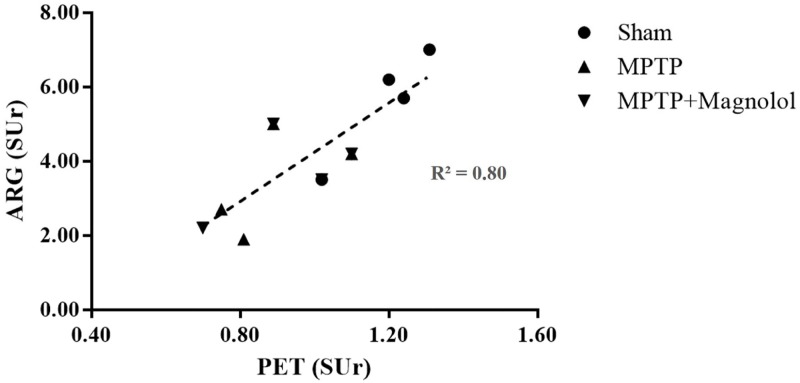
18F-9-Fluoropropyl-(+)-dihydrotetrabenazine [18F-FP-(+)-DTBZ] positron emission tomography (PET) has been shown to detect dopaminergic neuron loss associated with Parkinson's disease (PD) in human and neurotoxin-induced animal models. A polyphenol compound, magnolol, was recently proposed as having a potentially restorative effect in 1-methyl-4-phenyl-1,2,3,6-tetrahydropyridine (MPTP)- or 6-hydroxydopamine-treated animal models. In this study, 18F-FP-(+)-DTBZ PET was used to determine the therapeutic efficacy of magnolol in an MPTP-PD mouse model that was prepared by giving an intraperitoneally (i.p.) daily dose of 25 mg/kg MPTP to male C57BL/6 mice for 5 consecutive days. Twenty-minute static 18F-FP-(+)-DTBZ PET scans were performed before MPTP treatment and 5 days after the termination of MPTP treatment to set up the baseline control. Half of the MPTP-treated mice then received a daily dose of magnolol (10 mg/kg dissolved in corn oil, i.p.) for 6 days. 18F-FP-(+)-DTBZ PET imaging was performed the day after the final treatment. All 18F-FP-(+)-DTBZ PET images were analysed and the specific uptake ratio (SUr) was calculated. Ex vivo autoradiography (ARG) and corresponding immunohistochemistry (IHC) studies were conducted to confirm the distribution of dopaminergic terminals in the striatum. The striatal SUr ratios of 18F-FP-(+)-DTBZ PET images for the Sham, the MPTP, and the MPTP + Magnolol-treated groups were 1.25 ± 0.05, 0.75 ± 0.06, and 1.00 ± 0.11, respectively (n = 4 for each group). The ex vivo 18F-FP-(+)-DTBZ ARG and IHC results correlated favourably with the PET imaging results. 18F-FP-(+)-DTBZ PET imaging suggested that magnolol post-treatment may reverse the neuronal damage in the MPTP-lesioned PD mice. In vivo imaging of the striatal vesicular monoamine transporter type 2 (VMAT2) distribution using 18F-FP-(+)-DTBZ animal PET is a useful method to evaluate the efficacy of therapeutic drugs i.e., magnolol, for the management of PD.
Conflict of interest statement
Figures



References
-
- Gelb DJ, Oliver E, Gilman S (1999) Diagnostic criteria for Parkinson disease. Arch Neurol 56: 33–39. - PubMed
-
- Jenner P, Olanow CW (2006) The pathogenesis of cell death in Parkinson’s disease. Neurology 66: S24–S36. - PubMed
-
- Ungerstedt U (1968) 6-Hydroxy-dopamine induced degeneration of central monoamine neurons. Eur J Pharmacol 5: 107–110. - PubMed
-
- Schwarting RK, Huston JP (1996) Unilateral 6-hydroxydopamine lesions of meso-striatal dopamine neurons and their physiological sequelae. Prog Neurobiol 49: 215–266. - PubMed
MeSH terms
Substances
LinkOut - more resources
Full Text Sources
Other Literature Sources
Medical
Molecular Biology Databases
