. 2017 Mar 31;83(8):e03321-16.
doi: 10.1128/AEM.03321-16. Print 2017 Apr 15.

Quantifying the Importance of the Rare Biosphere for Microbial Community Response to Organic Pollutants in a Freshwater Ecosystem

Affiliations

Quantifying the Importance of the Rare Biosphere for Microbial Community Response to Organic Pollutants in a Freshwater Ecosystem

Yuanqi Wang et al. Appl Environ Microbiol. .

Abstract

A single liter of water contains hundreds, if not thousands, of bacterial and archaeal species, each of which typically makes up a very small fraction of the total microbial community (<0.1%), the so-called "rare biosphere." How often, and via what mechanisms, e.g., clonal amplification versus horizontal gene transfer, the rare taxa and genes contribute to microbial community response to environmental perturbations represent important unanswered questions toward better understanding the value and modeling of microbial diversity. We tested whether rare species frequently responded to changing environmental conditions by establishing 20-liter planktonic mesocosms with water from Lake Lanier (Georgia, USA) and perturbing them with organic compounds that are rarely detected in the lake, including 2,4-dichlorophenoxyacetic acid (2,4-D), 4-nitrophenol (4-NP), and caffeine. The populations of the degraders of these compounds were initially below the detection limit of quantitative PCR (qPCR) or metagenomic sequencing methods, but they increased substantially in abundance after perturbation. Sequencing of several degraders (isolates) and time-series metagenomic data sets revealed distinct cooccurring alleles of degradation genes, frequently carried on transmissible plasmids, especially for the 2,4-D mesocosms, and distinct species dominating the post-enrichment microbial communities from each replicated mesocosm. This diversity of species and genes also underlies distinct degradation profiles among replicated mesocosms. Collectively, these results supported the hypothesis that the rare biosphere can serve as a genetic reservoir, which can be frequently missed by metagenomics but enables community response to changing environmental conditions caused by organic pollutants, and they provided insights into the size of the pool of rare genes and species.IMPORTANCE A single liter of water or gram of soil contains hundreds of low-abundance bacterial and archaeal species, the so called rare biosphere. The value of this astonishing biodiversity for ecosystem functioning remains poorly understood, primarily due to the fact that microbial community analysis frequently focuses on abundant organisms. Using a combination of culture-dependent and culture-independent (metagenomics) techniques, we showed that rare taxa and genes commonly contribute to the microbial community response to organic pollutants. Our findings should have implications for future studies that aim to study the role of rare species in environmental processes, including environmental bioremediation efforts of oil spills or other contaminants.

Keywords: biodegradation; community response; metagenomics; organic contaminants; rare biosphere.


Figures

FIG 1
FIG 1
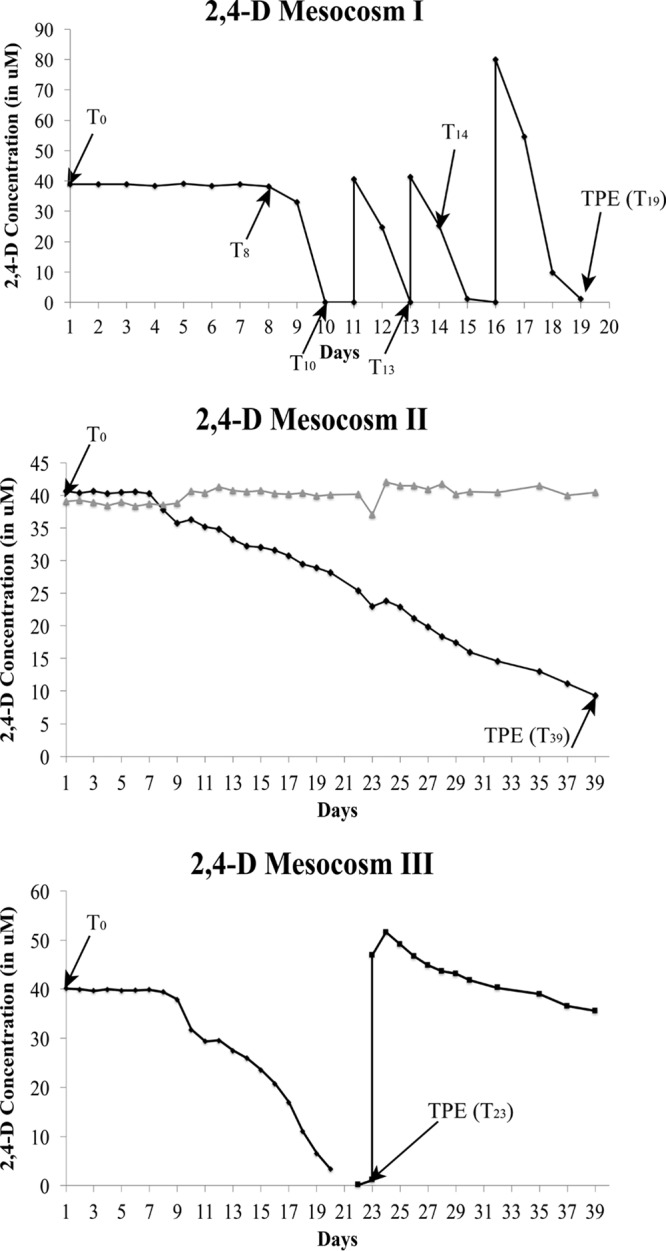
Degradation profiles of the triplicate 2,4-D mesocosms. The black line in each figure indicates the 2,4-D concentration over time, and the gray line represents the abiotic (negative) control (2,4-D in sterilized lake water). The black arrows indicate the time points at which DNA was extracted. The mesocosms were run in parallel, using the same mixed (homogenized) water as inoculum; hence, only one abiotic control was employed for all three mesocosms.
FIG 2
FIG 2
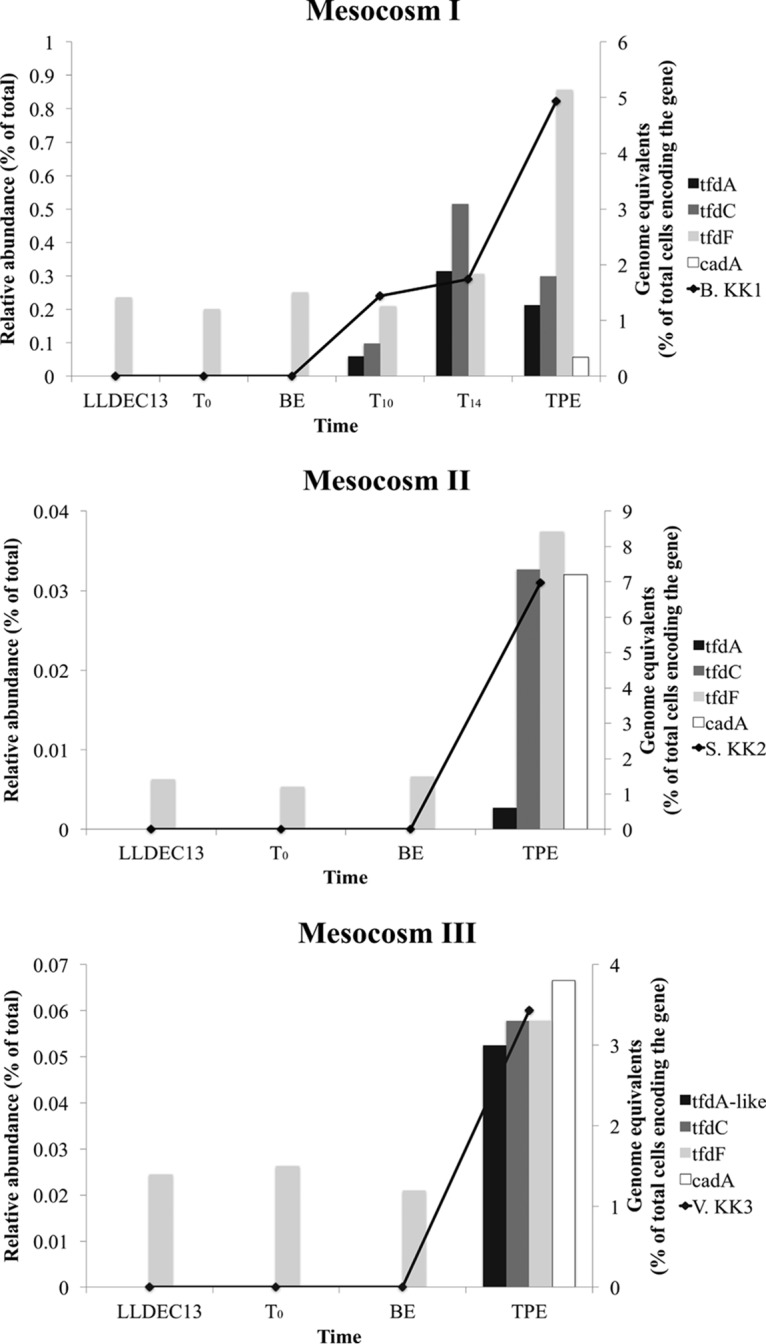
Relative abundance of 2,4-D degraders and genes from each mesocosm. The abundance of 2,4-D degraders was calculated as the fraction of total metagenomic reads mapping on the corresponding genome sequences (identity ≥99% and length ≥80 bp) in each metagenomic data set (black line, primary y axis). The abundance of 2,4-D genes was measured by genome equivalents, i.e., the percentage of total cells encoding the gene (bars, secondary y axis). BE, bottle effect; TPE, time post-enrichment, i.e., time for the last sampling time point from which the degraders were also isolated.
FIG 3
FIG 3
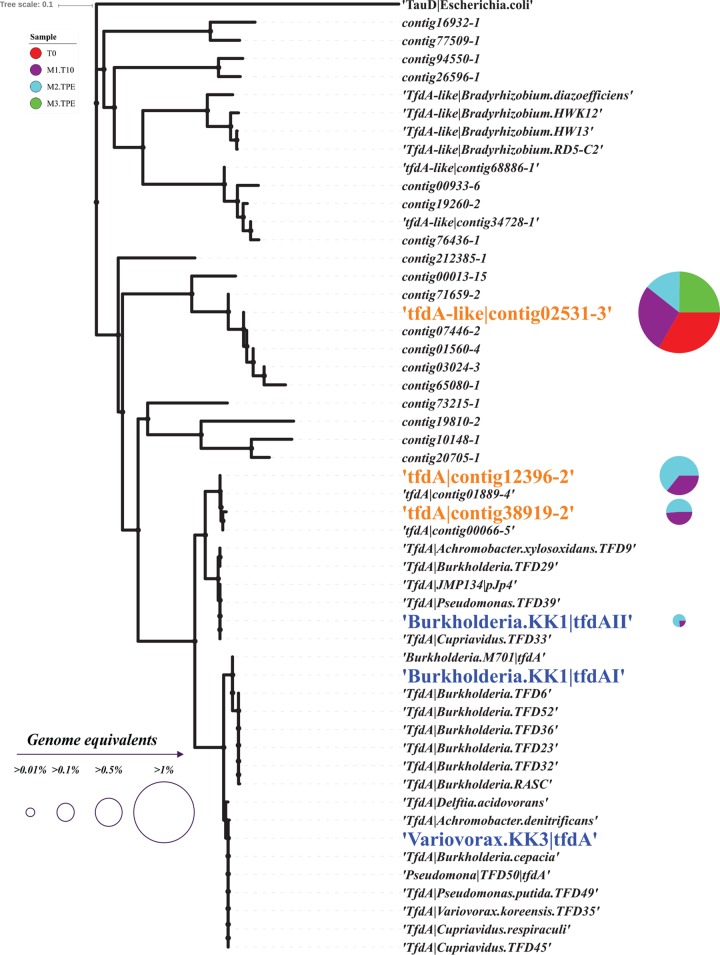
Phylogeny of all tfdA and tfdA-like genes recovered from the three 2,4-D mesocosms and isolates. The tree was built using the neighbor-joining method as implemented in Geneious (version 8.1.8) based on an amino acid sequence alignment. The abundance (genome equivalents) of tfdA-like|contig02531-3 (originally identified from mesocosm III in TPE [T = 23 days] sample), tfdA|contig12396-2 (originally identified from mesocosm II in TPE [T = 39 days] sample), and tfdA|contig38919-2 (originally identified from mesocosm I at T = 10 days sample), as well as tfdA genes recovered in the isolate genomes are represented by a pie chart next to the gene name. Blue denotes tfdA genes contained in our isolates, and orange denotes tfdA or tfdA-like genes identified from metagenomes. Note that only one tfdA gene of strain KK1 can be detected in M1.T10 and M2.TPE metagenomes.
FIG 4
FIG 4
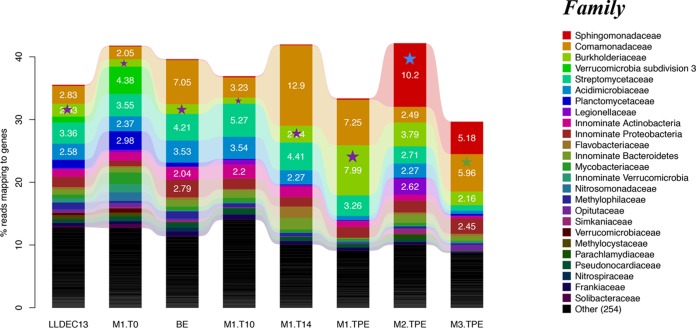
Shifts in microbial community composition over time in the 2,4-D mesocosms. Results shown are based on total 16S rRNA gene-containing reads recovered from each metagenomic data sets and classified at the family level. Only taxa that recruited more than >2% of total reads are shown; white numbers represent relative abundance. The data sets are as follows: original lake (LLDEC13), 2,4-D mesocosm I at T = 0, 10, 14, and 19 days samples (M1.T0, M1.T10, M1.T14, and M1.TPE, respectively); 2,4-D mesocosm II at TPE (T = 39 days) sample (M2.TPE); 2,4-D mesocosm III at TPE (T = 23 days) sample (M3.TPE); bottle-effect metagenome (BE). The purple star denotes the family that the Burkholderia sp. KK1 isolate was assignable to (100% 16S rRNA gene identity). The blue and green stars denote the family that the Sphingopyxis sp. strain KK2 and the Variovorax sp. strain KK3 isolates were assignable to (99% and 100% 16S rRNA gene identity, respectively).
FIG 5
FIG 5
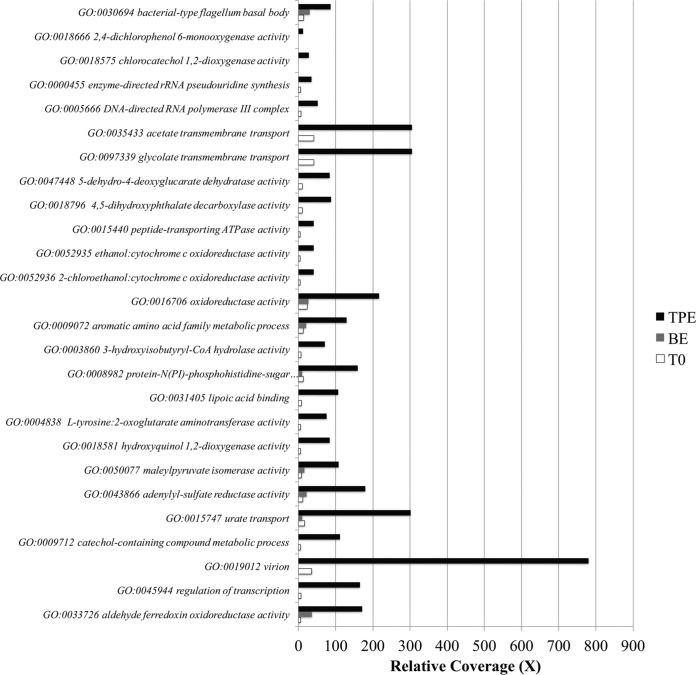
Microbial community gene content shifts in 2,4-D mesocosm I. The relative coverage (x axis) of genes (y axis) was calculated by summing the length of all reads mapping on the gene (a minimum cutoff for a match of ≥80 bp alignment length and ≥97% nucleotide identity was used) and dividing it by the length of the gene sequence. The most differentially abundant genes between T0 (T = 0) and TPE (T = 19 days) metagenomes were grouped by their GO terms and are shown on the graph. The GO accession number is also provided, followed by the GO description. BE, bottle-effect metagenome (control incubation with no 2,4-D added); CoA, coenzyme A.

References

    1. Torsvik V, Goksoyr J, Daae FL. 1990. High diversity in DNA of soil bacteria. Appl Environ Microbiol 56:782–787. - PMC - PubMed
    1. Whitman WB, Coleman DC, Wiebe WJ. 1998. Prokaryotes: the unseen majority. Proc Natl Acad Sci U S A 95:6578–6583. doi:10.1073/pnas.95.12.6578. - DOI - PMC - PubMed
    1. Curtis TP, Sloan WT, Scannell JW. 2002. Estimating prokaryotic diversity and its limits. Proc Natl Acad Sci U S A 99:10494–10499. doi:10.1073/pnas.142680199. - DOI - PMC - PubMed
    1. Nelson KE, Paulsen IT, Heidelberg JF, Fraser CM. 2000. Status of genome projects for nonpathogenic bacteria and archaea. Nat Biotechnol 18:1049–1054. doi:10.1038/80235. - DOI - PubMed
    1. Konstantinidis KT, Tiedje JM. 2005. Genomic insights that advance the species definition for prokaryotes. Proc Natl Acad Sci U S A 102:2567–2572. doi:10.1073/pnas.0409727102. - DOI - PMC - PubMed

Publication types

MeSH terms

LinkOut - more resources