


Viewing Siglecs through the lens of tumor immunology
- PMID: 28258691
- PMCID: PMC5860639
- DOI: 10.1111/imr.12526
Viewing Siglecs through the lens of tumor immunology
Abstract
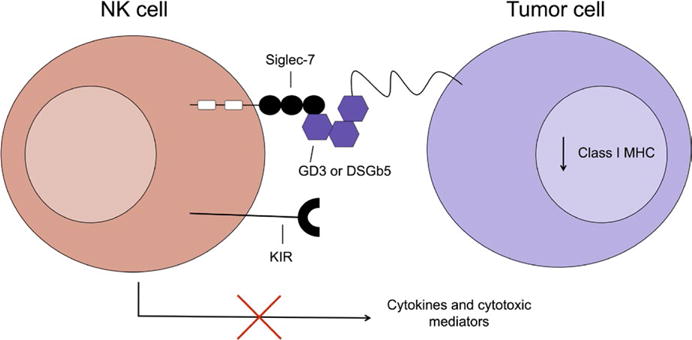
Many Siglecs function as inhibitory receptors on innate and adaptive immune cells and may contribute to the attenuation of immune responses to tumors. Siglec 9 on neutrophils and Siglec 7 on NK cells are prominent examples of inhibitory Siglecs that can potentially dampen anti-tumor immunity. CD169 is a Siglec that may function as an adhesion molecule and a facilitator of the recognition and internalization of sialic acid decorated apoptotic bodies and exosomes derived from tumors. It can potentially contribute to both the attenuation as well as the facilitation of anti-tumor immunity. Siglecs have been best studied in the tumor context in animal models of cancer. Modulators of Siglec function are likely to be developed and investigated clinically in a cancer context over the next few years.
Keywords: Siglec; cancer/tumor immunology; hypersialylation; immune evasion; immune regulation; inhibitory receptor; sialic acid.
© 2017 John Wiley & Sons A/S. Published by John Wiley & Sons Ltd.
Conflict of interest statement
The authors have no conflicts of interest.
Figures



References
-
- Varki A, Schauer R. Sialic Acids. In: Varki A, Cummings RD, Esko JD, Freeze HH, Stanley P, Bertozzi CR, Hart GR, Etzler ME, editors. Essentials of Glycobiology. Cold Spring Harbor, NY: Cold Spring Harbor Press; 2009. pp. 199–218. Chapter 14. - PubMed
Publication types
MeSH terms
Substances
Grants and funding
LinkOut - more resources
Full Text Sources
Other Literature Sources
Research Materials
