


Factors associated with spontaneous abortion: a cross-sectional study of Chinese populations
- PMID: 28259178
- PMCID: PMC5336639
- DOI: 10.1186/s12978-017-0297-2
Factors associated with spontaneous abortion: a cross-sectional study of Chinese populations
Abstract
Background: Spontaneous abortion (SA) is one of the prevalent negative reproductive outcomes among women around the world, which is a great challenge faced by maternal health promotion. The present study is aimed to explore the association between SA and socioeconomic status (SES) and provides reference for policy makers to improve strategies on maternal health promotion.
Methods: A cross-sectional analysis was conducted with baseline data from a large-scale population-based cohort study of 0.5 million people from 10 geographically diverse areas of China recruited from 2004 to 2008. The study collected data from 84,531 women aged 35-45 years old in the baseline survey of China Kadoorie Biobank. Participants were interviewed using a standardized questionnaire, and information on demographic-socioeconomic as well as reproductive health status was collected. Odds ratios (OR) with 95% CI, estimated by a multistep logistic regression, were used to approximate the associations between SA occurrence and characteristics of SES. A stratification analysis was also applied to find out how SES influenced women's reproductive health outcomes differently between rural and urban areas. The model was adjusted for age at study date, tea consumption, alcohol consumption, cigarette smoking, and number of induced abortion.
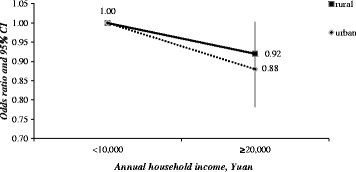
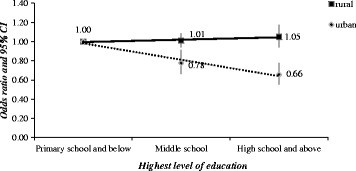
Results: The risk of SA in rural was 1.68 times greater than in urban (AOR = 1.68, 95%CI: 1.54-1.84). Women with high income had a decreased risk of SA when compared with that of women with low income (AOR = 0.90, 95%CI: 0.84-0.97). Compared with women in low educational attainment, women in higher educational attainment had a lower prevalence of SA (AOR = 0.90, 95%CI: 0.82-0.98). The risk of SA only reduced in factory worker (AOR = 0.59, 95%CI: 0.53-0.66) and professional worker (AOR = 0.75, 95%CI: 0.66-0.84) compared with agriculture and related workers. After stratifying by rural/urban, the association between income and SA in urban (AOR = 0.88, 95%CI: 0.78-0.99) was stronger than that in rural (AOR = 0.92, 95%CI: 0.84-1.00). Association between education and SA was found in urban (AOR = 0.66, 95%CI: 0.55-0.78) but not in rural (AOR = 1.05, 95%CI: 0.34-1.17), and there was no difference on how occupation impacted SA among women between the two subgroups.
Conclusions: Generally women with lower SES status had a higher risk of SA. Lower income and educational attainment were inversely associated with the risk of SA. Women with agricultural and related work had a significantly higher prevalence of SA. Interventions could be targeted more on women with low SES to increase both health profits as well as economic gains for health programs.
Keywords: China Kadoorie Biobank; Maternal health; Socioeconomic status; Spontaneous abortion.
Figures
Similar articles
-
Association between socioeconomic status and fertility among adolescents aged 15 to 19: an analysis of the 2013/2014 Zambia Demographic Health Survey (ZDHS).Reprod Health. 2021 Sep 10;18(1):182. doi: 10.1186/s12978-021-01230-8. Reprod Health. 2021. PMID: 34507589 Free PMC article.
-
Prevalence and socio-demographic correlates of stunting and thinness among Pakistani primary school children.BMC Public Health. 2011 Oct 11;11:790. doi: 10.1186/1471-2458-11-790. BMC Public Health. 2011. PMID: 21988799 Free PMC article.
-
Sex differences in the association between socioeconomic status and diabetes prevalence and incidence in China: cross-sectional and prospective studies of 0.5 million adults.Diabetologia. 2019 Aug;62(8):1420-1429. doi: 10.1007/s00125-019-4896-z. Epub 2019 May 31. Diabetologia. 2019. PMID: 31152186 Free PMC article.
-
Folic acid supplementation and malaria susceptibility and severity among people taking antifolate antimalarial drugs in endemic areas.Cochrane Database Syst Rev. 2022 Feb 1;2(2022):CD014217. doi: 10.1002/14651858.CD014217. Cochrane Database Syst Rev. 2022. PMID: 36321557 Free PMC article.
-
Socioeconomic studies of schistosomiasis in Brazil: a review.Acta Trop. 2008 Nov-Dec;108(2-3):194-201. doi: 10.1016/j.actatropica.2008.07.002. Epub 2008 Jul 23. Acta Trop. 2008. PMID: 18694715 Free PMC article. Review.
Cited by
-
Non-Motherhood between Obligation and Choice: Statistical Analysis Based on Permutation Tests of Spontaneous and Induced Abortion Rates in the Italian Context.Healthcare (Basel). 2022 Aug 11;10(8):1514. doi: 10.3390/healthcare10081514. Healthcare (Basel). 2022. PMID: 36011171 Free PMC article.
-
Vaginal bleeding during pregnancy: a retrospective cohort study assessing maternal and perinatal outcomes.J Int Med Res. 2025 Feb;53(2):3000605251315349. doi: 10.1177/03000605251315349. J Int Med Res. 2025. PMID: 39921410 Free PMC article.
-
Prevalence and Factors of Pregnancy Termination Among Reproductive-Aged Women: Evidence from the Bangladesh Demographic and Health Survey.Healthcare (Basel). 2024 Oct 25;12(21):2130. doi: 10.3390/healthcare12212130. Healthcare (Basel). 2024. PMID: 39517342 Free PMC article.
-
A Cross-Sectional Epidemiological Study of Abortions in a Rural Area of Delhi.Indian J Community Med. 2025 Jan-Feb;50(1):147-153. doi: 10.4103/ijcm.ijcm_558_23. Epub 2025 Jan 23. Indian J Community Med. 2025. PMID: 40124829 Free PMC article.
-
Understanding Miscarriage Prevalence and Risk Factors: Insights from Women in Jordan.Medicina (Kaunas). 2024 Jun 26;60(7):1044. doi: 10.3390/medicina60071044. Medicina (Kaunas). 2024. PMID: 39064473 Free PMC article.
References
-
- Zeng LX, Yan H, Chen ZJ. Study on the current status and risk factors of spontaneous abortion of women at reproductive age in rural areas of Xianyang district, Shaanxi province (in Chinese) Chin J Epidemiol. 2007;28:19–23. - PubMed
-
- Fan X, et al. Epidemiological features and risk factors of spontaneous abortion among rural Tibetan women at childbearing age (in Chinese) Chin J Epidemiol. 2014;35:401–5. - PubMed
MeSH terms
Grants and funding
LinkOut - more resources
Full Text Sources
Other Literature Sources
Medical
