


Long-Term Outcomes of Salvage Stereotactic Ablative Radiotherapy for Isolated Lung Recurrence of Non-Small Cell Lung Cancer: A Phase II Clinical Trial
- PMID: 28259750
- PMCID: PMC5881570
- DOI: 10.1016/j.jtho.2017.02.018
Long-Term Outcomes of Salvage Stereotactic Ablative Radiotherapy for Isolated Lung Recurrence of Non-Small Cell Lung Cancer: A Phase II Clinical Trial
Abstract
Objectives: Our goal was to evaluate stereotactic ablative radiotherapy (SABR) as a salvage option for isolated recurrence of NSCLC in the lung parenchyma after definitive treatment of stage I to III disease.
Methods: Patients who had histologically confirmed, positron emission tomography-staged, isolated NSCLC recurring locally or metastasis in the lung parenchyma (≤3 cm, suitable for SABR) after previous definitive treatment were prospectively enrolled in this trial and treated with volumetric, image-guided SABR to 50 Gy in four fractions. Patients were then followed with computed tomography or positron emission tomography/computed tomography. Primary end points included the pattern of failure after salvage SABR, overall survival (OS), and progression-free survival (PFS).
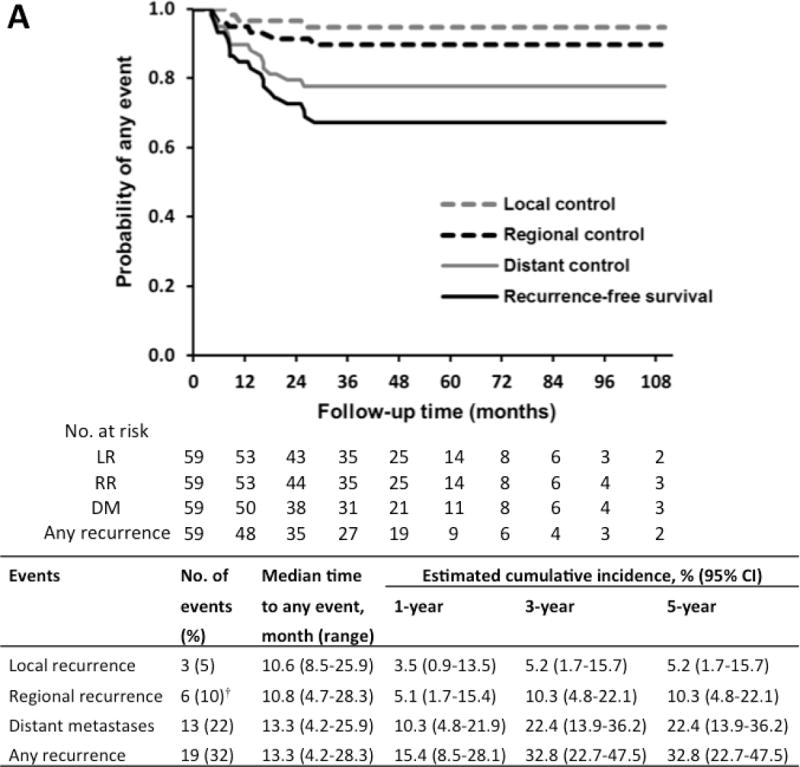
Results: Fifty-nine patients with recurrent disease were treated with salvage SABR. The median age was 70 years (range 45-86 years), and the median follow-up time after salvage SABR was 58.3 months. Re-recurrence after salvage SABR developed in 19 patients (32%). Measuring from the date of salvage SABR, the estimated 5-year rates of local, regional, and distant failure were 5.2%, 10.3%, and 22.4%, respectively; the estimated PFS was 46.2% at 3 years and 41.1% at 5 years; and the OS rates were 63.5% at 3 years and 56.5% at 5 years. A high post-SABR neutrophil-to-lymphocyte ratio was found to predict poor survival. Grade 3 treatment-related adverse events developed in three patients (5%). No patient had a grade 4 or 5 event.
Conclusion: Our study showed that salvage SABR provides excellent 5-year OS, local control, and PFS rates with minimal toxicity for patients with isolated NSCLC recurrence in the lung parenchyma. These results are striking and comparable to historically reported outcomes of patients with primary early-stage NSCLC treated with definitive SABR. SABR appears to be a very effective and safe salvage option for patients with isolated lung parenchyma recurrent disease after definitive treatment and should be considered along with surgery as a potential first-line option for patients with local lung parenchymal recurrent disease.
Trial registration: ClinicalTrials.gov NCT00489008.
Keywords: Non–small cell lung cancer; Pattern of failure; Recurrent lung cancer; Stereotactic ablative radiotherapy; Toxicity.
Copyright © 2017 International Association for the Study of Lung Cancer. Published by Elsevier Inc. All rights reserved.
Conflict of interest statement
Conflicts of interest: None declared.
Figures


Comment in
-
Challenging Situations for Lung SBRT.J Thorac Oncol. 2017 Jun;12(6):916-918. doi: 10.1016/j.jtho.2017.04.007. J Thorac Oncol. 2017. PMID: 28532561 No abstract available.
-
If at First You Don't Succeed-Stereotactic Body Radiation Therapy for Recurrent Non-Small Cell Lung Cancer.Int J Radiat Oncol Biol Phys. 2022 Sep 1;114(1):5-9. doi: 10.1016/j.ijrobp.2022.04.010. Int J Radiat Oncol Biol Phys. 2022. PMID: 35964631 No abstract available.
References
-
- Bradley JD, Paulus R, Komaki R, et al. Standard-dose versus high-dose conformal radiotherapy with concurrent and consolidation carboplatin plus paclitaxel with or without cetuximab for patients with stage IIIA or IIIB non-small-cell lung cancer (RTOG 0617): a randomised, two-by-two factorial phase 3 study. Lancet Oncol. 2015;16:187–199. - PMC - PubMed
-
- Senthi S, Lagerwaard FJ, Haasbeek CJ, et al. Patterns of disease recurrence after stereotactic ablative radiotherapy for early stage non-small-cell lung cancer: a retrospective analysis. The Lancet Oncology. 2012;13:802–809. - PubMed
-
- Hishida T, Yoshida J, Aokage K, et al. Postoperative oligo-recurrence of non-small-cell lung cancer: clinical features and survival. Eur J Cardiothorac Surg. 2016;49:847–853. - PubMed
-
- Johnson BE. Second lung cancers in patients after treatment for an initial lung cancer. Journal of the National Cancer Institute. 1998;90:1335–1345. - PubMed
Publication types
MeSH terms
Associated data
Grants and funding
LinkOut - more resources
Full Text Sources
Other Literature Sources
Medical
