Review
. 2017 Apr;15(4):1943-1951.
doi: 10.3892/mmr.2017.6248. Epub 2017 Feb 24.

Role of HLA-B27 in the pathogenesis of ankylosing spondylitis (Review)

Affiliations
Review

Role of HLA-B27 in the pathogenesis of ankylosing spondylitis (Review)

Bin Chen et al. Mol Med Rep. 2017 Apr.

Abstract

The study of ankylosing spondylitis (AS) has made significant progress over the last decade. Genome-wide association studies have identified and further substantiated the role of susceptibility genes outside the major histocompatibility complex locus. However, human leukocyte antigen (HLA)‑B27 has been suggested to be important in the pathogenesis of AS, contributing to ~20.1% of AS heritability. The current review will present the classical and non‑classical forms of HLA-B27, as well as their pathogenic roles, and further discuss the hypotheses regarding the potential pathogenesis of AS. In addition, the association between the pathogenic role of HLA‑B27 and inflammatory indexes, including the interleukin-23/‑17 axis will be investigated to provide novel insights into the pathogenesis of AS. The aim of the present review is to provide an update of the current research into the pathogenesis of AS, and provide a comprehensive description of the pathogenic role of HLA-B27 in AS.


Figures
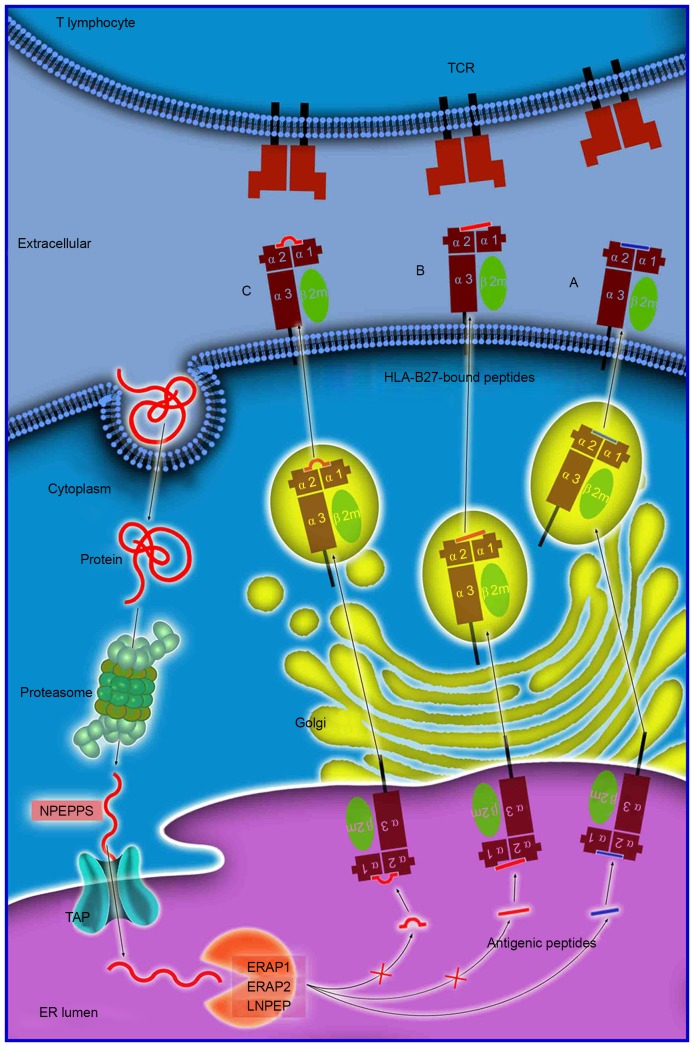
Figure 1.
Figure 1.
Antigen processing and presentation of peptides of various sizes. Antigen processing and presentation is a sequenced process. Numerous proteins are initially degraded into peptide fragments of up to 25 amino acids in length by the multi-unit proteasome complex followed by NPEPPS. TAP preferentially transports antigen peptides of 8–16 residues into the ER. N-terminal extended precursors will be further cleaved by ERAP1/ERAP2/LNPEP into oligopeptides of 8 or 9 residues, which is the optimal length for binding to HLA-B27. The peptides subsequently (A) enter the Golgi apparatus for generation of mature epitopes. However, various longer peptides may bind to HLA-B27, where they reside in the peptide groove of the HLA-B27 with (B) a protruding C-terminus, or (C) a bulge in the center. These HLA-B27-bound peptides may be highly immunogenic and may stimulate an extremely biased T-cell response repertoire. NPEPPS, aminopeptidase puromycin sensitive; TAP, transporter, ATP-binding cassette subfamily B member; HLA, human leukocyte antigen; ER, endoplasmic reticulum; ERAP1/2, endoplasmic reticulum aminopeptidase 1/2; LNPEP, leucyl cystinyl aminopeptidase; TCR, T-cell receptor.
Figure 2.
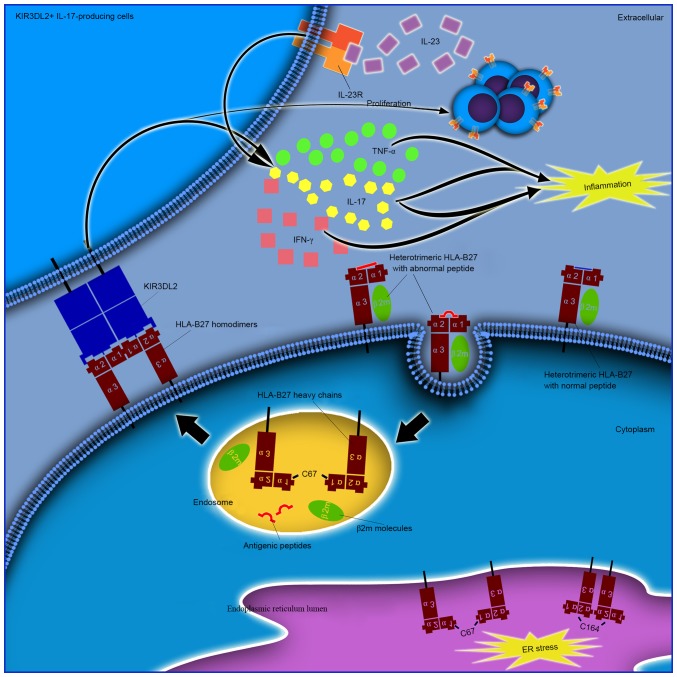
Figure 2.
Different pathogenic roles of ER-resident and cell surface HLA-B27 dimers. ER resident dimers may result in ER stress as a cellular response and lead to activation of the unfolded protein response. Cell surface dimers are reported to form following the recycling of fully-folded HLA-B27 cell surface molecules via the endocytic pathway, and re-express as dimers for presentation to immunoreceptors, including KIR and LILR. Enhanced proliferation and survival of KIR3DL2+ CD4+ T cells and increased IL-17 production in patients with AS following stimulation with antigen presenting cells expressing HLA-B27 homodimers has been previously demonstrated. The majority of these cells have been reported to produce TNF-α and IFN-γ. IL-17 has been demonstrated to synergize with TNF-α or IFN-γ to promote the release of inflammatory mediators and influence bone metabolism, thus demonstrating its important role in the pathogenesis of AS. ER, endoplasmic reticulum; HLA, human leukocyte antigen; IFN-γ, interferon-γ; IL-17, interleukin-17; KIR, killer cell immunoglobulin-like receptor; KIR3DL2, killer cell immunoglobulin-like receptor three domains long cytoplasmic tail 2; LILR, leucocyte immunoglobulin-like receptor; TNF-α, tumor necrosis factor-α; AS, ankylosing spondylitis.
Figure 3.
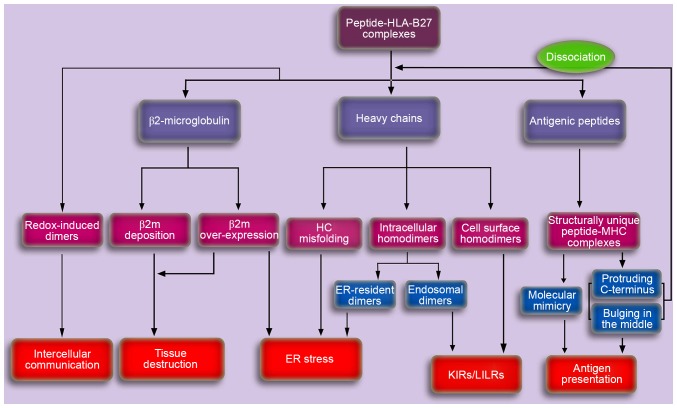
Figure 3.
A schematic depicting the potential pathogenesis of AS caused by HLA-B27. Aberrant processing and presentation of structurally unique peptides were initially proposed to explain the potential pathogenesis of AS. Cell surface HLA-B27 dimers may be recognized by various immunoreceptors and may be important in the pathogenesis of autoimmune disorders. Accumulation of proteins in the ER, including ER-resident dimers, misfolded HCs and β2m may result in the ER stress response, thereby activating the unfolded protein response, which is associated with cytokine dysregulation. In addition, the accumulating β2m in synovia for dissociation and/or overexpression, may induce the synthesis and secretion of proteins involved in tissue destruction, thus leading to AS. The exosomal fully-folded HLA-B27 dimers may be important in the pathogenesis of AS via intercellular communication. AS, ankylosing spondylitis; HLA, human leukocyte antigen; HC, heavy chain; KIR, killer cell immunoglobulin-like receptor; LILR, leucocyte immunoglobulin-like receptor; ER, endoplasmic reticulum; MHC, major histocompatibility complex; β2m, β2microglobulin.

References

    1. Dougados M, Baeten D. Spondyloarthritis. Lancet. 2011;377:2127–2137. doi: 10.1016/S0140-6736(11)60071-8. - DOI - PubMed
    1. Cho H, Kim T, Kim TH, Lee S, Lee KH. Spinal mobility, vertebral squaring, pulmonary function, pain, fatigue, and quality of life in patients with ankylosing spondylitis. Ann Rehabil Med. 2013;37:675–682. doi: 10.5535/arm.2013.37.5.675. - DOI - PMC - PubMed
    1. Braun J, Sieper J. Ankylosing spondylitis. Lancet. 2007;369:1379–1390. doi: 10.1016/S0140-6736(07)60635-7. - DOI - PubMed
    1. Végvári A, Szabó Z, Szántó S, Glant TT, Mikecz K, Szekanecz Z. The genetic background of ankylosing spondylitis. Joint Bone Spine. 2009;76:623–628. doi: 10.1016/j.jbspin.2009.02.006. - DOI - PubMed
    1. Brewerton DA, Hart FD, Nicholls A, Caffrey M, James DC, Sturrock RD. Ankylosing spondylitis and HL-A 27. Lancet. 1973;1:904–907. doi: 10.1016/S0140-6736(73)91360-3. - DOI - PubMed

Substances