


Is early morning flowering an effective trait to minimize heat stress damage during flowering in rice?
- PMID: 28260830
- PMCID: PMC5310116
- DOI: 10.1016/j.fcr.2016.11.011
Is early morning flowering an effective trait to minimize heat stress damage during flowering in rice?
Abstract
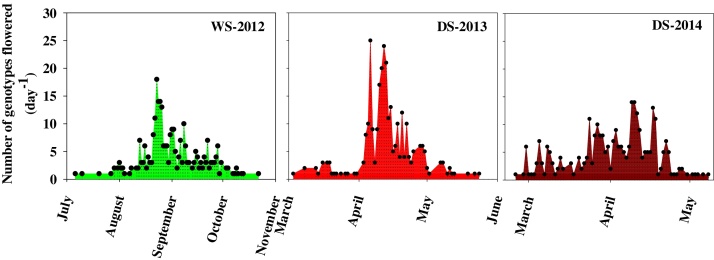
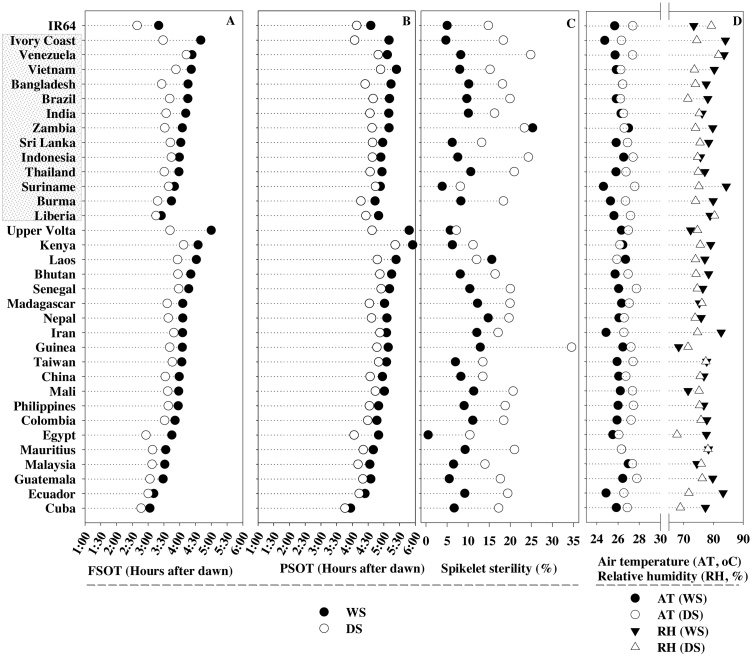
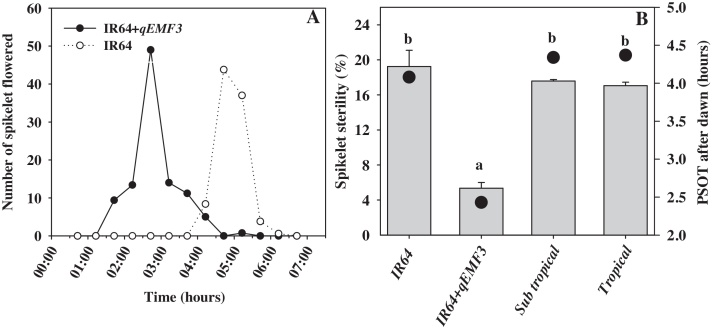
Higher spikelet sterility due to heat stress exposure during flowering in rice is becoming a major threat for sustaining productivity in tropical and sub-tropical regions. Therefore, exploiting and incorporating early morning flowering (EMF) trait into ongoing breeding pipelines could be an effective strategy to minimize the damage. In this study, we have focused on quantifying the time of day of flowering traits such as first spikelet opening time (FSOT) and peak spikelet opening time (PSOT) in a diverse set of cultivars (n = 289) representing major rice growing regions (13 tropical and 20 subtropical countries) over three years (wet season; WS-2012, dry season; DS-2013 and 2014), under field conditions. EMF traits (FSOT and PSOT) and spikelet sterility displayed significant (p < 0.001) variations among cultivars, both within and between seasons (WS and DS). Averaged across two dry seasons, the FSOT ranged between 2.35 h and 5.08 h after dawn compared to 3.05 h and 5.50 h during the WS, while, PSOT varied from 3.32 to 6.27 h in DS and from 3.50 to 7.05 h in WS. On average, PSOT was strongly associated with FSOT both in WS (R2 = 0.78) and DS (R2 = 0.77). A near-isogenic line (IR64 + qEMF3) effectively minimized the spikelet sterility by 71% during dry seasons under field conditions compared to 289 tropical and subtropical cultivars. None of the tropical and subtropical originated cultivars possess EMF trait including the popular IR64, thus indicating the usefulness of incorporating this trait to reduce heat stress damage under hotter climate. Our findings provide evidence for the effectiveness of the EMF trait in overcoming heat stress induced sterility under field conditions. Hence, it sounds logical to introgress EMF trait into currently growing popular rice cultivars for improving their resilience to heat stress episodes coinciding with flowering.
Keywords: Early morning flowering; Heat stress; Rice (Oryza sativa); Spikelet sterility.
Figures
References
-
- Bheemanahalli R., Sathishraj R., Tack J., Nalley L.L., Muthurajan R., Jagadish K.S. Temperature thresholds for spikelet sterility and associated warming impacts for sub-tropical rice. Agric. For. Meteorol. 2016;221:122–130.
-
- Gourdji S.M., Sibley A.M., Lobell D.B. Global crop exposure to critical high temperatures in the reproductive period: historical trends and future projections. Environ. Res. Lett. 2013;8:024041.
-
- Hasegawa, T., Kuwagata, T., Nishimori, M., Ishigooka, Y., Murakami, M., Yoshimoto,Y., Kondo, M., Ishimaru, T., Sawano, S., Masaki, Y., Matsuzaki, H., 2009. Recent warming trends and rice growth and yield in Japan. P 44–51. In: Hasegawa T.and Sakai H., (Eds.), Crop production under heat stress: monitoring, impact assessment and adaptation. proceedings of the MARCO symposium 2009 heldin Tsukuba, Japan, 5–9 October 2009. Tsukuba (Japan): National Institute for Agro-Environmental Sciences (NIAES). p90. http://www.niaes.affrc.go.jp/marco/marco2009/ws2proc.pdf.
-
- Hirabayashi H., Sasaki K., Kambe T., Gannaban R.B., Miras M.A., Mendioro M.S., Simon E.V., Lumanglas P.D., Fujita D., Takemoto-Kuno Y., Takeuchi Y., Kaji R., Kondo M., Kobayashi N., Ogawa T., Ando I., Jagadish S.V.K., Ishimaru T. qEMF3, a novel QTL for the early-morning flowering trait from wild rice Oryza officinalis, to mitigate heat stress damage at flowering in rice, O. sativa L. J. Exp. Bot. 2014;66:1227–1236. - PMC - PubMed
LinkOut - more resources
Full Text Sources
Other Literature Sources