


Barriers and facilitators of adjuvant hormone therapy adherence and persistence in women with breast cancer: a systematic review
- PMID: 28260867
- PMCID: PMC5328144
- DOI: 10.2147/PPA.S126651
Barriers and facilitators of adjuvant hormone therapy adherence and persistence in women with breast cancer: a systematic review
Abstract
Purpose: Nonadherence to hormone therapy in breast cancer survivors is common and associated with increased risk of mortality. Consistent predictors of nonadherence and nonpersistence are yet to be identified, and little research has examined psychosocial factors that may be amenable to change through intervention. This review aimed to identify predictors of nonadherence and nonpersistence to hormone therapy in breast cancer survivors in order to inform development of an intervention to increase adherence rates.
Methods: Studies published up to April 2016 were identified through MEDLINE, Embase, Web of Science, PsycINFO, CINAHL and gray literature. Studies published in English measuring associations between adherence or persistence and any predictor variables were included. Eligible studies were assessed for methodological quality, data were extracted and a narrative synthesis was conducted.
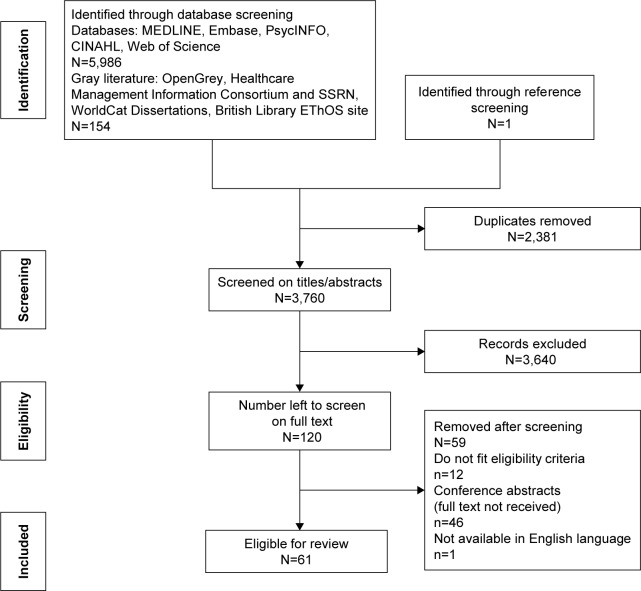
Results: Sixty-one eligible articles were identified. Most studies focused on clinical and demographic factors with inconsistent results. Some evidence suggested that receiving specialist care and social support were related to increased persistence, younger age and increased number of hospitalizations were associated with nonadherence, and good patient-physician relationship and self-efficacy for taking medication were associated with better adherence. A small amount of evidence suggested that medication beliefs were associated with adherence, but more high-quality research is needed to confirm this.
Conclusion: Some psychosocial variables were associated with better adherence and persistence, but the results are currently tentative. Future high-quality research should be carried out to identify psychosocial determinants of nonadherence or nonpersistence that are modifiable through intervention.
Keywords: adherence; breast cancer; hormone therapy; persistence.
Conflict of interest statement
Disclosure The authors report no conflicts of interest in this work.
Figures
References
-
- Breast Cancer Statistics [webpage on the Internet] Cancer Research UK Web Site. 2016. [Accessed October 10, 2016]. Available from: http://www.cancerresearchuk.org/health-professional/cancer-statistics/st....
-
- Gray RG, Rea D, Handley K, et al. ATTom: long-term effects of continuing adjuvant tamoxifen to 10 years versus stopping at 5 years in 6,953 women with early breast cancer. J Clin Oncol. 2013;18(31):5.
-
- Early Breast Cancer Trialists’ Collaborative Group Tamoxifen for early breast cancer: an overview of the randomised trials. Early Breast Cancer Trialists’ Collaborative Group. Lancet. 1998;351(9114):1451–1467. - PubMed
Publication types
LinkOut - more resources
Full Text Sources
Other Literature Sources
Miscellaneous
