


COPD symptom burden: impact on health care resource utilization, and work and activity impairment
- PMID: 28260874
- PMCID: PMC5327905
- DOI: 10.2147/COPD.S123896
COPD symptom burden: impact on health care resource utilization, and work and activity impairment
Abstract
Background: Chronic obstructive pulmonary disease (COPD) can greatly impact the quality of life by limiting patients' activities. However, data on impact of symptomatic burden on the health care resource utilization (HCRU) and employment in COPD are lacking. We examined the association between COPD Assessment Test (CAT) score and direct/indirect costs associated with HCRU and work productivity.
Methods: Data from >2,100 patients with COPD consulting for routine care were derived from respiratory disease-specific programs in Europe, the USA and China. Questionnaires, including CAT and Work Productivity and Activity Impairment (WPAI), were used to collect the past and current disease status data and HCRU characteristics from physicians (general practitioners/specialists) and patients. A regression approach was used to quantify the association of CAT with HCRU and WPAI variables. CAT score was modeled as a continuous independent variable (range: 0-40).
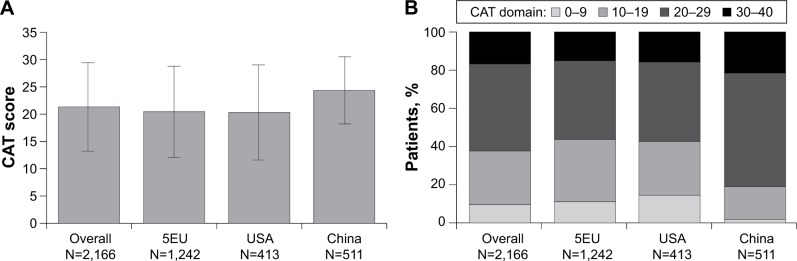
Results: Ninety percent of patients with COPD had a CAT score ≥10. Short-acting therapy and maintenance bronchodilator monotherapy, respectively, were currently prescribed to patients with CAT scores of 10-19 (5.8% and 27.6%), 20-29 (5.1% and 13.1%) and 30-40 (2.8% and 6.6%). Prescribing of maintenance bronchodilator dual therapy was low across the CAT score groups (0-9, 7.8%; 10-19, 6.4%; 20-29, 5.9%; 30-40, 4.4%), whereas maintenance triple combination therapy was prescribed more commonly in patients with higher CAT scores (0-9, 16.1%; 10-19, 23.2%; 20-29, 25.9%; 30-40, 35.5%). Increasing CAT scores were significantly associated with a higher frequency of primary care physician visits (P<0.001), pulmonologist visits (P=0.007), exacerbations requiring hospitalization (P<0.001) and WPAI scores (P<0.001).
Conclusion: Most patients with COPD presented with high symptom levels, despite being treated for COPD. Increasing symptom burden was associated with increasing HCRU and had a detrimental impact on work productivity.
Keywords: COPD; health care resource utilization; routine care; symptom; work and activity impairment.
Conflict of interest statement
Disclosure UH, GB and BD are employees of AstraZeneca. MS is an employee of Adelphi Real World. The authors report no other conflicts of interest in this work.
Figures
References
-
- World Health Organization World Health Statistics. 2008. [Accessed on October 30, 2016]. [updated 2008]. Available from: http://www.who.int/whosis/whostat/EN_WHS08_Full.pdf.
-
- Waschki B, Kirsten A, Holz O, et al. Physical activity is the strongest predictor of all-cause mortality in patients with COPD: a prospective cohort study. Chest. 2011;140(2):331–342. - PubMed
-
- O’Donnell DE. Impacting patient-centred outcomes in COPD: breathlessness and exercise tolerance. Eur Resp Rev. 2006;15(99):37–41.
-
- Global Initiative for Chronic Obstructive Lung Disease Global Strategy for the Diagnosis, Management and Prevention of COPD, Global Initiative for Chronic Obstructive Lung Disease (GOLD); 2016. 2016. [Accessed on October 30, 2016]. Available from: http://www.goldcopd.org/
Publication types
MeSH terms
Substances
LinkOut - more resources
Full Text Sources
Other Literature Sources
Medical
Miscellaneous
