Comparison of Male vs Female Resident Milestone Evaluations by Faculty During Emergency Medicine Residency Training
- PMID: 28264090
- PMCID: PMC5818781
- DOI: 10.1001/jamainternmed.2016.9616
Comparison of Male vs Female Resident Milestone Evaluations by Faculty During Emergency Medicine Residency Training
Erratum in
-
Missing Additional Contributions Section.JAMA Intern Med. 2017 May 1;177(5):747. doi: 10.1001/jamainternmed.2017.1262. JAMA Intern Med. 2017. PMID: 28395062 Free PMC article. No abstract available.
Abstract
Importance: Although implicit bias in medical training has long been suspected, it has been difficult to study using objective measures, and the influence of sex and gender in the evaluation of medical trainees is unknown. The emergency medicine (EM) milestones provide a standardized framework for longitudinal resident assessment, allowing for analysis of resident performance across all years and programs at a scope and level of detail never previously possible.
Objective: To compare faculty-observed training milestone attainment of male vs female residency training.
Design, setting, and participants: This multicenter, longitudinal, retrospective cohort study took place at 8 community and academic EM training programs across the United States from July 1, 2013, to July 1, 2015, using a real-time, mobile-based, direct-observation evaluation tool. The study examined 33 456 direct-observation subcompetency evaluations of 359 EM residents by 285 faculty members.
Main outcomes and measures: Milestone attainment for male and female EM residents as observed by male and female faculty throughout residency and analyzed using multilevel mixed-effects linear regression modeling.
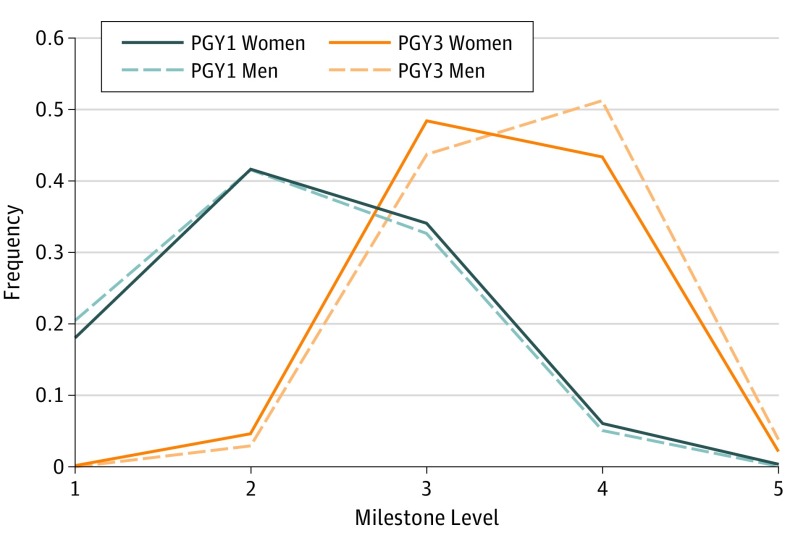
Results: A total of 33 456 direct-observation evaluations were collected from 359 EM residents (237 men [66.0%] and 122 women [34.0%]) by 285 faculty members (194 men [68.1%] and 91 women [31.9%]) during the study period. Female and male residents achieved similar milestone levels during the first year of residency. However, the rate of milestone attainment was 12.7% (0.07 levels per year) higher for male residents through all of residency (95% CI, 0.04-0.09). By graduation, men scored approximately 0.15 milestone levels higher than women, which is equivalent to 3 to 4 months of additional training, given that the average resident gains approximately 0.52 levels per year using our model (95% CI, 0.49-0.54). No statistically significant differences in scores were found based on faculty evaluator gender (effect size difference, 0.02 milestone levels; 95% CI for males, -0.09 to 0.11) or evaluator-evaluatee gender pairing (effect size difference, -0.02 milestone levels; 95% CI for interaction, -0.05 to 0.01).
Conclusions and relevance: Although male and female residents receive similar evaluations at the beginning of residency, the rate of milestone attainment throughout training was higher for male than female residents across all EM subcompetencies, leading to a gender gap in evaluations that continues until graduation. Faculty should be cognizant of possible gender bias when evaluating medical trainees.
Conflict of interest statement
Figures
Comment in
-
Implicit Bias in Academic Medicine: #WhatADoctorLooksLike.JAMA Intern Med. 2017 May 1;177(5):657-658. doi: 10.1001/jamainternmed.2016.9643. JAMA Intern Med. 2017. PMID: 28264084 No abstract available.
References
-
- Edmunds LD, Ovseiko PV, Shepperd S, et al. Why do women choose or reject careers in academic medicine? a narrative review of empirical evidence. Lancet. 2016;388(10062):2948-2958. - PubMed
-
- Kuhn GJ, Abbuhl SB, Clem KJ; Society for Academic Emergency Medicine (SAEM) Taskforce for Women in Academic Emergency Medicine . Recommendations from the Society for Academic Emergency Medicine (SAEM) Taskforce on women in academic emergency medicine. Acad Emerg Med. 2008;15(8):762-767. - PubMed
-
- Cydulka RK, D’Onofrio G, Schneider S, Emerman CL, Sullivan LM. Women in academic emergency medicine. Acad Emerg Med. 2000;7(9):999-1007. - PubMed
Publication types
MeSH terms
Grants and funding
LinkOut - more resources
Full Text Sources
Other Literature Sources
Miscellaneous