Microguidewire Looping to Traverse Stented Parent Arteries of Intracranial Aneurysms
- PMID: 28264249
- PMCID: PMC5365287
- DOI: 10.3340/jkns.2016.0707.009
Microguidewire Looping to Traverse Stented Parent Arteries of Intracranial Aneurysms
Abstract
Objective: Stents are widely used in coil embolization of intracranial aneurysms, but on occasion, a microcatheter must traverse a stented segment of artery (so-called trans-cell technique) to select an aneurysm, or double stenting may necessary. In such situations, microguidewire passage and microcatheter delivery through a tortuous stented parent artery may pose a technical challenge. Described herein is a microguidewire looping technique to facilitate endovascular navigation in these circumstances.
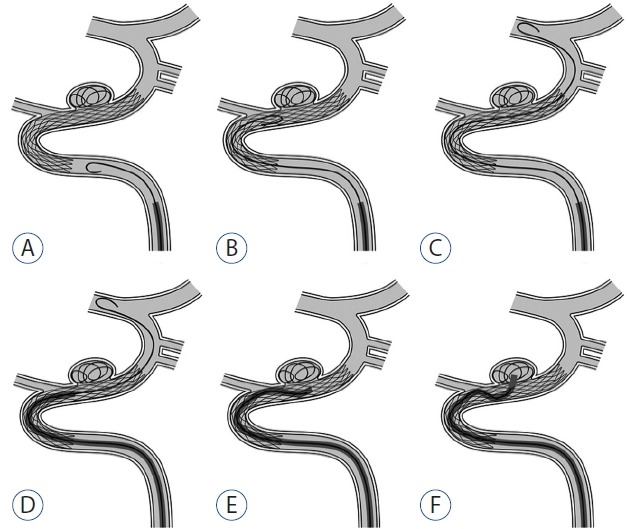
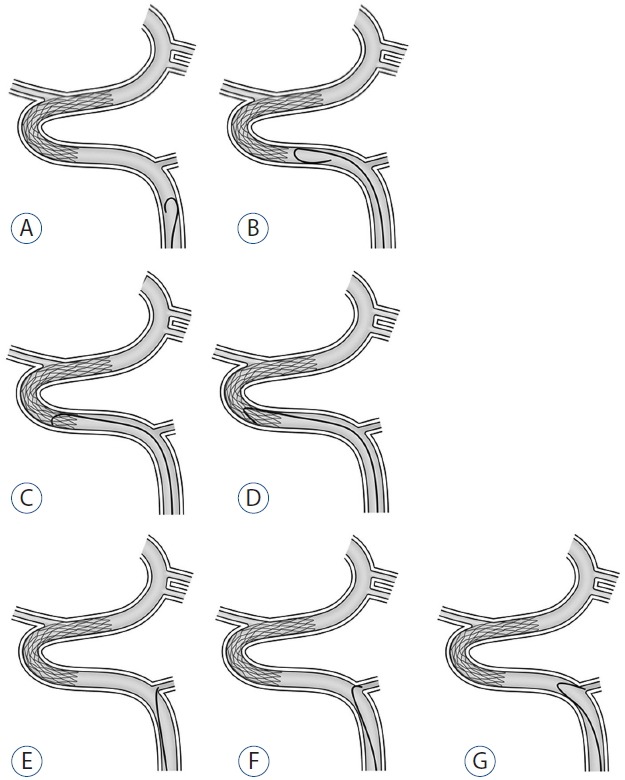
Methods: To apply this technique, the microguidewire tip is looped before entering the stented parent artery and then advanced distally past the stented segment, with the loop intact. Rounding of the tip prevents interference from stent struts during passage. A microcatheter is subsequently passed into the stented artery for positioning near the neck of aneurysm, with microguidewire assistance. The aneurysm is then selected, steering the microcatheter tip (via inner microguidewire) into the dome.
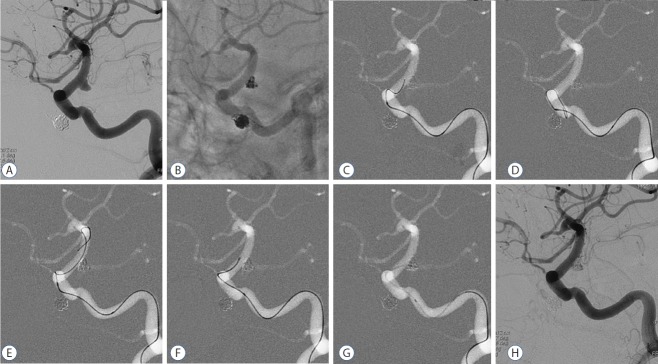
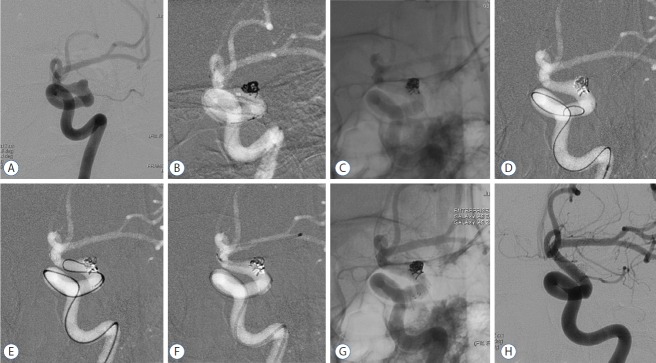
Results: This technique proved successful during coil embolization of nine saccular intracranial aneurysms (internal carotid artery [ICA], 6; middle cerebral artery, 2; basilar tip, 1), performing eight trans-cell deliveries and one additional stenting. Selective endovascular embolization was enabled in all patients, resulting in excellent clinical and radiologic outcomes, with no morbidity or mortality directly attributable to microguidewire looping.
Conclusion: Microguidewire looping is a reasonable alternative if passage through a stented artery is not feasible by traditional means, especially at paraclinoid ICA sites.
Keywords: Aneurysm; Coil; Embolization; Microguidewire; Stent.
Figures
References
-
- Benndorf G, Bender A, Lehmann R, Lanksch W. Transvenous occlusion of dural cavernous sinus fistulas through the thrombosed inferior petrosal sinus: report of four cases and review of the literature. Surg Neurol. 2000;54:42–54. - PubMed
-
- Chalouhi N, Jabbour P, Singhal S, Drueding R, Starke RM, Dalyai RT, et al. Stent-assisted coiling of intracranial aneurysms: predictors of complications, recanalization, and outcome in 508 cases. Stroke. 2013;44:1348–1353. - PubMed
-
- Cho YD, Kang HS, Kim JE, Son YJ, Lee JY, Lee SJ, et al. Microcatheter looping technique for coil embolization of complex configuration middle cerebral artery aneurysms. Neurosurgery. 2012;71:1185–1191. discussion 1191. - PubMed
-
- Cho YD, Lee JY, Seo JH, Lee SJ, Kang HS, Kim JE, et al. Does stent implantation improve the result of repeat embolization in recanalized aneurysms? Neurosurgery. 2012;71(2 Suppl Operative):ons253–ons259. discussion ons259. - PubMed
-
- Cho YD, Park SW, Lee JY, Lee JY, Seo JH, Kang HS, et al. Nonoverlapping Y-configuration stenting technique with dual closed-cell stents in wide-neck basilar tip. Neurosurgery. 2012;70(2 Suppl Operative):244–249. - PubMed
LinkOut - more resources
Full Text Sources
Other Literature Sources
Miscellaneous