


Do Plant-Bound Masked Mycotoxins Contribute to Toxicity?
- PMID: 28264486
- PMCID: PMC5371840
- DOI: 10.3390/toxins9030085
Do Plant-Bound Masked Mycotoxins Contribute to Toxicity?
Abstract
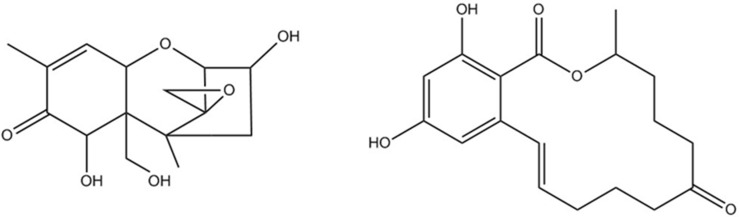
Masked mycotoxins are plant metabolites of mycotoxins which co-contaminate common cereal crops. Since their discovery, the question has arisen if they contribute to toxicity either directly or indirectly through the release of the parent mycotoxins. Research in this field is rapidly emerging and the aim of this review is to summarize the latest knowledge on the fate of masked mycotoxins upon ingestion. Fusarium mycotoxins are the most prevalent masked mycotoxins and evidence is mounting that DON3Glc and possibly other masked trichothecenes are stable in conditions prevailing in the upper gut and are not absorbed intact. DON3Glc is also not toxic per se, but is hydrolyzed by colonic microbes and further metabolized to DOM-1 in some individuals. Masked zearalenone is rather more bio-reactive with some evidence on gastric and small intestinal hydrolysis as well as hydrolysis by intestinal epithelium and components of blood. Microbial hydrolysis of ZEN14Glc is almost instantaneous and further metabolism also occurs. Identification of zearalenone metabolites and their fate in the colon are still missing as is further clarification on whether or not masked zearalenone is hydrolyzed by mammalian cells. New masked mycotoxins continuously emerge and it is crucial that we gain detailed understanding of their individual metabolic fate in the body before we can assess synergistic effects and extrapolate the additive risk of all mycotoxins present in food.
Keywords: absorption; deoxynivalenol; hydrolysis; intestine; masked mycotoxins; trichothecenes; zearalenone.
Conflict of interest statement
The author declares no conflict of interest.
Figures
References
-
- Biomin, Mycotoxin Report–Mycotoxin Survey 2015. [(accessed on 10 January 2017)]. Available online: http://info.biomin.net/acton/attachment/14109/f-018d/1/-/-/l-0009/l-0009....
-
- EFSA Panel on Contaminants in the Food Chain Scientific Opinion on the risks for animal and public health related to the presence of T-2 and HT-2 toxin in food and feed. EFSA J. 2011;9:2481.
-
- FAO/WHO . Deoxynivalenol. WHO Food Additives Series; Geneva, Switzerland: 2001. Safety evaluation of certain food additives and contaminants; p. 47.
-
- Nesic K., Ivanovic S., Nesic V. Fusarial toxins: Secondary metabolites of Fusarium fungi. Review. Environ. Contam. Toxicol. 2014;228:101–120. - PubMed
Publication types
MeSH terms
Substances
LinkOut - more resources
Full Text Sources
Other Literature Sources
