Motives for online gaming questionnaire: Its psychometric properties and correlation with Internet gaming disorder symptoms among Chinese people
- PMID: 28264590
- PMCID: PMC5572999
- DOI: 10.1556/2006.6.2017.007
Motives for online gaming questionnaire: Its psychometric properties and correlation with Internet gaming disorder symptoms among Chinese people
Abstract
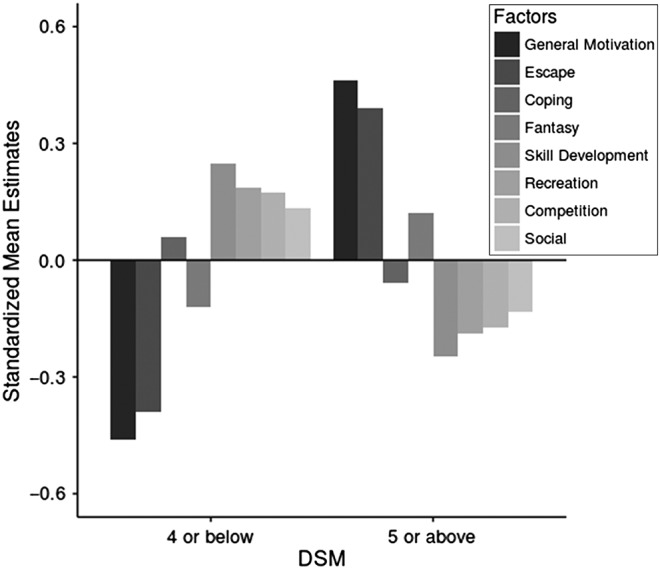
Background and aims Internet gaming disorder (IGD) imposes a potential public health threat worldwide. Gaming motives are potentially salient factors of IGD, but research on Chinese gaming motives is scarce. This study empirically evaluated the psychometric properties of the Chinese version of the Motives for Online Gaming Questionnaire (C-MOGQ), the first inventory that measures seven different gaming motives applicable to all type of online games. We also investigated the associations between various gaming motives and IGD symptoms among Chinese gamers. Methods Three hundred and eighty-three Chinese adult online gamers (Mean age = 23.7 years) voluntarily completed our online, anonymous survey in December 2015. Results The confirmatory factor analysis results supported a bi-factor model with a general factor subsuming all C-MOGQ items (General Motivation) and seven uncorrelated domain-specific factors (Escape, Coping, Fantasy, Skill Development, Recreation, Competition, and Social). High internal consistencies of the overall scale and subscales were observed. The criterion-related validity of this Chinese version was also supported by the positive correlations of C-MOGQ scale scores with psychological need satisfaction and time spent gaming. Furthermore, we found that high General Motivation (coupled with high Escape motive and low Skill Development motive) was associated with more IGD symptoms reported by our Chinese participants. Discussion and conclusions Our findings demonstrated the utility of C-MOGQ in measuring gaming motives of Chinese online gamers, and we recommend the consideration of both its total score and subscale scores in future studies.
Keywords: Internet; addiction; bi-factor modeling; gaming; motives; scale validation.
Figures
References
-
- American Psychiatric Association. (2013). Diagnostic and statistical manual of mental disorders (5th ed.). Washington, DC: American Psychiatric Association.
-
- Bartle R. (1996). Hearts, clubs, diamonds, spades: Players who suit MUDs. Journal of MUD Research, 1(1), 19 Retrieved from http://www.mud.co.uk/richard/hcds.htm
-
- Batey M., Booth T., Furnham A., Lipman H. (2011). The relationship between personality and motivation: Is there a general factor of motivation? Individual Differences Research, 9(2), 115–125.
-
- Billieux J., Chanal J., Khazaal Y., Rochat L., Gay P., Zullino D., Van der Linden M. (2011). Psychological predictors of problematic involvement in massively multiplayer online role-playing games: Illustration in a sample of male cybercafé players. Psychopathology, 44(3), 165–171. doi: - DOI - PubMed
MeSH terms
LinkOut - more resources
Full Text Sources
Other Literature Sources