IFT56 regulates vertebrate developmental patterning by maintaining IFTB complex integrity and ciliary microtubule architecture
- PMID: 28264835
- PMCID: PMC5399663
- DOI: 10.1242/dev.143255
IFT56 regulates vertebrate developmental patterning by maintaining IFTB complex integrity and ciliary microtubule architecture
Abstract
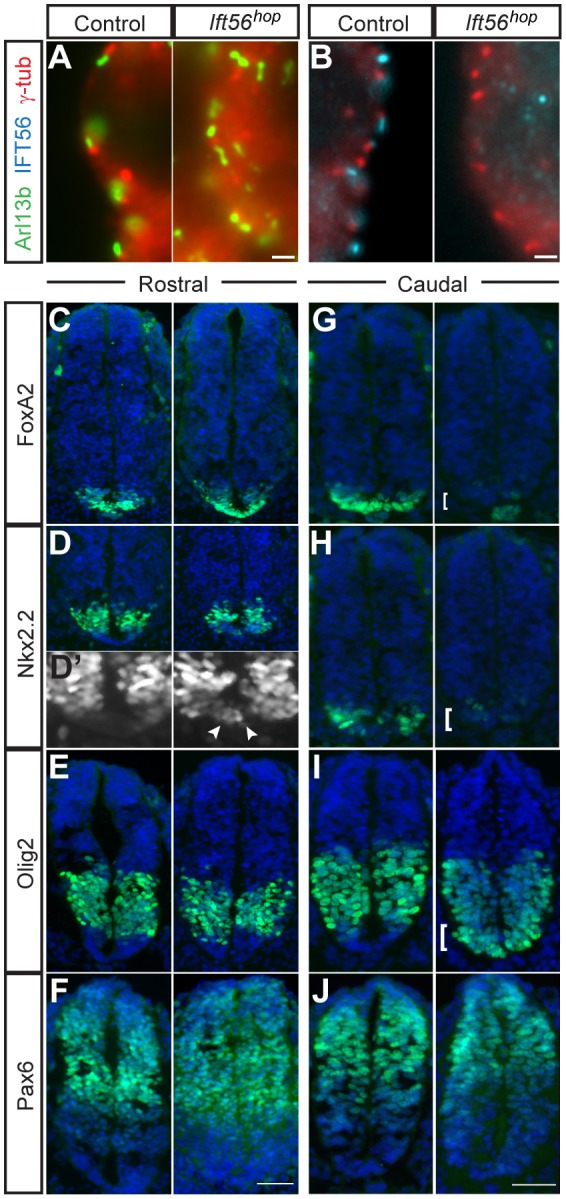
Cilia are key regulators of animal development and depend on intraflagellar transport (IFT) proteins for their formation and function, yet the roles of individual IFT proteins remain unclear. We examined the Ift56hop mouse mutant and reveal novel insight into the function of IFT56, a poorly understood IFTB protein. Ift56hop mice have normal cilia distribution but display defective cilia structure, including abnormal positioning and number of ciliary microtubule doublets. We show that Ift56hop cilia are unable to accumulate Gli proteins efficiently, resulting in developmental patterning defects in Shh signaling-dependent tissues such as the limb and neural tube. Strikingly, core IFTB proteins are unable to accumulate normally within Ift56hop cilia, including IFT88, IFT81 and IFT27, which are crucial for key processes such as tubulin transport and Shh signaling. IFT56 is required specifically for the IFTB complex, as IFTA components and proteins that rely on IFTA function are unaffected in Ift56hop cilia. These studies define a distinct and novel role for IFT56 in IFTB complex integrity that is crucial for cilia structure and function and, ultimately, animal development.
Keywords: Cilia; Hedgehog signaling; IFT56; IFTB; Intraflagellar transport; Microtubule structure; TTC26.
© 2017. Published by The Company of Biologists Ltd.
Conflict of interest statement
The authors declare no competing or financial interests.
Figures


References
Publication types
MeSH terms
Substances
Grants and funding
LinkOut - more resources
Full Text Sources
Other Literature Sources
Molecular Biology Databases