. 2017 Feb 17;6(2):e130.
doi: 10.1038/cti.2016.89. eCollection 2017 Feb.

A generalized quantitative antibody homeostasis model: regulation of B-cell development by BCR saturation and novel insights into bone marrow function

Affiliations

A generalized quantitative antibody homeostasis model: regulation of B-cell development by BCR saturation and novel insights into bone marrow function

József Prechl. Clin Transl Immunology. .

Abstract

In a pair of articles, we present a generalized quantitative model for the homeostatic function of clonal humoral immune system. In this first paper, we describe the cycles of B-cell expansion and differentiation driven by B-cell receptor engagement. The fate of a B cell is determined by the signals it receives via its antigen receptor at any point of its lifetime. We express BCR engagement as a function of apparent affinity and free antigen concentration, using the range of 10-14-10-3 M for both factors. We assume that for keeping their BCR responsive, B cells must maintain partial BCR saturation, which is a narrow region defined by [Ag]≈KD. To remain in this region, B cells respond to changes in [Ag] by proliferation or apoptosis and modulate KD by changing BCR structure. We apply this framework to various niches of B-cell development such as the bone marrow, blood, lymphoid follicles and germinal centers. We propose that clustered B cells in the bone marrow and in follicles present antigen to surrounding B cells by exposing antigen captured on complement and Fc receptors. The model suggests that antigen-dependent selection in the bone marrow results in (1) effector BI cells, which develop in blood as a consequence of the inexhaustible nature of soluble antigens, (2) memory cells that survive in antigen rich niches, identified as marginal zone B cells. Finally, the model implies that memory B cells could derive survival signals from abundant non-cognate antigens.


Conflict of interest statement

The author declares no conflict of interest.

Figures
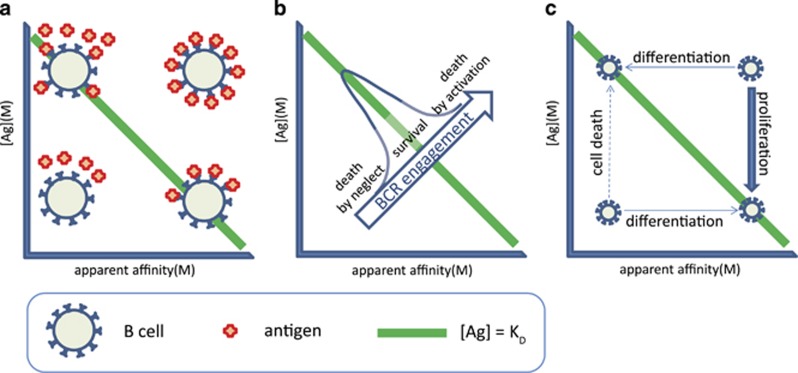
Figure 1
Figure 1
Outlines of the GQM for BCR-mediated B-cell regulation. (a) Identical BCR engagement due to interactions with different apparent affinity is reached at different antigen concentrations. (b) BCR engagement, as determined by apparent affinity and free antigen concentration at equilibrium, regulates B-cell survival. Green line indicates the comfort zone of the cells. (c) Strategies for survival at BCR under- and overengagement.
Figure 2
Figure 2
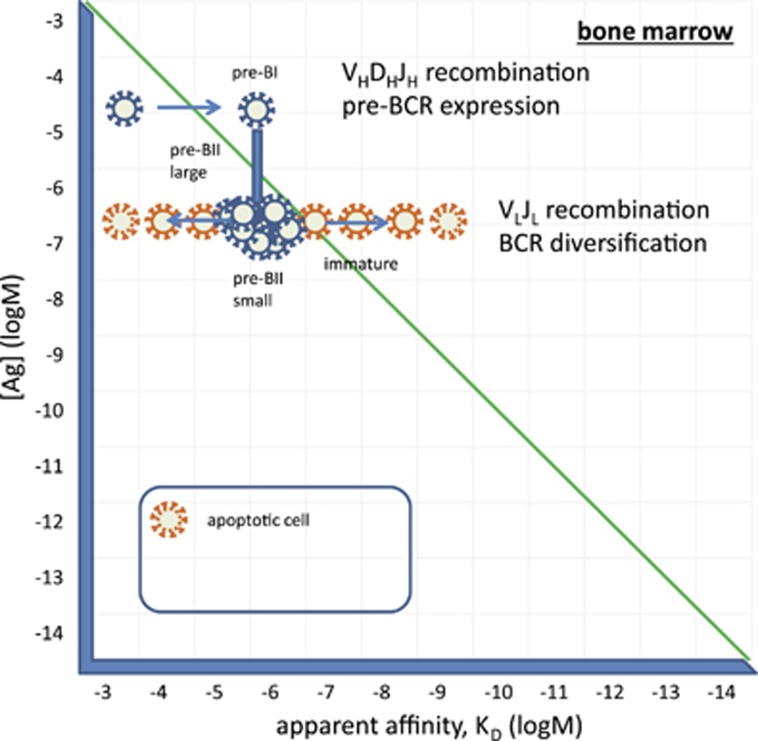
Development of B cells in the bone marrow. Pre-BI cells receive proliferation signals via the pre-BCR, entering several rounds of cells division. Cycling large pre-BII cells come to rest when they lose SLC, and start rearranging their light chains. Pre-BI small cells forming a signaling fit BCR reach their comfort zone and survive as immature B cells, other rearrange another light chain locus or die. Immature B cells leave the bone marrow.
Figure 3
Figure 3
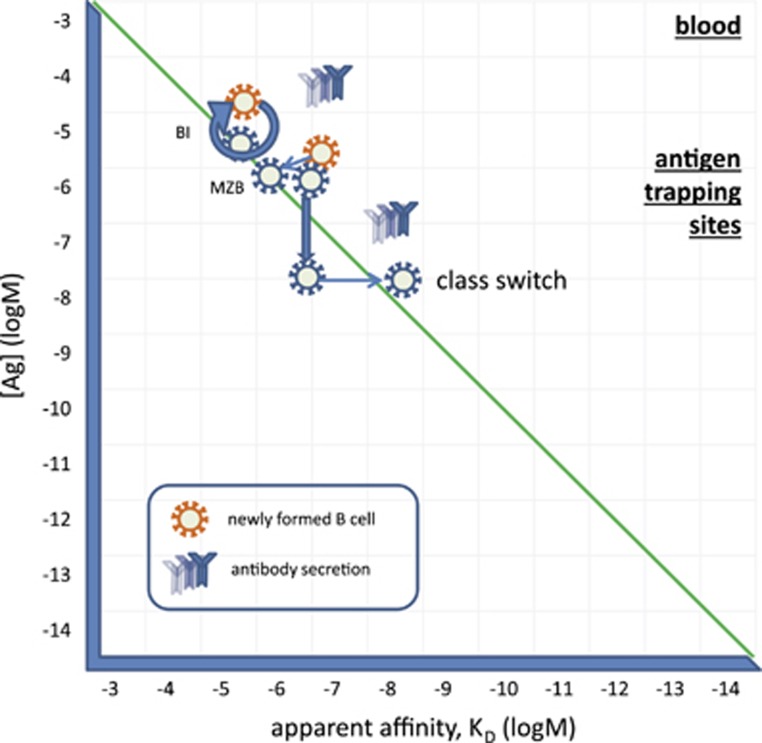
Differentiation of immature B cells in blood. Circulating B cells that receive moderate supraoptimal BCR signals may remain in a continuously activated state, dividing from time-to-time and secreting antibodies as BI cells. Otherwise these cells may differentiate into MZB cells and settle at antigen-trapping sites such as the marginal zone. Upon activation, these cells may switch their heavy chain isotype in an attempt to increase apparent affinity of their BCR.
Figure 4
Figure 4
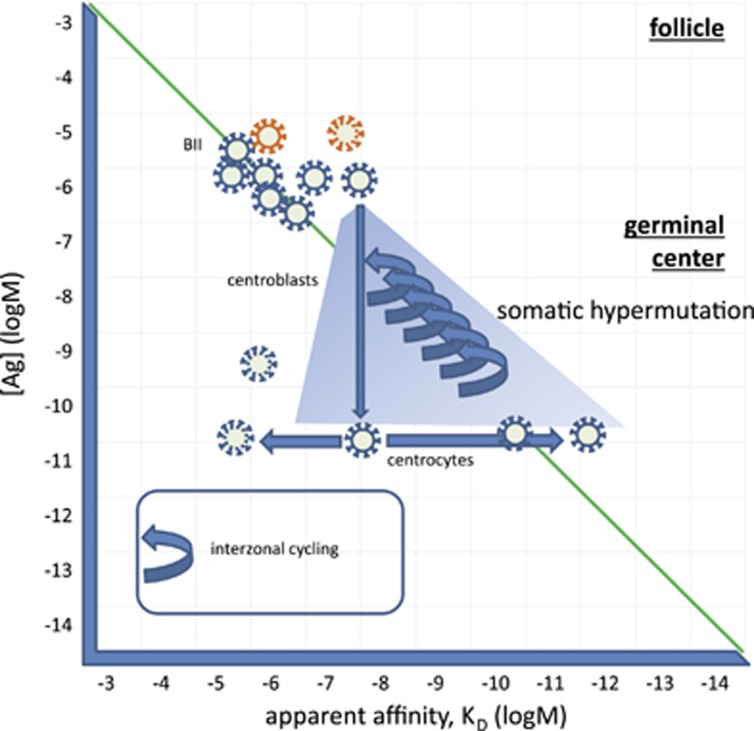
The generation of a germinal center. BII cells recirculate between follicles in a quiescent state. Here Ag from the blood, lymph and mucosa is presented. When encountering an antigen that engages BCR, they start dividing. Presentation of antigen via the MHCII to cognate Th cells provides costimulatory signals and results in the generation of a germinal center. Centroblasts divide and accumulate mutations, leading to changes in the affinity of the BCR. Competition favors BCRs with higher affinity. Selected high-affinity cells return to the dark zone several times, capturing more antigen and starting another cycle of divisions.
Figure 5
Figure 5
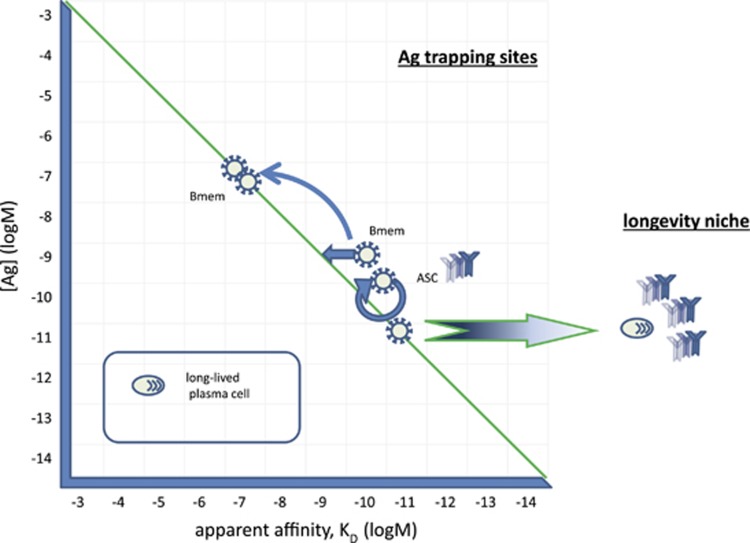
Generation of memory and antibody-secreting cells. Cycling cells can reach their comfort zone by modulating their BCR signals and searching for a niche where a BCR ligand can provide survival signal. Until antigen concentration decreases, these cells will continue to secrete antibodies and divide. Ideal sites for these cells, bone marrow perivascular niche, splenic marginal zone, lymph node subcapsular sinus, tonsillar epithelium, subepithelial dome of Peyer's patches are close to sources of antigen and are equipped with antigen-presenting cells. Cells with similar BCR engagement may therefore reach two different states: memory by BCR signaling adjustment and ASC by cycling and exerting effector function. ASC, which do reach the BCR comfort zone exit cell cycle and start terminal differentiation. Of these cells, some will find a niche suitable for sustaining longevity and become long-lived plasma cells. These terminally differentiated cells lose BCR and become independent of antigen concentration regulation.

References

    1. Melchers F. Checkpoints that control B cell development. J Clin Invest 2015; 125: 2203–2210. - PMC - PubMed
    1. LeBien TW, Tedder TF. B lymphocytes: how they develop and function. Blood 2008; 112: 1570–1580. - PMC - PubMed
    1. Kurosaki T. Regulation of B cell fates by BCR signaling components. Curr Opin Immunol 2002; 14: 341–347. - PubMed
    1. Anderson NL, Anderson NG. The human plasma proteome: history, character, and diagnostic prospects. Mol Cell Proteomics 2002; 1: 845–867. - PubMed
    1. Batista FD, Neuberger MS. Affinity dependence of the B cell response to antigen: a threshold, a ceiling, and the importance of off-rate. Immunity 1998; 8: 751–759. - PubMed

LinkOut - more resources