


The importance of physical function to people with osteoporosis
- PMID: 28265717
- PMCID: PMC5391375
- DOI: 10.1007/s00198-017-3911-9
The importance of physical function to people with osteoporosis
Abstract
There is increasing need to understand patient outcomes in osteoporosis. This article discusses that fracture in osteoporosis can lead to a cycle of impairment, driven by complex psychosocial factors, having a profound impact on physical function/activity which accumulates over time. More information is required on how treatments impact physical function.
Introduction: There is increasing need to understand patient-centred outcomes in osteoporosis (OP) clinical research and management. This multi-method paper provides insight on the effect of OP on patients' physical function and everyday activity.
Methods: Data were collected from three sources: (1) targeted literature review on OP and physical function, conducted in MEDLINE, Embase and PsycINFO; (2) secondary thematic analysis of transcripts from patient interviews, conducted to develop a patient-reported outcome instrument. Transcripts were re-coded to focus on OP impact on daily activities and physical function for those with and without fracture history; and (3) discussions of the literature review and secondary qualitative analysis results with three clinical experts to review and interpret the importance and implications of the findings.
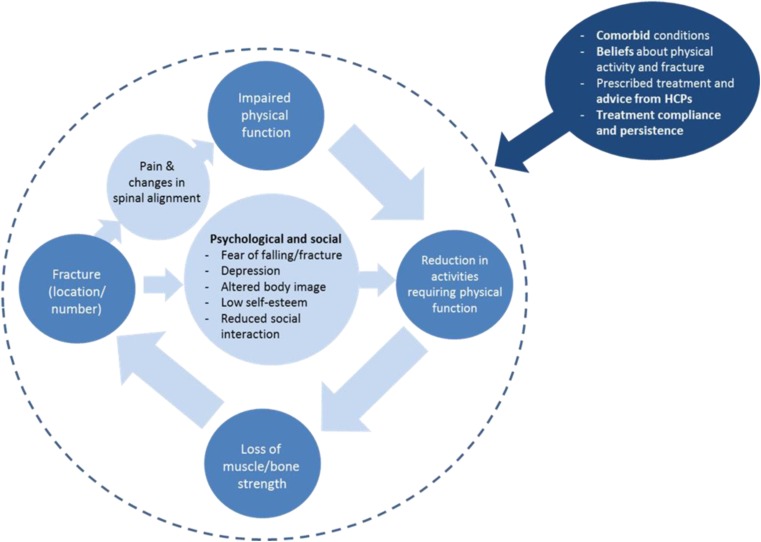
Results: Results suggest that OP, particularly with fracture, can have profound impacts on physical function/activity. These impacts accumulate over time through a cycle of impairment, as fracture leads to longer term detriments in physical function, including loss of muscle, activity avoidance and reduced physical capacity, which in turn leads to greater risk of fracture and potential for further physical restrictions. The cycle of impairment is complex, as other physical, psychosocial and treatment-related factors, such as comorbidities, fears and beliefs about physical activity and fracture risk influence physical function and everyday activity.
Conclusion: More information on how treatments impact physical function would benefit healthcare professionals and persons with OP in making treatment decisions and improving treatment compliance/persistence, as these impacts may be more salient to patients than fracture incidence.
Keywords: Health-related quality of life; Osteoporosis; Patient-centred outcomes; Physical function; Psychological outcomes; Social outcomes.
Conflict of interest statement
Disclosure
This work was completed as part of a programme of work in OP funded by Eli Lilly.
Conflicts of interest
This review was funded by Eli Lilly, who commissioned ICON plc to conduct the work. Chloe Patel, Catherine Bottomley, Hayley M. de Freitas, Cicely Kerr and Sarah Shingler were employees of ICON plc at the time the research was completed. Deborah T. Gold, PhD is a consultant and speaker for Eli Lilly & Co. and Amgen. Lora Giangregorio worked as a consultant for ICON plc on this research and has received funding for other research from Merck Canada Inc. (primary investigator) and Amgen (co-investigator). Susan Randall is employed by the National Osteoporosis Foundation.
Figures
References
-
- Endocrine Society (2016) Endocrine facts and figures: bone and mineral. First edition. http://endocrinefacts.org/health-conditions/bone-calcium/2-osteoporosis/. Accessed 21 Mar 2016
-
- National Osteoporosis Foundation (2016) What is osteoporosis and what causes it? https://www.nof.org/patients/what-is-osteoporosis/. Accessed 30 Nov 2016
-
- World Health Organization (2004) WHO scientific group on the assessment of osteoporosis at primary health care level. Report of a WHO Study Group. http://www.who.int/chp/topics/Osteoporosis.pdf. Accessed 12 Oct 2015
-
- U.S. Food and Drug Administration (1994) Guidelines for preclinical and clinical evaluation of agents used in the prevention or treatment of postmenopausal osteoporosis. http://www.fda.gov/downloads/UCM131206.pdf. Accessed 12 Oct 2015
Publication types
MeSH terms
LinkOut - more resources
Full Text Sources
Other Literature Sources
Medical
Molecular Biology Databases
Miscellaneous
