. 2018 Feb;34(1):13-21.
doi: 10.1007/s12264-017-0106-5. Epub 2017 Mar 6.

Spinal CCL2 Promotes Central Sensitization, Long-Term Potentiation, and Inflammatory Pain via CCR2: Further Insights into Molecular, Synaptic, and Cellular Mechanisms

Affiliations

Spinal CCL2 Promotes Central Sensitization, Long-Term Potentiation, and Inflammatory Pain via CCR2: Further Insights into Molecular, Synaptic, and Cellular Mechanisms

Rou-Gang Xie et al. Neurosci Bull. 2018 Feb.

Abstract

Mounting evidence supports an important role of chemokines, produced by spinal cord astrocytes, in promoting central sensitization and chronic pain. In particular, CCL2 (C-C motif chemokine ligand 2) has been shown to enhance N-methyl-D-aspartate (NMDA)-induced currents in spinal outer lamina II (IIo) neurons. However, the exact molecular, synaptic, and cellular mechanisms by which CCL2 modulates central sensitization are still unclear. We found that spinal injection of the CCR2 antagonist RS504393 attenuated CCL2- and inflammation-induced hyperalgesia. Single-cell RT-PCR revealed CCR2 expression in excitatory vesicular glutamate transporter subtype 2-positive (VGLUT2+) neurons. CCL2 increased NMDA-induced currents in CCR2+/VGLUT2+ neurons in lamina IIo; it also enhanced the synaptic NMDA currents evoked by dorsal root stimulation; and furthermore, it increased the total and synaptic NMDA currents in somatostatin-expressing excitatory neurons. Finally, intrathecal RS504393 reversed the long-term potentiation evoked in the spinal cord by C-fiber stimulation. Our findings suggest that CCL2 directly modulates synaptic plasticity in CCR2-expressing excitatory neurons in spinal lamina IIo, and this underlies the generation of central sensitization in pathological pain.

Keywords: Chemokines; C–C motif chemokine ligand 2 (CCL2); Monocyte chemoattractant protein 1 (MCP-1); Neuron–glial interaction.


Figures
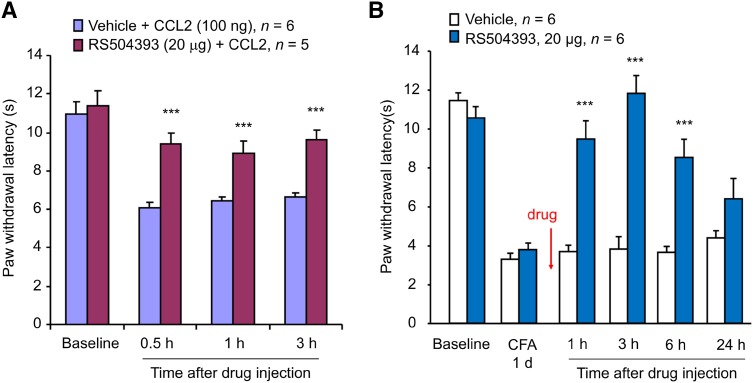
Fig. 1
Fig. 1
Inhibition of CCL2- and CFA-induced heat hyperalgesia by intrathecal injection of RS504393. A Prevention of CCL2 (100 ng, i.t)-induced heat hyperalgesia by RS504393 (20 μg, i.t.). B Reversal of CFA-induced heat hyperalgesia by RS504393 (20 μg, i.t.) given 1 day after CFA injection. ***P < 0.001 vs vehicle control (10% DMSO), two-Way ANOVA followed by post-hoc Bonferroni test; n = 5–6 mice/group; data are expressed as mean ± SEM.
Fig. 2
Fig. 2
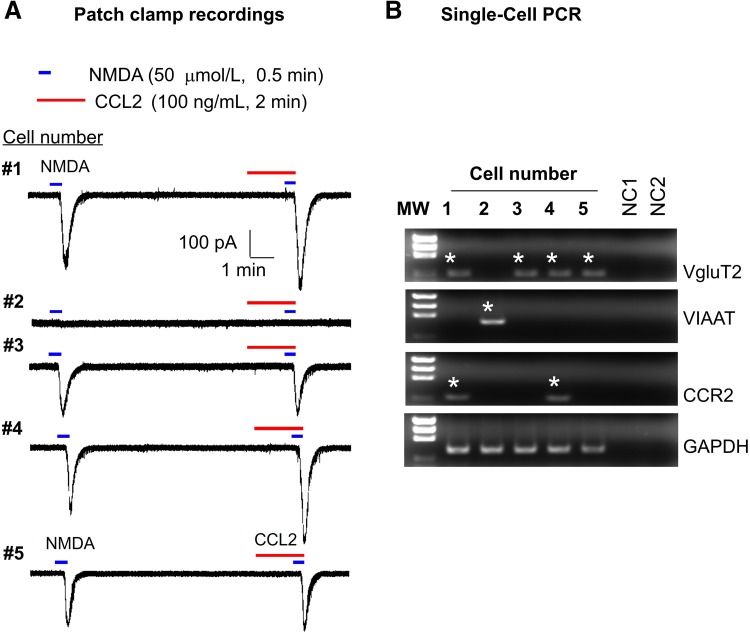
A combination approach of patch-clamp recordings and single-cell PCR showed enhancement of NMDA currents by CCL2 in CCR2-expressing excitatory neurons in lamina IIo neurons of spinal cord slices. A Patch-clamp recording shows NMDA (50 μmol/L)-induced currents in lamina IIo neurons and the effect of CCL2 (100 ng/mL). CCL2 treatment increased NMDA currents in 2 of 5 neurons. B Single-cell PCR from the recorded neurons demonstrated that 4 out of 5 lamina IIo neurons expressed VGLUT2. GAPDH was used as positive control. Negative control (NC), no cells in the reaction buffer. Positive bands are indicated by stars. Note that only two CCR2-expressing neurons displayed increased NMDA currents after the CCL2 treatment. Also note that all the VGLUT2+ but not the VIAAT+ neurons exhibited NMDA currents.
Fig. 3
Fig. 3
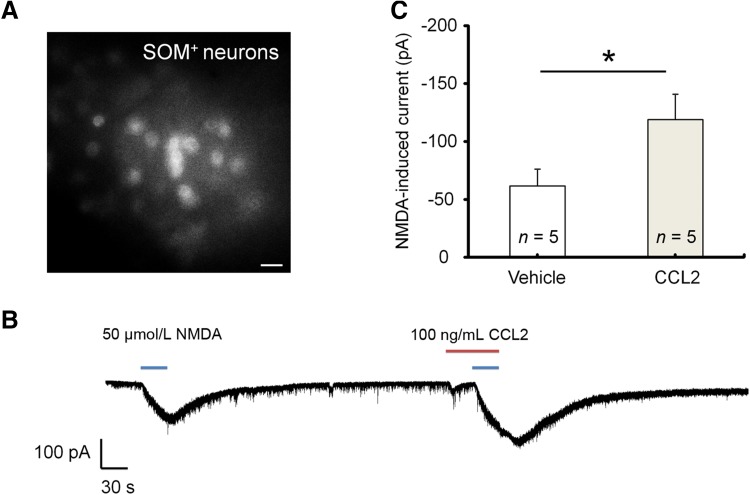
CCL2 enhances NMDA currents in SOM+ neurons in lamina IIo of spinal cord slices. A SOM+ neurons in lamina IIo of spinal cord slices from transgenic mice, as shown by tdTomato fluorescence (scale bar, 20 μm). B Traces of NMDA-induced currents in SOM+ neurons before and after CCL2 perfusion. C Amplitude of NMDA-induced currents. *P < 0.05, paired two-tailed Student’s t test; n = 5 neurons/group; data expressed as mean ± SEM.
Fig. 4
Fig. 4
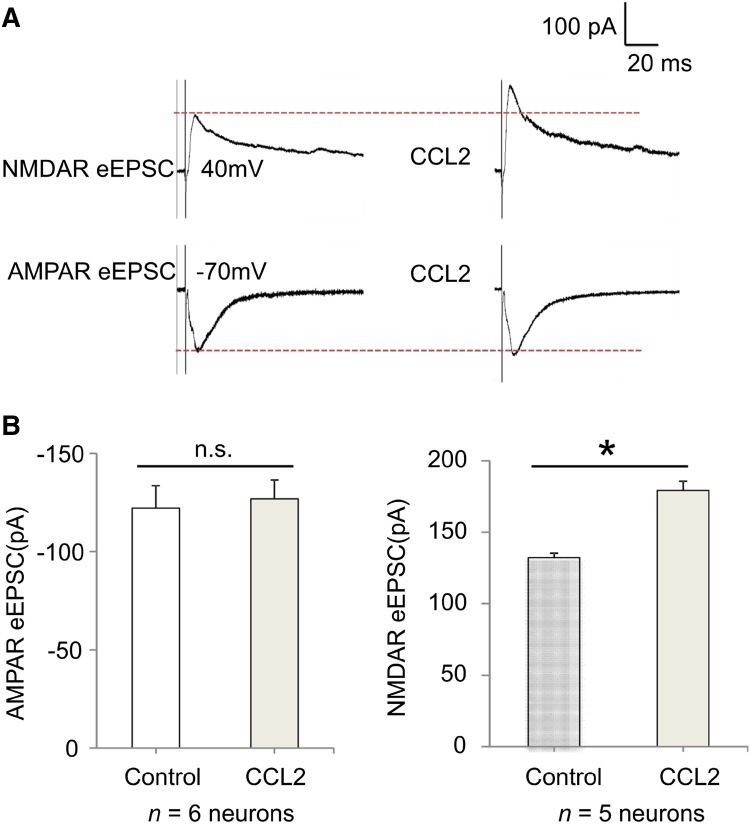
CCL2 enhances NMDAR-mediated synaptic currents in lamina IIo neurons evoked by dorsal root stimulation of spinal cord slices. A Traces of evoked NMDAR-mediated and AMPAR-mediated currents (eEPSC) before and after CCL2 treatment (100 ng/mL, 2 min). B Amplitude of NMDAR-mediated and AMPAR-mediated currents (eEPSC). *P < 0.05, paired two-tailed Student’s t test; n = 5–6 neurons/group; n.s., not significant. Note that CCL2 only enhanced NMDAR-mediated but not AMPAR-mediated synaptic currents. The data are expressed as mean ± SEM.
Fig. 5
Fig. 5
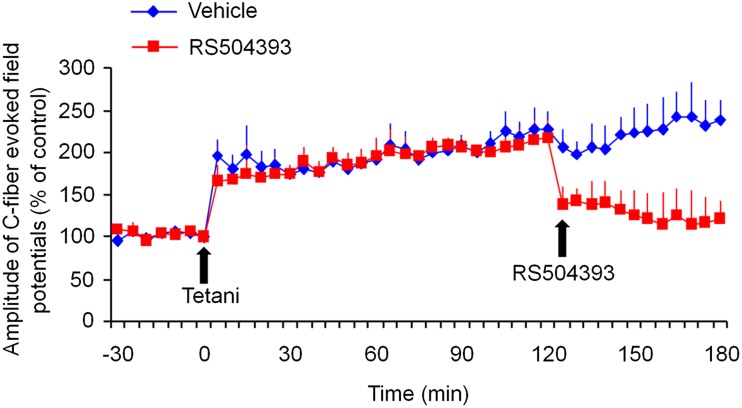
Reversal of LTP of C-fiber-evoked field potentials in the dorsal horn of anesthetized mice by RS504393 (45 μg, 15 μL, i.t.), administered 2 h after LTP induction. Spinal LTP was induced by tetanic stimulation (100 Hz, 1 s, 4 trains) of C-fiber intensity in C57/B6 mice. *P < 0.05, vehicle (10% DMSO) vs RS504393, two-way ANOVA, n = 5 mice/group.

References

    1. White FA, Jung H, Miller RJ. Chemokines and the pathophysiology of neuropathic pain. Proc Natl Acad Sci U S A. 2007;104:20151–20158. doi: 10.1073/pnas.0709250104. - DOI - PMC - PubMed
    1. Gao YJ, Ji RR. Chemokines, neuronal-glial interactions, and central processing of neuropathic pain. Pharmacol Ther. 2010;126:56–68. doi: 10.1016/j.pharmthera.2010.01.002. - DOI - PMC - PubMed
    1. Bai L, Wang X, Li Z, Kong C, Zhao Y, Qian JL, et al. Upregulation of Chemokine CXCL12 in the Dorsal Root Ganglia and Spinal Cord Contributes to the Development and Maintenance of Neuropathic Pain Following Spared Nerve Injury in Rats. Neurosci Bull. 2016;32:27–40. doi: 10.1007/s12264-015-0007-4. - DOI - PMC - PubMed
    1. Bhangoo SK, Ren D, Miller RJ, Chan DM, Ripsch MS, Weiss C, et al. CXCR4 chemokine receptor signaling mediates pain hypersensitivity in association with antiretroviral toxic neuropathy. Brain Behav Immun. 2007;21:581–591. doi: 10.1016/j.bbi.2006.12.003. - DOI - PMC - PubMed
    1. Abbadie C, Bhangoo S, De KY, Malcangio M, Melik-Parsadaniantz S, White FA. Chemokines and pain mechanisms. Brain Res Rev. 2009;60:125–134. doi: 10.1016/j.brainresrev.2008.12.002. - DOI - PMC - PubMed

MeSH terms

LinkOut - more resources