


Differences in incidence of diabetic retinopathy between type 1 and 2 diabetes mellitus: a nine-year follow-up study
- PMID: 28270484
- PMCID: PMC5629951
- DOI: 10.1136/bjophthalmol-2016-310063
Differences in incidence of diabetic retinopathy between type 1 and 2 diabetes mellitus: a nine-year follow-up study
Abstract
Background/aims: To determine the incidence of any diabetic retinopathy (any-DR), sight-threatening diabetic retinopathy (STDR) and diabetic macular oedema (DMO) and their risk factors in type 1 diabetes mellitus (T1DM) over a screening programme.
Methods: Nine-year follow-up, prospective population-based study of 366 patients with T1DM and 15 030 with T2DM. Epidemiological risk factors were as follows: current age, age at DM diagnosis, sex, type of DM, duration of DM, arterial hypertension, levels of glycosylated haemoglobin (HbA1c), triglycerides, cholesterol fractions, serum creatinine, estimated glomerular filtration rate (eGFR) and urine albumin to creatinine ratio (UACR).
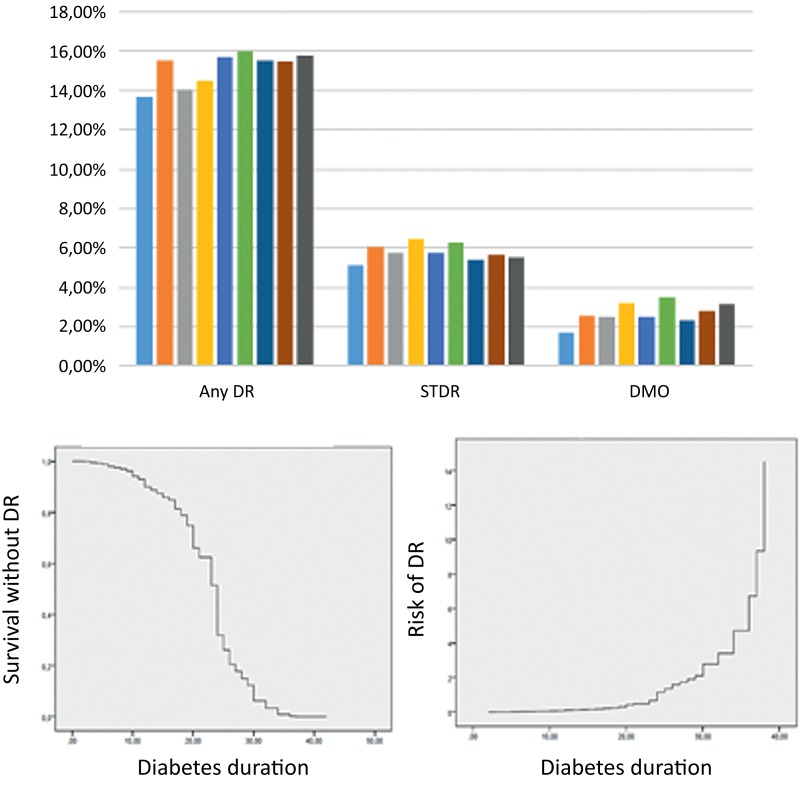
Results: Sum incidence of any-DR was 47.26% with annual incidence 15.16±2.19% in T1DM, and 26.49% with annual incidence 8.13% in T2DM. Sum incidence of STDR was 18.03% with annual incidence 5.77±1.21% in T1DM, and 7.59% with annual incidence 2.64±0.15% in T2DM. Sum incidence of DMO was 8.46% with annual incidence 2.68±038% in patients with T1DM and 6.36% with annual incidence 2.19±0.18% in T2DM. Cox's survival analysis showed that current age and age at diagnosis were risk factors at p<0.001, as high HbA1c levels at p<0.001, LDL cholesterol was significant at p<0.001, eGFR was significant at p<0.001 and UACR at p=0.017.
Conclusions: The incidence of any-DR and STDR was higher in patients with T1DM than those with T2DM. Also, the 47.26% sum incidence of any-DR in patients with T1DM was higher than in a previous study (35.9%), which can be linked to poor metabolic control of DM. Our results suggest that physicians should be encouraged to pay greater attention to treatment protocols for T1DM in patients.
Keywords: Epidemiology; Retina; Telemedicine.
Published by the BMJ Publishing Group Limited. For permission to use (where not already granted under a licence) please go to http://www.bmj.com/company/products-services/rights-and-licensing/.
Conflict of interest statement
Competing interests: None declared.
Figures
References
-
- International Diabetes Federation. IDF diabetes Atlas. 6th edn Brussels, Belgium, 2013. http://www.idf.org/diabetesatlas
-
- The Expert Committee on the Diagnosis and Classification of Diabetes Mellitus. Report of the Expert Committee on the Diagnosis and Classification of Diabetes Mellitus. Diabetes Care 2000;23(Suppl 1):S4–19. - PubMed
Publication types
MeSH terms
Substances
LinkOut - more resources
Full Text Sources
Other Literature Sources
Medical
Research Materials
Miscellaneous
