Review
. 2017 Feb 21:11:79.
doi: 10.3389/fnins.2017.00079. eCollection 2017.

Chaperone Proteins in the Central Nervous System and Peripheral Nervous System after Nerve Injury

Affiliations
Review

Chaperone Proteins in the Central Nervous System and Peripheral Nervous System after Nerve Injury

Shalina S Ousman et al. Front Neurosci. .

Abstract

Injury to axons of the central nervous system (CNS) and the peripheral nervous system (PNS) is accompanied by the upregulation and downregulation of numerous molecules that are involved in mediating nerve repair, or in augmentation of the original damage. Promoting the functions of beneficial factors while reducing the properties of injurious agents determines whether regeneration and functional recovery ensues. A number of chaperone proteins display reduced or increased expression following CNS and PNS damage (crush, transection, contusion) where their roles have generally been found to be protective. For example, chaperones are involved in mediating survival of damaged neurons, promoting axon regeneration and remyelination and, improving behavioral outcomes. We review here the various chaperone proteins that are involved after nervous system axonal damage, the functions that they impact in the CNS and PNS, and the possible mechanisms by which they act.

Keywords: axotomy; chaperone proteins; chaperones; myelination; neuronal cell death; peripheral nerve injury; regeneration; spinal cord injury.


Figures
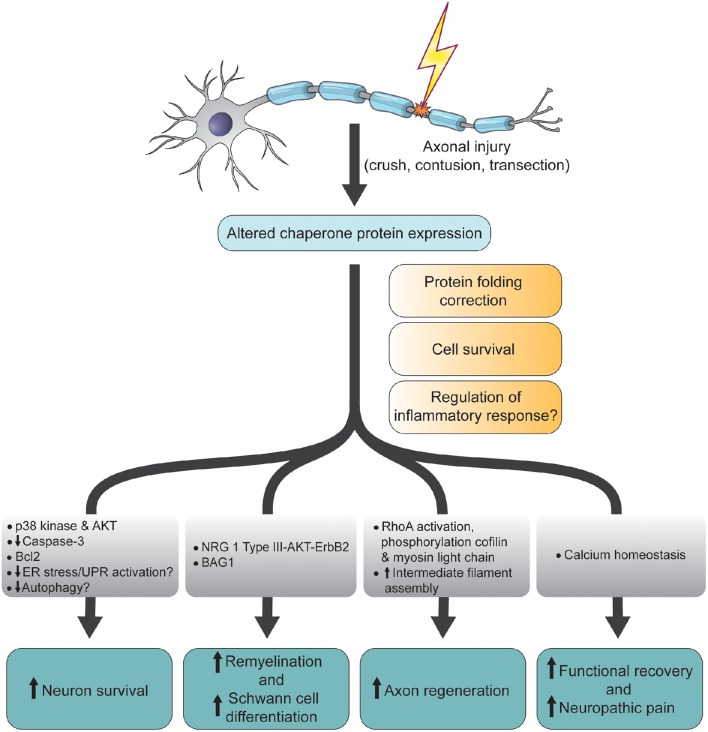
Figure 1
Figure 1
Schematic diagram summarizing the functions and molecular changes associated with altered chaperone protein expression following CNS and PNS axonal injury. ER, endoplamic reticulum; UPR, unfolded protein response; NRG, neuregulin; Bcl2, B-cell lymphoma 2; BAG1, Bcl-2-associated athanogene-1; AKT, AKT8 virus oncogene cellular homolog; p38, p38 mitogen-activated protein kinase.

References

    1. Bangaru M. L., Weihrauch D., Tang Q. B., Zoga V., Hogan Q., Wu H. E. (2013). Sigma-1 receptor expression in sensory neurons and the effect of painful peripheral nerve injury. Mol. Pain 9:47. 10.1186/1744-8069-9-47 - DOI - PMC - PubMed
    1. Benn S. C., Perrelet D., Kato A. C., Scholz J., Decosterd I., Mannion R. J., et al. . (2002). Hsp27 upregulation and phosphorylation is required for injured sensory and motor neuron survival. Neuron 36, 45–56. 10.1016/S0896-6273(02)00941-8 - DOI - PubMed
    1. Bonnard A. S., Chan P., Fontaine M. (1997). Expression of clusterin and C4 mRNA during rat peripheral nerve regeneration. Immunopharmacology 38, 81–86. 10.1016/S0162-3109(97)00073-8 - DOI - PubMed
    1. Campisi J., Fleshner M. (2003). Role of extracellular HSP72 in acute stress-induced potentiation of innate immunity in active rats. J. Appl. Physiol. (1985) 94, 43–52. 10.1152/japplphysiol.00681.2002 - DOI - PubMed
    1. Cauley K. A., Sherman T. G., Ford-Holevinski T., Agranoff B. W. (1986). Rapid expression of novel proteins in goldfish retina following optic nerve crush. Biochem. Biophys. Res. Commun. 138, 1177–1183. 10.1016/S0006-291X(86)80406-5 - DOI - PubMed

LinkOut - more resources
