Review
. 2017 Feb 21:11:37.
doi: 10.3389/fncel.2017.00037. eCollection 2017.

Understanding the Role of GPCR Heteroreceptor Complexes in Modulating the Brain Networks in Health and Disease

Affiliations
Review

Understanding the Role of GPCR Heteroreceptor Complexes in Modulating the Brain Networks in Health and Disease

Dasiel O Borroto-Escuela et al. Front Cell Neurosci. .

Abstract

The introduction of allosteric receptor-receptor interactions in G protein-coupled receptor (GPCR) heteroreceptor complexes of the central nervous system (CNS) gave a new dimension to brain integration and neuropsychopharmacology. The molecular basis of learning and memory was proposed to be based on the reorganization of the homo- and heteroreceptor complexes in the postjunctional membrane of synapses. Long-term memory may be created by the transformation of parts of the heteroreceptor complexes into unique transcription factors which can lead to the formation of specific adapter proteins. The observation of the GPCR heterodimer network (GPCR-HetNet) indicated that the allosteric receptor-receptor interactions dramatically increase GPCR diversity and biased recognition and signaling leading to enhanced specificity in signaling. Dysfunction of the GPCR heteroreceptor complexes can lead to brain disease. The findings of serotonin (5-HT) hetero and isoreceptor complexes in the brain over the last decade give new targets for drug development in major depression. Neuromodulation of neuronal networks in depression via 5-HT, galanin peptides and zinc involve a number of GPCR heteroreceptor complexes in the raphe-hippocampal system: GalR1-5-HT1A, GalR1-5-HT1A-GPR39, GalR1-GalR2, and putative GalR1-GalR2-5-HT1A heteroreceptor complexes. The 5-HT1A receptor protomer remains a receptor enhancing antidepressant actions through its participation in hetero- and homoreceptor complexes listed above in balance with each other. In depression, neuromodulation of neuronal networks in the raphe-hippocampal system and the cortical regions via 5-HT and fibroblast growth factor 2 involves either FGFR1-5-HT1A heteroreceptor complexes or the 5-HT isoreceptor complexes such as 5-HT1A-5-HT7 and 5-HT1A-5-HT2A. Neuromodulation of neuronal networks in cocaine use disorder via dopamine (DA) and adenosine signals involve A2AR-D2R and A2AR-D2R-Sigma1R heteroreceptor complexes in the dorsal and ventral striatum. The excitatory modulation by A2AR agonists of the ventral striato-pallidal GABA anti-reward system via targeting the A2AR-D2R and A2AR-D2R-Sigma1R heteroreceptor complex holds high promise as a new way to treat cocaine use disorders. Neuromodulation of neuronal networks in schizophrenia via DA, adenosine, glutamate, 5-HT and neurotensin peptides and oxytocin, involving A2AR-D2R, D2R-NMDAR, A2AR-D2R-mGluR5, D2R-5-HT2A and D2R-oxytocinR heteroreceptor complexes opens up a new world of D2R protomer targets in the listed heterocomplexes for treatment of positive, negative and cognitive symptoms of schizophrenia.

Keywords: G protein-coupled receptor; addiction; depression; dopamine receptor; heteroreceptor complexes; oligomerization; schizophrenia; serotonin receptor.


Figures
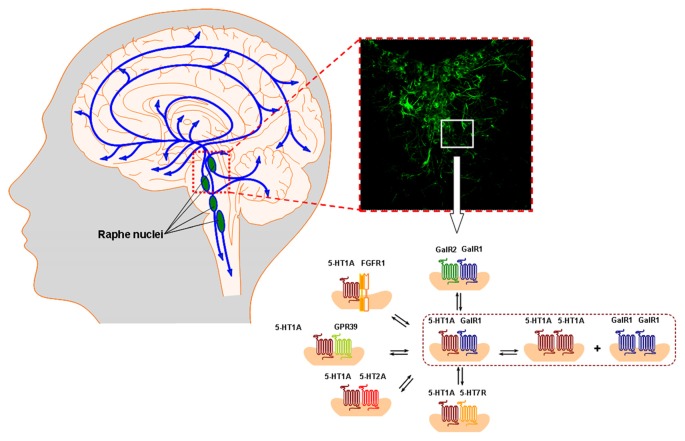
Figure 1
Figure 1
The ascending and descending 5-HT pathways from the rostral and caudal raphe nuclei are illustrated in the left panel. In the right panel the 5-HT immunoreactive nerve cell bodies and dendrites in the dorsal raphe are shown. The panorama of 5-HT1A heteroreceptor complexes including the 5-HT1A isoreceptor complexes demonstrated in the dorsal raphe and in the dorsal hippocampus are given in the lower right part shown as heterodimers and in possible balance with each other. They were described at the postjunctional level, likely in synaptic and extrasynaptic locations. The prejunctional existence of these 5-HT1A heterocomplexes at the 5-HT nerve terminal still remains to be studied. They play a major role in the 5-HT modulation of the neuronal networks in the raphe-hippocampal system together with the corresponding homoreceptor complexes and monomers. For the abbreviations see Supplementary Material.
Figure 2
Figure 2
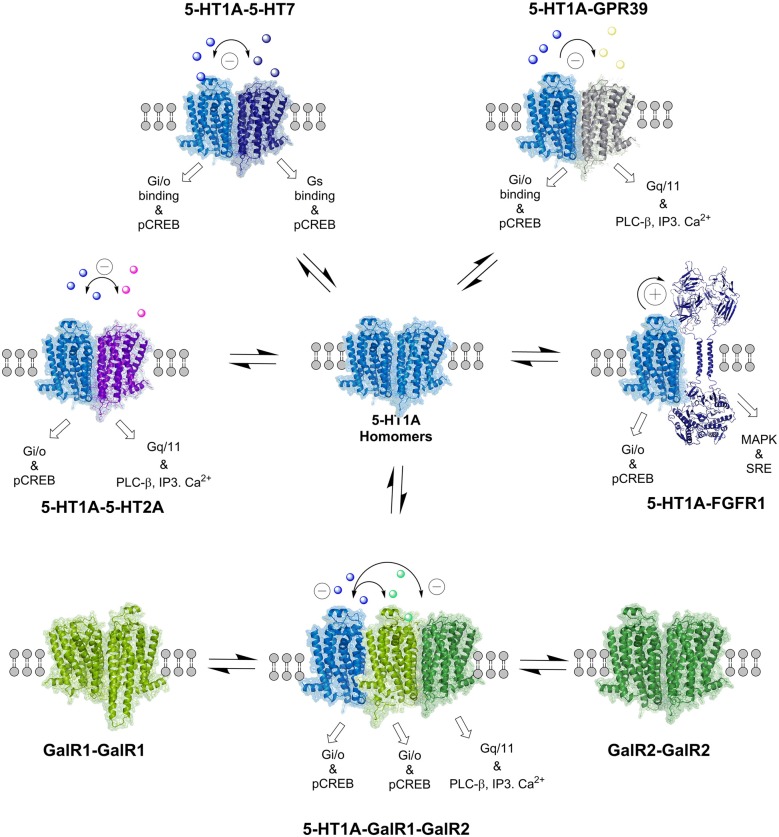
The balance of the various serotonin 5-HT1A and galanin (GalR1 and GalR2) homo- and heteroreceptor complexes is indicated. Also the 5-HT1A-FGFR1 heteroreceptor complexes are presented, which have a role in depression. The allosteric receptor–receptor interactions induced constitutively or by activation of one receptor protomer can influence the recognition, G protein coupling, signaling and trafficking of the other protomers in the homo and heteroreceptor complex as indicated. The nature of the allosteric receptor–receptor interactions found in the individual heteromers is indicated in the top part of the receptor complexes ([−] antagonistic allosteric modulation, [+] facilitatory allosteric modulation). The signaling of the receptor protomers reflects the signaling of the basal states. For the abbreviations see Supplementary Material.
Figure 3
Figure 3
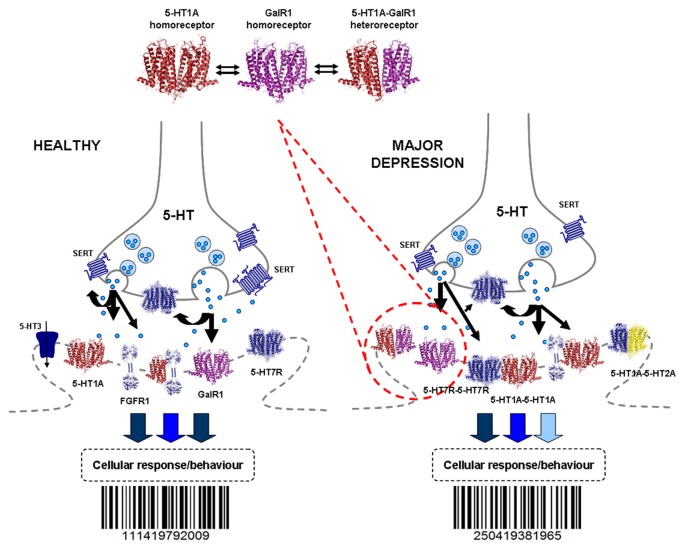
The 5-HT1A hetero- and homoreceptor complexes shown as heterodimers are illustrated in the pre and postjunctional membranes of the 5-HT junctions. This represents a general hypothesis not specifically related to the raphe and/or hippocampus. In the right part the reorganization of the panorama of the 5-HT1A heteroreceptor complexes in major depression are illustrated. Such reorganization can also take place in synapses and their peri and extrasynaptic regions including inter alia glutamate synapses involving also changes in the balance of the 5-HT1A heteroreceptor complexes with their corresponding homoreceptor complexes shown as hetero-and homodimers in the upper part. Also changes in 5-HT release may play a role in the 5-HT receptor reorganization. This leads to changes in the integrative 5-HT receptor signaling including the multiple 5-HT receptor families and the various heteroreceptor complexes formed from each of the 5-HT receptor subtypes. Thus, the barcodes of the 5-HT junctions and of inter alia glutamate and GABA synapses can be changed in depression. This induces changes in the operation of the neuronal networks e.g., the raphe-hippocampal 5-HT system contributing to changes in cellular and behavioral responses leading to major depression. For the abbreviations see Supplementary Material.
Figure 4
Figure 4
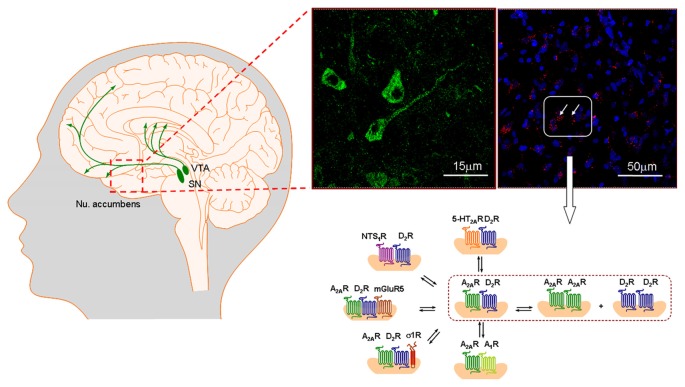
To the far left the ascending nigro-striatal and meso-limbic-cortical dopamine (DA) neurons are presented. The meso-limbic DA neurons play a major role in cocaine addiction inter alia through their dense innervations of the nucleus accumbens shell with their D2R positive nerve cells regulating the brain circuit from the nucleus accumbens shell to the prefrontal cortex. The first pathway is the ventral striato-pallidal GABA anti-reward system, rich inter alia in A2AR-D2R heteroreceptor complexes. In the far right part the A2AR-D2R heteroreceptor complexes are visualized as red clusters in the nucleus accumbens shell using the in situ proximity ligation assay (in situ PLA). To the left of this panel, sigma1R is seen as green immunofluorescence in nerve cell bodies in the nucleus accumbens shell which likely mainly represent GABAergic projection neurons. In this region a large panorama of D2R heteroreceptor complexes exists in the accumbens shell-ventral pallidal GABA anti-reward neurons modulating their activity (lower part). It represents previous work performed mainly in nuc accumbens (Fuxe et al., 2014e,f). They play as major role in modulating these neurons and the panorama is reorganized in cocaine addiction and schizophrenia contributing to the development of these diseases by increasing salience through inter alia removal of the brakes on the D2R protomer signaling found in distinct heterocomplexes. As examples from the nucleus accumbens are shown: A2AR-D2R, 5-HT2AR-D2R, NTS1-D2R complexes given as heterodimers and A2AR-D2R-mGluR5 and A2AR-D2R-sigma1R heterocomplexes given as heterotrimers (Cabello et al., ; Borroto-Escuela et al., ,,, ,; Trifilieff et al., 2011). The A2A-D2 complexes are not located on the DA terminals and thus do not exist in a prejunctional position. Overall, the heteroreceptor complexes are mainly postjunctional on dendrites-soma but some are located also on glutamate terminals like A2AR-D2R and NTS1-D2R heteroreceptor complexes (Tanganelli et al., 2004, 2012).The scheme shown of heteroreceptor complexes in the figure does not itself give any indication of pre vs. post-junctional localization. For the abbreviations see Supplementary Material.
Figure 5
Figure 5
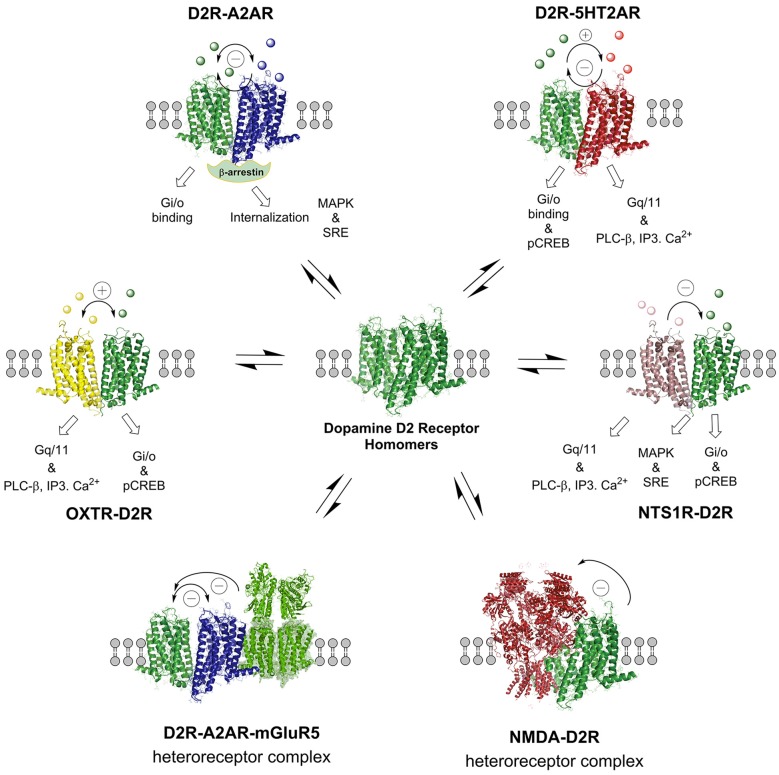
The D2R heteroreceptor complexes illustrated in this figure are mainly found in the striatum. The balance of the various D2R homo and heteroreceptor complexes are presented and their allosteric receptor–receptor interactions indicated. Also the NMDAR-D2R and OXTR-D2 heteroreceptor complexes are presented, the latter having a role in social salience. The basal signaling of some of the D2R heteroreceptor complexes is indicated. The nature of the allosteric receptor–receptor interactions found in the individual heteromers is indicated in the top part of the receptor complexes ([−] antagonistic allosteric modulation, [+] facilitatory allosteric modulation). For the abbreviations see Supplementary Material.

References

    1. Agnati L. F., Celani M. F., Fuxe K. (1983a). Cholecystokinin peptides in vitro modulate the characteristics of the striatal 3H-N-propylnorapomorphine sites. Acta Physiol. Scand. 118, 79–81. 10.1111/j.1748-1716.1983.tb07244.x - DOI - PubMed
    1. Agnati L. F., Fuxe K., Benfenati F., Battistini N. (1983b). Neurotensin in vitro markedly reduces the affinity in subcortical limbic 3H-N-propylnorapomorphine binding sites. Acta Physiol. Scand. 119, 459–461. 10.1111/j.1748-1716.1983.tb07363.x - DOI - PubMed
    1. Agnati L. F., Guidolin D., Guescini M., Genedani S., Fuxe K. (2010). Understanding wiring and volume transmission. Brain Res. Rev. 64, 137–159. 10.1016/j.brainresrev.2010.03.003 - DOI - PubMed
    1. Albizu L., Holloway T., González-Maeso J., Sealfon S. C. (2011). Functional crosstalk and heteromerization of serotonin 5-HT2A and dopamine D2 receptors. Neuropharmacology 61, 770–777. 10.1016/j.neuropharm.2011.05.023 - DOI - PMC - PubMed
    1. Amargós-Bosch M., Bortolozzi A., Puig M. V., Serrats J., Adell A., Celada P., et al. (2004). Co-expression and in vivo interaction of serotonin1A and serotonin2A receptors in pyramidal neurons of prefrontal cortex. Cereb. Cortex 14, 281–299. 10.1093/cercor/bhg128 - DOI - PubMed