


Complementary Keratoconus Indices Based on Topographical Interpretation of Biomechanical Waveform Parameters: A Supplement to Established Keratoconus Indices
- PMID: 28270858
- PMCID: PMC5320073
- DOI: 10.1155/2017/5293573
Complementary Keratoconus Indices Based on Topographical Interpretation of Biomechanical Waveform Parameters: A Supplement to Established Keratoconus Indices
Abstract
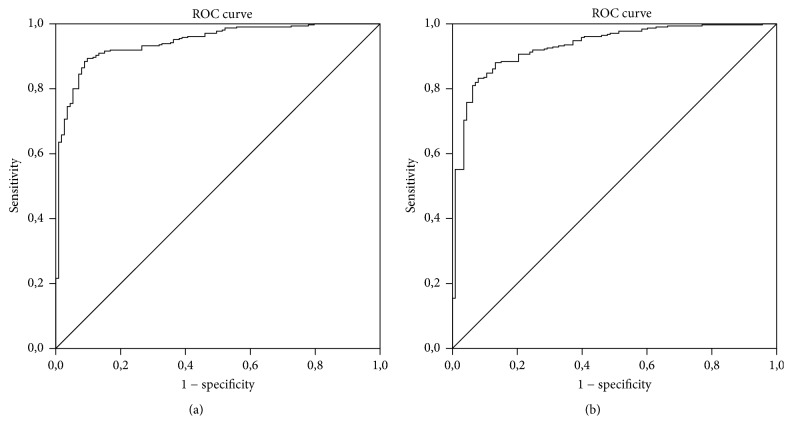
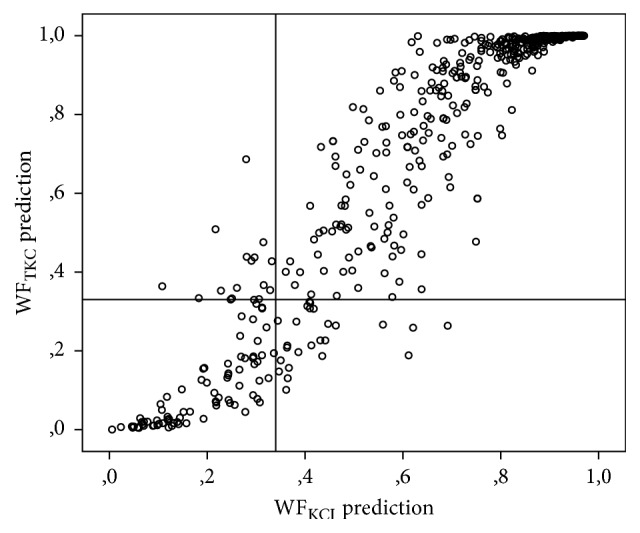
Purpose. To build new models with the Ocular Response Analyzer (ORA) waveform parameters to create new indices analogous to established topographic keratoconus indices. Method. Biomechanical, tomographic, and topographic measurements of 505 eyes from the Homburger Keratoconus Centre were included. Thirty-seven waveform parameters (WF) were derived from the biomechanical measurement with the ORA. Area under curve (ROC, receiver operating characteristic) was used to quantify the screening performance. A logistic regression analysis was used to create two new keratoconus prediction models based on these waveform parameters to resample the clinically established keratoconus indices from Pentacam and TMS-5. Results. ROC curves show the best results for the waveform parameters p1area, p2area, h1, h2, dive1, mslew1, aspect1, aplhf, and dslope1. The new keratoconus prediction model to resample the Pentacam topographic keratoconus index (TKC) was WFTKC = -4.068 + 0.002 × p2area - 0.005 × dive1 - 0.01 × h1 - 2.501 × aplhf, which achieves a sensitivity of 90.3% and specificity of 89.4%; to resample the TMS-5 keratoconus classification index (KCI) it was WFKCI = -3.606 + 0.002 × p2area, which achieves a sensitivity of 75.4% and a specificity of 81.8%. Conclusion. In addition to the biomechanically provided Keratoconus Index two new indices which were based on the topographic gold standards (either Pentacam or TMS-5) were created. Of course, these do not replace the original topographic measurement.
Conflict of interest statement
The authors report no conflict of interests and have no proprietary interest in any of the materials or instruments mentioned in this article.
Figures

References
MeSH terms
LinkOut - more resources
Full Text Sources
Other Literature Sources
