


EDIN Scale Implemented by Gestational Age for Pain Assessment in Preterms: A Prospective Study
- PMID: 28271074
- PMCID: PMC5320371
- DOI: 10.1155/2017/9253710
EDIN Scale Implemented by Gestational Age for Pain Assessment in Preterms: A Prospective Study
Abstract
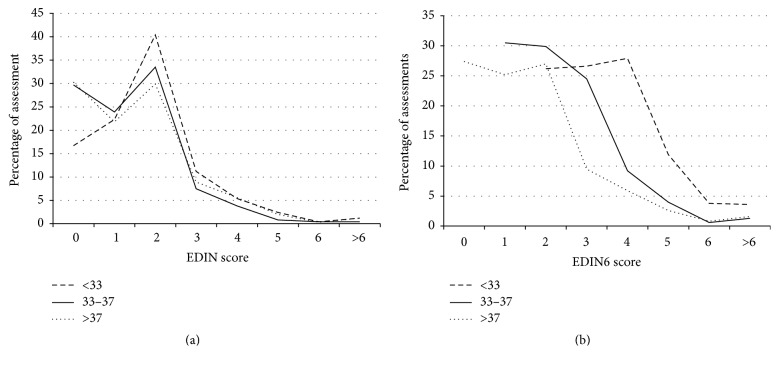
Background. Chronic neonatal pain can lead to long-term adverse effects on the immature brain. EDIN scale for prolonged pain might not be fully suitable for premature infants. We aimed to test a modified EDIN scale, adding postmenstrual age (PMA) as a sixth item (EDIN6). Methods. In a two-phase prospective study, pain was assessed in all neonates admitted in our NICU. In T1 EDIN was applied; in T2 EDIN6 with additional scores of 2, 1, and 0, respectively, for 25-32, 33-37, and >37 weeks PCA was tested. Scores > 6 suggested pain. The nursing staff was given a questionnaire to evaluate EDIN and EDIN6. Results. A total of 15960 pain assessments were recorded (8693 in T1; 7267 in T2). With EDIN6, cumulative detection of pain almost tripled (117/7267 versus 52/8693, p = 0.001). Main differences were found among less mature categories (50/1472 versus 17/1734, p = 0.001 in PCA 25-32; 26/2606 versus 10/4335, p = 0.001 in PMA 33-37; 41/3189 versus 25/2624, p = 0.26 in PMA > 37). Adequacy of pain assessment in lower PMA was judged "medium-high" in 13,4% of nurses in T1 and 71,4% in T2. Conclusions. EDIN6 may allow improved evaluation of pain in preterm infants.
Conflict of interest statement
The authors declare that there is no conflict of interests regarding the publication of this paper.
Figures
References
Publication types
MeSH terms
LinkOut - more resources
Full Text Sources
Other Literature Sources
Medical
