. 2017 May;45(9):1201-1212.
doi: 10.1111/apt.14021. Epub 2017 Mar 8.

Transformation of hepatitis C antiviral treatment in a national healthcare system following the introduction of direct antiviral agents

Affiliations

Transformation of hepatitis C antiviral treatment in a national healthcare system following the introduction of direct antiviral agents

A M Moon et al. Aliment Pharmacol Ther. 2017 May.

Abstract

Background: Highly effective direct antiviral agents (DAAs) for hepatitis C virus (HCV) were introduced recently. Their utilisation has been limited by high cost and low access to care.

Aim: To describe the effect of DAAs on HCV treatment and cure rates in the United States Veterans Affairs (VA) national healthcare system.

Methods: We identified all HCV antiviral treatment regimens initiated from 1 January 1999 to 31 December 2015 (n = 105 369) in the VA national healthcare system, and determined if they resulted in sustained virological response (SVR).

Results: HCV antiviral treatment rates were low (1981-6679 treatments/year) in the interferon era (1999-2010). The introduction of simeprevir and sofosbuvir in 2013 and ledipasvir/sofosbuvir and paritaprevir/ombitasvir/ritonavir/dasabuvir in 2014 were followed by increases in annual treatment rates to 9180 in 2014 and 31 028 in 2015. The number of patients achieving SVR was 1313 in 2010, the last year of the interferon era, and increased 5.6-fold to 7377 in 2014 and 21-fold to 28 084 in 2015. The proportion of treated patients who achieved SVR increased from 19.2% in 1999 and 36.0% in 2010 to 90.5% in 2015. Within 2015, monthly treatment rates ranged from 727 in July to 6868 in September correlating with the availability of funds for DAAs.

Conclusions: DAAs resulted in a 21-fold increase in the number of patients achieving HCV cure. Treatment rates in 2015 were limited primarily by the availability of funds. Further increases in funding and cost reductions of DAAs in 2016 suggest that the VA could cure the majority of HCV-infected Veterans in VA care within the next few years.


Conflict of interest statement

Declaration of Personal Interests

None

Figures

Figure 1
Figure 1
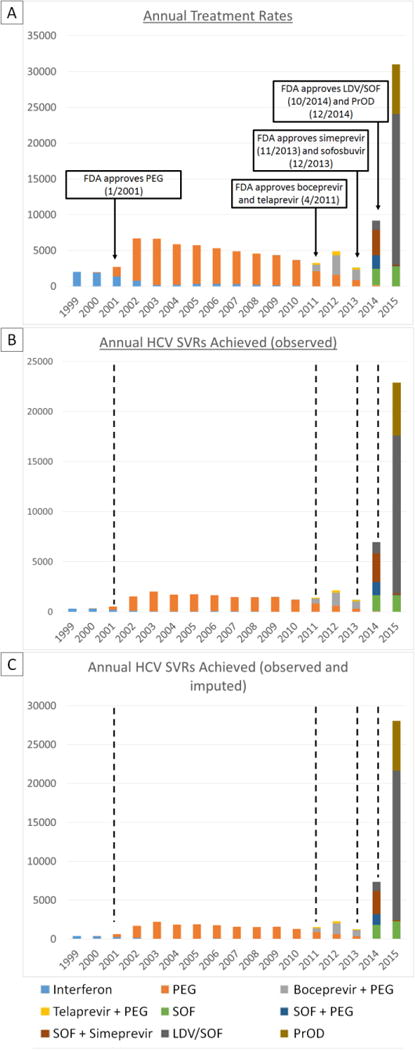
Annual HCV regimens initiated (A), achieving SVR (observed) (B) and achieving SVR (observed and imputed) (C) with eras of HCV treatment regimens marked with dashed lines. Low HCV treatment and SVR levels during the pegylated interferon era (2001-2011) were followed by modest improvements during the boceprevir and telaprevir era (2011-2013) and much larger increases during the simeprevir and sofosbuvir (2014) and LDV/SOF and PrOD eras (2015). The regimens shown include those with and without concomitant ribavirin. Simeprevir + PEG regimens are not shown due to insufficient number of regimens initiated A very small number of “SOF” regimens also included additional daclatasvir, which was approved on 7/24/15 for HCV genotype 3 infection. PEG = pegylated-interferon SOF = sofosbuvir LDV/SOF = ledipasvir/sofosbuvir PrOD = paritaprevir/ritonavir/ombitasvir/dasabuvir
Figure 2
Figure 2
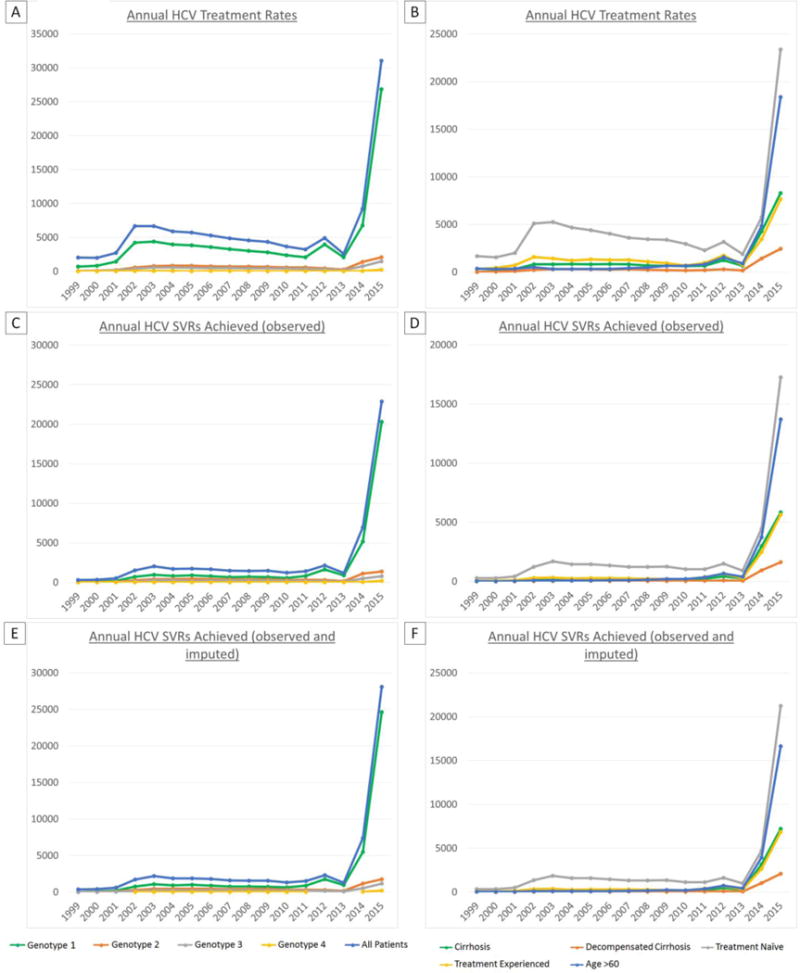
Annual HCV regimens initiated by clinical characteristics (A), regimens achieving SVR by clinical characteristics using observed SVR data (B) or observed and imputed SVR data (C). Treatment and cure rates increased substantially in all patient subgroups, including previously “difficult-to-treat” patients such as those with cirrhosis, but the most profound increase occurred in older patients (age >60 years).
Figure 3
Figure 3
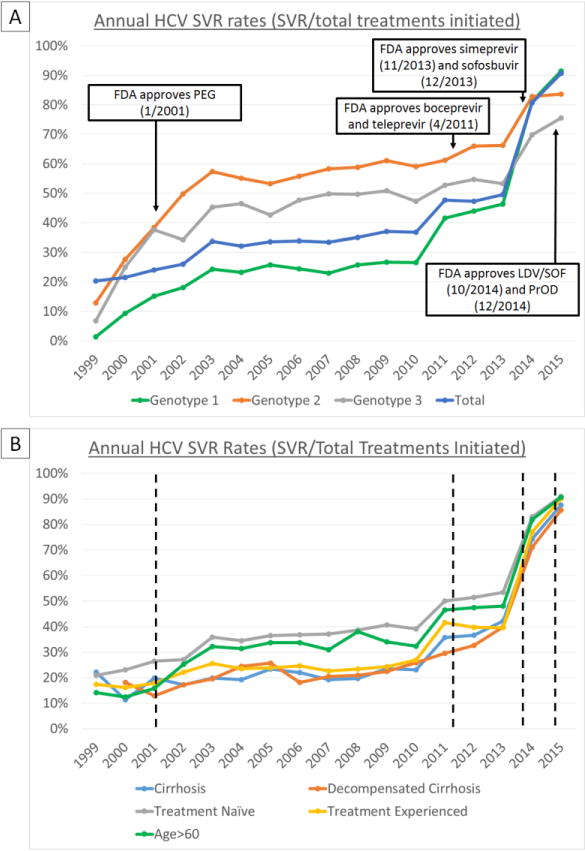
Annual SVR rates by HCV genotype (A) and clinical characteristics (B) with HCV treatment eras demarcated with dashed lines. With each successive introduction of new HCV treatment regimens, SVR rates increased from <25% in the PEG-interferon era (2001-2010) to approximately 50% in 2011-2013 (boceprevir & teleprevir era), 80% in 2014 (simeprevir & SOF era), and >90% in 2015 (LDV/SOF & PrOD era). “Difficult-to-treat” groups such as treatment-experienced patients, and those with cirrhosis or decompensated cirrhosis had lower SVR rates prior to 2014-2015. In 2014-2015, SVR rates for these groups were similar to those of lower risk groups, such as treatment naïve patients. SVR rates for 2015 only reflect rates from the first half of the year (January-June), due to the large number of patients missing SVR data in the latter half of 2015 (insufficient time elapsed until data pull in April 2016) PEG = pegylated-interferon, SOF = sofosbuvir, LDV/SOF = ledipasvir/sofosbuvir, PrOD = paritaprevir/ritonavir/ombitasvir/dasabuvir
Figure 4
Figure 4
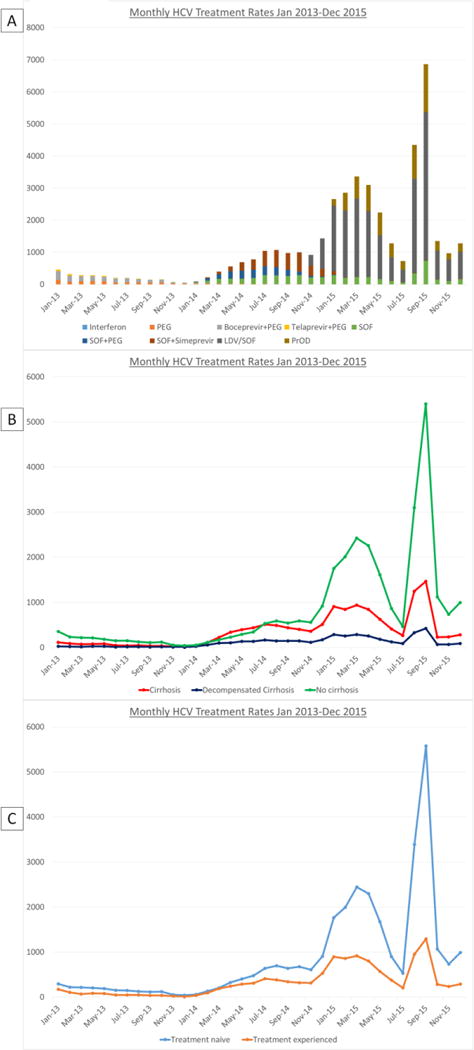
Monthly HCV regimens initiated from January 2013 to December 2015 by HCV regimen (A) and clinical characteristics (B and C). After increased funding became available in October 2014, monthly rates increased dramatically from October 2014 to March 2015. After funding began to become exhausted, treatment numbers declined, particularly among patients without cirrhosis. Congress passed legislation for HCV treatment in August and September 2015, followed by a dramatic increase in treatment initiations, particularly among patients without cirrhosis. PEG = pegylated-interferon, SOF = sofosbuvir, LDV/SOF = ledipasvir/sofosbuvir, PrOD = paritaprevir/ritonavir/ombitasvir/dasabuvir

References

    1. Holmberg SD, Spradling PR, Moorman AC, et al. Hepatitis C in the United States. N Engl J Med. 2013;368:1859–61. - PMC - PubMed
    1. Afdhal N, Zeuzem S, Kwo P, et al. Ledipasvir and sofosbuvir for untreated HCV genotype 1 infection. N Engl J Med. 2014;370:1889–98. - PubMed
    1. Afdhal N, Reddy KR, Nelson DR, et al. Ledipasvir and sofosbuvir for previously treated HCV genotype 1 infection. N Engl J Med. 2014;370:1483–93. - PubMed
    1. Kowdley KV, Gordon SC, Reddy KR, et al. Ledipasvir and sofosbuvir for 8 or 12 weeks for chronic HCV without cirrhosis. N Engl J Med. 2014;370:1879–88. - PubMed
    1. Feld JJ, Kowdley KV, Coakley E, et al. Treatment of HCV with ABT-450/r-ombitasvir and dasabuvir with ribavirin. N Engl J Med. 2014;370:1594–603. - PubMed