. 2017 Oct;42(11):2222-2231.
doi: 10.1038/npp.2017.50. Epub 2017 Mar 8.

The Differential Binding of Antipsychotic Drugs to the ABC Transporter P-Glycoprotein Predicts Cannabinoid-Antipsychotic Drug Interactions

Affiliations

The Differential Binding of Antipsychotic Drugs to the ABC Transporter P-Glycoprotein Predicts Cannabinoid-Antipsychotic Drug Interactions

Natalia I Brzozowska et al. Neuropsychopharmacology. 2017 Oct.

Abstract

Cannabis use increases rates of psychotic relapse and treatment failure in schizophrenia patients. Clinical studies suggest that cannabis use reduces the efficacy of antipsychotic drugs, but there has been no direct demonstration of this in a controlled study. The present study demonstrates that exposure to the principal phytocannabinoid, Δ9-tetrahydrocannabinol (THC), reverses the neurobehavioral effects of the antipsychotic drug risperidone in mice. THC exposure did not influence D2 and 5-HT2A receptor binding, the major targets of antipsychotic action, but it lowered the brain concentrations of risperidone and its active metabolite, 9-hydroxy risperidone. As risperidone and its active metabolite are excellent substrates of the ABC transporter P-glycoprotein (P-gp), we hypothesized that THC might increase P-gp expression at the blood-brain barrier (BBB) and thus enhance efflux of risperidone and its metabolite from brain tissue. We confirmed that the brain disposition of risperidone and 9-hydroxy risperidone is strongly influenced by P-gp, as P-gp knockout mice displayed greater brain concentrations of these drugs than wild-type mice. Furthermore, we demonstrated that THC exposure increased P-gp expression in various brain regions important to risperidone's antipsychotic action. We then showed that THC exposure did not influence the neurobehavioral effects of clozapine. Clozapine shares a very similar antipsychotic mode of action to risperidone, but unlike risperidone is not a P-gp substrate. Our results imply that clozapine or non-P-gp substrate antipsychotic drugs may be better first-line treatments for schizophrenia patients with a history of cannabis use.


Figures
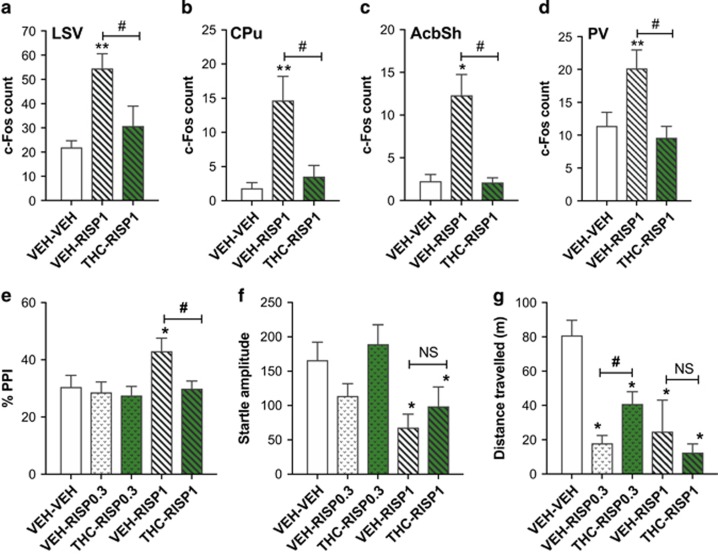
Figure 1
Figure 1
Repeated THC exposure reduced the neurobehavioral effects of the antipsychotic drug risperidone. c-Fos expression in the (a) ventrolateral septum (LSV), (b) dorsomedial caudate putamen (CPu), (c) nucleus accumbens shell (AcbSh), and (d) paraventricular nucleus of the thalamus (PV) (n=8 per group). (e) %PPI, (f) startle response, and (g) locomotor activity (n=11–12 per group). VEH, vehicle; THC, 1 mg/kg Δ9-tetrahydrocannabinol; RISP0.3, 0.3 mg/kg risperidone; RISP1, 1 mg/kg risperidone. Data presented as mean+SEM. Significant differences compared with VEH-VEH control *P<0.05 and **P<0.01, and between VEH-RISP and THC-RISP groups #P<0.05 (Mann–Whitney U for c-Fos or SNK post hoc test for behavior). For PPI, startle response, and locomotor activity, one-way ANOVA revealed an overall group effect (F(4, 53)=3.1, P<0.05; F(4, 53)=4.3, P<0.01; F(4, 53)=7.3, P<0.0001, respectively).
Figure 2
Figure 2
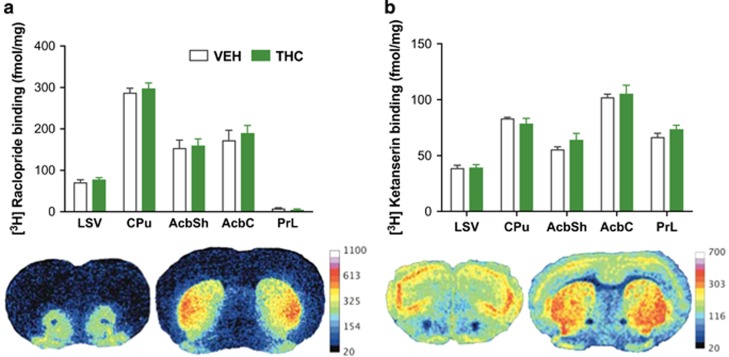
THC exposure did not influence binding or expression of D2 and 5-HT2A receptors, the major targets of antipsychotic drug action. (a) [3H] raclopride (D2 antagonist) binding and representative autoradiograph. (b) [3H] ketanserin (5-HT2A antagonist) binding and representative autoradiograph (n=6 per group). LSV, ventrolateral septum; CPu, dorsomedial caudate putamen; AcbSh, nucleus accumbens shell; AcbC, nucleus accumbens core; PrL, prelimbic cortex; VEH, vehicle; THC, Δ9-tetrahydrocannabinol. Data represent mean+SEM. No main effects of THC in two-way ANOVA (THC by brain region) Ps>0.05. This was confirmed with individual unpaired t-tests for each brain region that indicated no significant differences between vehicle and THC pretreated groups for either D2 or 5-HT2A receptor binding.
Figure 3
Figure 3
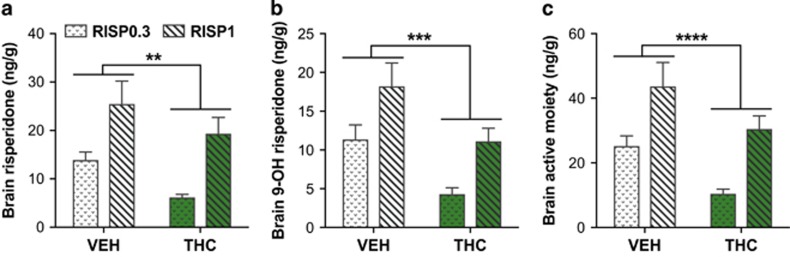
Repeated THC exposure reduced whole brain concentrations of risperidone, its active metabolite 9-hydroxy risperidone, and total active moiety. (a) Risperidone, (b) 9-hydroxy risperidone, and (c) total active moiety brain concentrations (n=6–8 per group). VEH, vehicle; THC, Δ9-tetrahydrocannabinol; RISP0.3, 0.3 mg/kg risperidone; RISP1, 1 mg/kg risperidone. Data represent mean+SEM. Significant differences denoted reflect a main effect of THC in two-way ANOVA **P<0.01, ***P<0.001 and ****P<0.0001. Two-way ANOVA indicated that THC-treated mice had significantly decreased brain concentrations compared with vehicle of risperidone (F(1, 26)=10, P<0.01), 9-hydroxy risperidone (F(1, 26)=19.1, P<0.001), and the total active drug moiety (F(1, 26)=17, P<0.0001). There was a significant effect of risperidone dose on the brain concentrations of risperidone (F(1, 26)=23.2, P<0.0001), 9-hydroxy risperidone (F(1, 26)=18.6, P<0.0001), and total active moiety (F(1, 26)=29.3, P<0.0001), but there were no significant interactions between THC and risperidone dose on these brain concentrations.
Figure 4
Figure 4
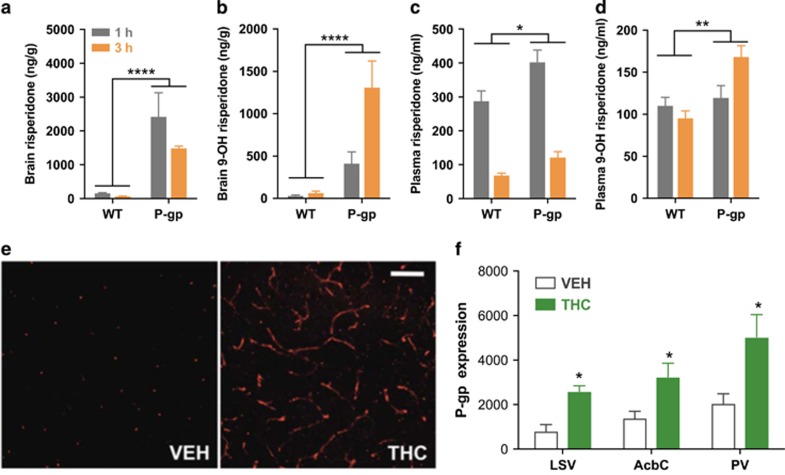
The brain disposition of risperidone and 9-hydroxy risperidone is regulated by the ABC transporter P-gp and repeated THC exposure increased brain P-gp expression. Brain (a) risperidone and (b) 9-hydroxy risperidone concentrations, as well as plasma (c) risperidone and (d) 9-hydroxy risperidone concentrations in WT and P-gp KO mice (n=5–8 per group). (e) Representative images of P-gp immunofluorescence in mouse brain and (f) P-gp expression in different brain regions of mice treated with VEH or THC. Data represent mean+SEM. WT; wild type; P-gp, P-gp KO mice; VEH, vehicle; THC, Δ9-tetrahydrocannabinol; LSV, ventrolateral septum; CPu, dorsomedial caudate putamen; AcbC, nucleus accumbens core; PV, paraventricular nucleus of the thalamus. Significant differences in KO mice studies reflect a main effect of P-gp genotype in two-way ANOVA, *P<0.05, **P<0.01 and ****P<0.0001. Specifically, we found a main effect of P-gp genotype for both brain and plasma risperidone concentrations (F(1, 20)=37.6, P<0.0001; F(1, 18)=7.7, P<0.05, respectively) and brain and plasma 9-hydroxy risperidone concentrations (F(1, 20)=31.4, P<0.0001; F(1, 18)=10.8, P<0.01, respectively). There were no effects of time or genotype by time interactions for brain and plasma risperidone concentrations. However, 9-hydroxy risperidone brain and plasma concentrations increased over time (F(1, 20=10.3, P<0.01; F(1, 18)=67.8, P<0.0001, respectively) and did more so in the P-gp KO mice supported by P-gp genotype by time interactions (F(1, 20)=8.9, P<0.01; F(1, 18)=6.3, P<0.05, respectively). Repeated THC exposure significantly increased the cumulative volume of P-gp transporter expression in key brain regions relevant to antipsychotic action (n=4–6 per group). Mann–Whitney U-tests *P<0.05.
Figure 5
Figure 5
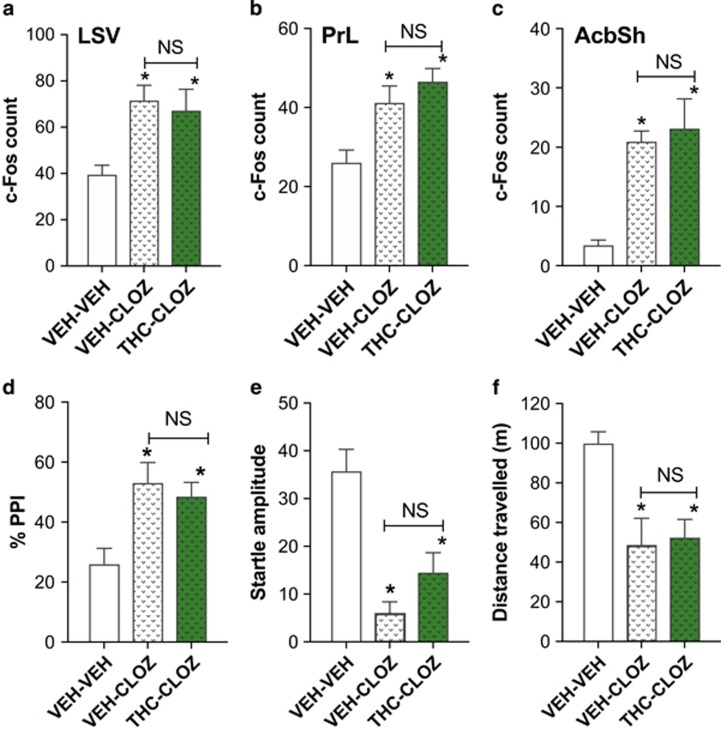
Repeated THC exposure did not influence the acute neurobehavioral effects of the non-P-gp substrate clozapine. c-Fos expression in the (a) ventrolateral septum, (b) prelimbic cortex, and (c) nucleus accumbens shell (n=6 per group). (d) %PPI, (e) startle response, and (f) locomotor activity (n=12–24 per group). Data represent mean+SEM. VEH, vehicle; THC, Δ9-tetrahydrocannabinol; CLOZ, 3 mg/kg clozapine. Significant difference to VEH-VEH indicated using SNK post hoc *P<0.05. NS, no significant effect comparing VEH-CLOZ with THC-CLOZ. For c-Fos data in the LSV, PrL, and AcbSh, one-way ANOVA revealed an overall group effect (F(2, 12)=9.89, P<0.05; F(2, 12)=9.30, P<0.05; F(2, 12)=20.3, P<0.05, respectively). For %PPI, startle response, and locomotor activity, one-way ANOVA revealed an overall group effect (F(2, 41)=6.7, P<0.01; F(2, 41)=11, P<0.001; F(2, 41)=13.6, P<0.0001, respectively).

References

    1. Agid O, Kapur S, Arenovich T, Zipursky RB (2003). Delayed-onset hypothesis of antipsychotic action: a hypothesis tested and rejected. Arch Gen Psychiatry 60: 1228–1235. - PubMed
    1. Arnold JC, Hone P, Holland ML, Allen JD (2012). CB2 and TRPV1 receptors mediate cannabinoid actions on MDR1 expression in multidrug resistant cells. Pharmacol Rep 64: 751–757. - PubMed
    1. Bendayan R, Ronaldson PT, Gingras D, Bendayan M (2006). In situ localization of P-glycoprotein (ABCB1) in human and rat brain. J Histochem Cytochem 54: 1159–1167. - PMC - PubMed
    1. Boucher AA, Hunt GE, Karl T, Micheau J, McGregor IS, Arnold JC (2007). Heterozygous neuregulin 1 mice display greater baseline and Delta(9)-tetrahydrocannabinol-induced c-Fos expression. Neuroscience 149: 861–870. - PubMed
    1. Boucher AA, Hunt GE, Micheau J, Huang X, McGregor IS, Karl T et al (2011). The schizophrenia susceptibility gene neuregulin 1 modulates tolerance to the effects of cannabinoids. Int J Neuropsychopharmacol 14: 631–643. - PubMed

MeSH terms